There is a massive hurdle standing between you and successful advocacy: self doubt.
Whether we wish to admit it or not, most of us are carrying a bit of a complex around with us. Somewhere, tucked back in our brains is an invasive thought: what I have to say won’t really matter.
I’ve thought about the source of this mental barrier quite a bit in the past few months. This kind of self doubt can be crippling for both advocacy managers and the folks they are trying to compel toward participation. Think on it. For an advocacy manager, they are stuck in a role where they must convince others that a) participating will benefit them; and b) their participation will make a difference. With the cynicism surrounding our modern politics, that second half is a hard sell.
For the would-be advocate, that cynicism screams in our sub-conscious: “They’ve already decided what they’re going to do.” Or, “Who cares what I think? I’m not in politics.” And in its worst form: “It doesn’t matter, someone else will just buy their vote.”
We’ve somehow forgotten the basic premise of our (small-r) republican system: citizen participation informs representative action.
But what’s the harm in forgetting that premise? After all, we’re a nation of 330 Million. Our budget is in the trillions of dollars. The issues get boiled down to political slogans that can fit on bumper stickers, and the nuance of the policy process is largely ignored in our school system. With all of that stacked against us as individuals, do we really care to engage in the process?
Here’s the damage: members of congress, and I’d argue elected officials at every level, are clamoring for information specific to the people they serve. Here’s how big the problem is, according to the Congressional Management Foundation (CMF). In a study of members of congress and senior staff, the CMF found the following:
When asked: How helpful is it for messages from constituents to include information about the impact the bill would have on the district or state, 91% of respondents rated that information as very helpful. But when asked: How frequently do messages from constituents include that information, only 9% responded that they frequently receive those impact stories.
Think about it. 9 out of 10 members of congress are saying they value constituent participation that informs them on potential impacts, but only 1 in 10 are receiving that input. That is a MASSIVE information gap that can only be filled by the real-world application of ideas to constituent experience. The clearest way to demonstrate to aspiring advocates that they will add value to the process is to show this gap, and help them build stories to fill it.
And that may be enough to get someone to take an initial action. But how do we keep them involved? How do we continue to show their value to the process? Well, I start by showing them this chart, also from CMF:
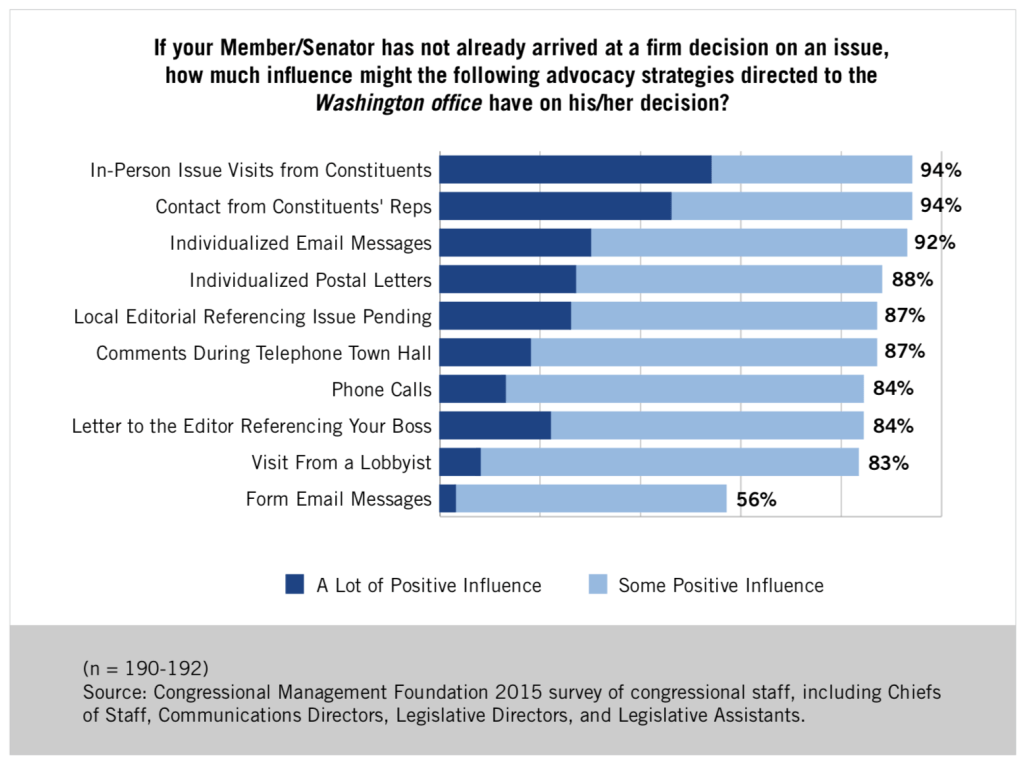
Not for nothing, look how far down the list we lobbyists rank. Frankly, I think that’s because we’re seen as mercenaries. The volunteer advocates we empower, though, are the true believers and our most effective storytellers. It’s our place to propel them forward, arm them with the tools they need to communicate the issue and its importance to them, and then get out of the way.
Volunteer advocates are the secret sauce in American politics. If you’re not already engaged in some kind of advocacy, I challenge you to get involved. Find an issue important to you, join a group working on it, and get some basic training on storytelling.
Bottom line: You matter more than you think.


 Part of the Possible