Empowering Engagement: The Role of Political Parties

Political parties are not the devil in our political system.

Since some of our earliest American elections, party mechanisms have facilitated the joining of aligned interests in a way that allowed individuals to participate more effectively in the political system. When you control for the obvious variables of political corruption – times like Tammany Hall and Watergate – the more common individual experience of political parties in America is one that sees average Americans gaining additional opportunities to engage directly with those they elect.

That’s not a flaw in the system. It’s a feature. One that empowers and enfranchises people who decide to show up and participate.

My own experience is what becomes available to anyone else willing to put in the work. No one in my immediate family had deep-rooted experience in politics. None were exceptionally well-connected. We were about as far removed from the so-called political elite as you can be. Middle to lower-middle class, blue collar until my own generation. My grandparents were farmers. My parents worked in a distribution center. And I grew up with no direct connections to give me a leg up in Ohio politics.

Then I got a chance to volunteer knocking doors and putting up yard signs in college. After my time in uniform, my then still very limited political network led to an opportunity to work directly for a member of the United States House of Representatives. All because one person in my political party saw an opening for me.

That’s not just luck, it’s a part of the political party structure. That may be why the erosion of party-building in American politics is a major concern for me. An ongoing drought of party-builders harms our representation and our individual access.

So far, this election cycle seems to be contributing to a trend (at least from my point of view – challenge me in the comments if you disagree). Since the 2016 election the dominating influence on our national politics is undeniably President Trump. Whether you agree with him on anything or nothing at all, it’s about as clear a fact as you can state that he has been the center of our national attention. His on camera persona has not lost a single step in the decade since. Love him or hate him, that’s a reality.

Another reality is that countless others have tried to capture similar lightning in a bottle. They’ve tried to create their own “Trump-effect” by adopting his tactics. We see more of our politicians in social media feeds, and less of them in town halls. We see them hosting pep rallies instead of debates. Yet there’s also seemingly less and less room available for others on the stage. The politics of parties is gradually ceding ground to the politics of personalities.

And that’s a problem on BOTH sides of the aisle.

If you’ve been following national politics in recent weeks, you’ve undoubtedly seen coverage of a public spat between a sitting United States Senator and a fellow democrat campaigning in a different state. From the same party, seeking to flip the same chamber, and yet one attacking the other as if they were opponents in a primary. Bizarre.

In this environment where politicians can leverage new media to take their message directly to the voter, we’re losing agency as individuals who could previously leverage party structures as a check on personality. The Republican party is certainly no stranger to this dynamic either. Look beyond President Trump and you’ll see a contemporary history of infighting where party leaders have sought to rein in show horses to allow work horses to govern. How many times has that desire to govern led to the political demise of a Speaker of the House?

Instead of building party bases, new media is empowering individual candidates to go their own way. Damn the torpedoes, full speed ahead there’s no need for them to balance personal ambition against perpetuating meaningful agendas.

New media seems great because it makes us believe we’re getting more, unfiltered access to the thoughts of our elected representatives. But I would challenge you to think about the quality of that “access” moving forward. Is it really more access, or are we just enduring more monologues? Not too long ago, political parties were trending toward more input from the general public, not less.

After the 1968 Democratic primary, both parties have been subjected to rule changes that stemmed from a commission to balance the power of party elites and the rank-and-file membership. The Democrats’ McGovern-Fraser commission led to more primaries and stricter rules about how the results of those primaries would allocate representation within the party. Further, because those primaries are run by states, there was a spill-over effect in the Republican primary process as well.

McGovern-Fraser was a step toward eliminating the smoke-filled rooms of party bosses selecting Presidential candidates. Further reforms in the 1980s were the result of the Democrat party trying to strike a balance between popular enfranchisement and delivering candidates who were more competitive in general elections. That push and pull between representation and political viability continues to evolve the structures we see in place to nominate Presidents. Modern Democrats are wrestling with the influence of superdelegates and party bosses still, a la 2024’s anointment of Kamala Harris.

Striking just the right balance causes conflict within both parties. My contention is this: that intra-party conflict isn’t a bad thing. Legacy party structures that facilitate that friction serve us as individuals and issue advocates.

Party structures become recruiting grounds for volunteers, staff, and candidates alike. They empower people like me to be a part of the system, not just a hapless bystander. And when leveraged properly, they allow current political leaders to mentor and build up the winners of the future. But those would-be party-builders have to willingly pursue the work, AND we have to willingly deliver on our own responsibility as members of those parties.

It’s not good enough to save your political participation for election day. It’s not good enough to grab a slate card on the way in to the polling place. If you’re serious about engaging in American politics, the work starts further out. It starts with accepting the faults and foibles of your own party’s team and working toward the public good even though we are going to fall well short of perfect.

Quit hating the players and the game. Realize the ways in which participation acts as a force multiplier for the issues you care about most. Because complaining about parties and partisanship isn’t serving you. But building a better party just might.

When we look beyond this year’s general election, both parties will start the process all over again. They’ll digest the results, lay blame, and then start fundraising – almost immediately. That’s their job. It’s our job as advocates to leverage every advantage we can to position ourselves as credible experts on our issues. Party structures still serve that goal. When they start gearing up for the next cycle is a prime time for you to step up as a party-builder. And you’re needed more now than ever.


Leave a comment

Mastering Advocacy: The Art of Letting Go and Trusting Leaders

She was sweating, shaking, and full of equal parts doubt and determination. She slowly repeated after me: “I’m brave. I’m strong. I’m ready.” As the sidewalk beneath her began to roll by, she was the only person in the world who could feel the bumps, cracks, and crevices rattle through her handlebars. She was the only one who could see the narrow path of concrete unfold in front of her through the mental blinders she’d set in place reminding her to “paint a straight line with her front tire.”

And she was off.

Unbeknownst to my seven year old daughter, I had just fought through my own fears and let go of her seat, trusting to physics and a seven year old little girl all of her safety and success. That moment, that choice to let go, became a moment of mastery for her – and just as much for me. I just didn’t know it yet.

Parent walking behind child riding a bicycle on a residential street
A parent watches closely as a child pedals down a sunny residential street.

Earlier this summer, my daughter learned to ride her bike without training wheels. Not to be outdone, her four year old little brother decided to conquer the same set of skills. Their dad had to conquer something else entirely.

In the days since, those moments of letting go have kept popping into my mind. I find myself sitting down to write today – the first time in more than 18 months – because there’s a lesson resonating with me about how those first moments of letting go mean just as much to anyone who wants to find success in political advocacy, too.

There’s a common set of fears facing anyone who wants to engage in public life. Anyone who picks up their own set of pressing issues and tries to move the political football forward will have to overcome them. But they’re not necessarily what you think.

I often spend a great deal of time with individual advocates addressing the fundamental challenges that keep average people from participating in our political process. These are the things that come top of mind: the confusing process, the feeling that no one will listen to you, the expense, the time commitment. But these are challenges keeping you out. What if you’ve already committed to playing the game? What if you’re already working hard for the issues you care about?

That’s when another hurdle comes your way: trusting the process and your champions to finish the job.

Work on an issue – any issue – for long enough, and it starts to become a part of your identity. You just cannot casually relinquish control over its success or failure. I know this in my own work. Success or failure in an advocacy strategy can take hold of my thinking and it becomes difficult to separate political life from the rest of my life. No matter how hard I try, my win-loss record starts to weigh on my self-worth. And trusting that to someone else? Frightening.

Those issues we let consume us are like the bike my daughter rode this summer. They are big, meaningful accomplishments. They’re complicated. They’re scary. BUT as an advocate, it’s not our job to ride them. The bumpy solo ride and bruised knees are going to have to fall to someone else. Our job is to get our leaders pedaling on their own.

At some point in the political process, our issue has to leave us behind. I’ve seen this throughout my career, and very recently on a major portfolio item as well. After more than a dozen years of working on one narrow, niche issue, there was a window for all the many thousands of people who had contributed to the effort to witness it leap forward. Yet that leap was entirely out of our control.

In our American (lower-case) republican system of government, advocates don’t get to ride the issue home. We have all the responsibility up to a point. We provide training wheels (data, information, stories) that get our champions comfortable with an issue. We hold their hands, we nudge them, we encourage them. But as individual legislators buy into our issues, the process requires them to carry out the work that no unelected member of the public can. They have to navigate the politics. They have to carry the message to their colleagues. They have to ride on their own.

And it’s scary as hell for us, the advocates left on the outside looking in.

Letting go of the issue, and trusting your champions may just be the hardest skill of all for an advocate. We don’t jump into the fray of public debates with the intention to cede our voice to others. But in a representative system we must. And at some point, we don’t have a choice.

Because the issues we care most about are bigger than each of us individually. The thousands of advocates who had worked on the niche issue over the past dozen years? Some have retired. Some have passed on. Some are just starting in for the first time ever. And the issue persists. Because the system is structured in a way that forces long, deliberate debate we have to entrust the work to others at some point. I think the hardest moment for that trust might just be when advocates have to watch their issue head to the floor of the US House of Representatives for a standalone vote.

Representative republics aren’t comfortable because of this dynamic. They leave us to our nervous habits while our champions leverage every skill and relationship they’ve developed to finish a job others started. At the same time it is beautiful and insufferable to watch. But unless we are willing to run for, and be elected to high office, this is our fate. We have to develop the humility to leg go and let our partners take control of the handlebars for themselves.

While I’ve been plugging away at my daily work over the past 18 months, I’ve deliberately let go of posting frequently here. The nature of our current political climate demands it. There are too many moving pieces – too much intentional chaos – to allow otherwise. But as I look toward November, and the scenarios that could unfold for 2027-2028, I know this truth will remain the same: issues bigger than us will always require us to let go and count on those we elect. No matter the work we put in, and the variables we try to control, we will be called to master this skill.

So, in the coming months while I plan for what’s next after the election, I’ll be looking for other ways to build that muscle for letting go. We’re past bike-riding and solo swimming. As long as my kids don’t decide to get into skydiving anytime soon I think I can handle the training.


I initially started this post more than two months ago. In the interim, the US House passed a standalone bill on the niche issue I referenced. The bill passed 218-203 with a large bi-partisan majority. Since then, the US Senate has taken small steps forward on their own version of the legislation. Now, in the August recess, I’m struck by another metaphor. My daughter is currently refusing to ride her bike. For whatever reason, with the hurdle overcome, she’s done with that experience for now. As frustrating as it is, I know another window will open – just like the issue we’re working will get another window of opportunity in Congress. So, we’ll keep chipping away at the daily work to make that happen. And I’ll keep nagging her that it’s time to get back up in the saddle.

Building Credibility in Political Advocacy

What if your ability to influence an elected official had nothing to do with your, or their political party; nothing to do with your contributions to a campaign; nothing to do with how they vote on a thousand issues that aren’t your issue? What if, instead, your credibility could survive any divide, any headline, or any debate of the day?

Here’s the reality check: it can.

I’m extremely grateful that I’ve had the chance to work for and with industry associations in my career. Association work forces you into a form of political advocacy that cannot be defined by party lines. It forces you into an advocacy environment that can’t rely solely on campaign contributions. And it forces you into situations where real people have to argue issues on the merits. Call me an idealist, but that’s my sweet spot for civic responsibility.

What makes that type of work so rewarding is the balance of all those pieces. It forces individual advocates to remain focused on the moment – and the issue – right in front of us. In short, it constrains us to what’s actually in our control, and limits how much effort we can waste thinking and worrying about all the bits and pieces of politics that are out of our control.

And believe it or not, building credibility is absolutely in your control – even if the timeline to do so isn’t.

There’s no shortcut to this work. It will take you time. It will require your patience. And it will absolutely cause you discomfort. But if you endeavor to adopt the tactics below in good faith, I’m absolutely confident they will help expand and strengthen your credibility. You just have to work at it.

Try these tactics on for size, and put my theory to the test!

Tactic 1: Turn off the News

It’s easier than ever to gain access to information and opinions about the public issues of the day. Name an issue and there are news outlets, blogs, podcasts, and countless other forums where you can learn about the politics surrounding it. Turn on your cable news channel of choice and you can endure 24 hours of talking-head panels dissecting every breaking headline and giving you “analysis” of what it means for elected officials and the general public.

And you’ll run yourself ragged trying to keep up.

The enthusiastic activist will try. They’ll sprint to keep on top of the latest breaking news. And in the end, they’ll be more anxious and less discerning about how to convey their beliefs.

Instead of tuning in to the news of the day, trim your content. Limit it. Don’t let it run you over. Read books on big ideas. And don’t let yourself get bogged down in the breaking news ticker. You’ll create more space to think about your own specialty, and you’ll be able to communicate about it better. It’s about sparing your resources for when they really matter. And in dealing with politicians who are forced to be generalists, that’s not a bad thing. Because they need to see the big picture on your issue, and they can’t do that without specialists like you.

Tactic 2: Specialize in Your Specialty, Not Politics

I’ve seen a lot of advocates try to be “in-the-know” when they head to Washington or their state capitals. It’s a naturally human reaction. We logically equate political knowledge with credibility in politics. So as advocacy organizations prepare their advocates to meet with legislators or regulators, oftentimes the questions those advocates bring revolve around political pressure points in the moment.

But talking to politicians about politics devalues your greatest asset: knowledge about a complex issue that they just don’t have.

The moment a person is elected to Congress, they don’t magically become an expert on the thousands of legislative ideas that will come their way in the next two years. Far from it. They employ staffs that divvy that work up so the individual elected official can keep their focus on priorities they’ve set for their own districts. Members of congress, in particular, are forced to become a knowledgable generalist on so many issues they can’t possibly be expected to know the ins and outs of your issue.

Instead, they rely heavily on the lived experience of their constituents to help them understand complex problems. Personal stories and hard data about real-world impacts serve them better than you talking about how issues will play with voters or other politicians. They have pundits, consultants and staff who will all go out of their way to ensure the politician understands the politics of the moment. They don’t always have a person on their team who can fill them in on what you know.

When you stick to your specialty, you start building opportunities to be brought into their “team” as a trusted expert. That’s worth way more than you ever demonstrating that you know the politics of the day. Because when you earn that level of access – trusted as an industry expert – you gain more chances to add value to their work.

Tactic 3: Add Value Without Being Asked

And value is the name of the game for longterm credibility. If you are constantly harping on an issue and asking – er, demanding – action, you run the risk of becoming white noise like so many other activists.

Most of us have it all wrong in activism. Most of us think that all publicity is good publicity. We think that pressure tactics and calling people out publicly will force a hand or a change of heart. And it almost never works in politics. Not because politicians are inherently bad or the system is rigged. But because it’s just not how you win friends and influence people.

So when I advise advocacy teams, I remind them of the little things they can do to invite others into the fold on their issues. Creating value for a political operation can look like giving them access to constituent groups back home through tours and roundtable discussions. It can be offering private opportunities for their staffs to learn about the work and ask hard questions without pressure. Or, creating value can simply be not overburdening them with form letters and volume, focusing on quality engagements instead of attempts at grassroots intimidation.

You should treat your political targets – and their teams – like a garden to be tended, not a mine to be stripped bare.

Because building credibility isn’t about what you can gain in the moment. Building credibility is about creating space for your issue to have a moment when someone chooses to give the bandwidth to pay attention. It may not seem fair that it takes all that work to get a fair hearing. But this isn’t a court. Your side isn’t guaranteed a chance to plead the case. You have to earn your voice, and that’s always easier when you can think beyond the moment and past the partisanship.

Create space for yourself by being strategic about the information you absorb. Create opportunities by building information that matters. And create trust by adding value with no expectation of anything in return. In the long run, you’ll make a bigger impact.


P.S.

When I first started typing this piece, it was headlined “Instant Credibility in American Politics.” I was going to flip our desire for instant results on its head. I often refer to that desire as “microwave dinner” politics. But clearly, good things take time. Home-cooked is almost always better than home-nuked. But I opted to stray away from being cute this go-around.

In Advocacy, Consistency Makes You Bold

Last week, I shared the three traits that really matter most if you’re going to have staying power and be effective in American politics: compassion, credibility, and consistency. Those three qualities, balanced between each other will help you stand out from the masses when you’re trying to be heard. They’ll increase your access, and keep you focused on what matters most to you.

They’re qualities we don’t talk about much in politics, though. So often, we approach our political engagement like a finite game that only has one objective: to beat your opponent. But that’s a fundamentally flawed paradigm. It confuses campaign politics with governing politics, and does nothing more than drive the division so many of us are quick to bemoan and slow to battle. But bitchin’ ain’t enough, and it’s time we get on with making the system better through our own work. So where do we start?

As I train advocates around the country, I almost always share a story about an octogenarian Navy widow named Sue. Sue taught me a lot of lessons about real politics, even though she’d never held political office. Sue was a tenacious, celtic rebel who didn’t care how big the system was. She was going to fight like hell for a good cause.

And she was no amateur.

What separated Sue from so many individual advocates is that she was absolutely brilliant in one regard – she never stopped showing up. She built a plan that allowed her to fight the federal bureaucracy for more than 30 years(!) before finally winning her private, just war. For me, it meant that I heard from Sue about her issue every two weeks for nearly two years. She was bold, and she was disciplined.

Even when there wasn’t a substantial update. Even when I didn’t have good news to help her feel better. Even when she was sick. Especially when she was down. Every other week, I knew I was going to hear from Sue, or her granddaughter, or her team of third party experts. There was a plan in place that she would seek out new information or provide new evidence in her favor. Every. Two. Weeks.

Does that seem excessive to you?

You may be right. Maybe for your particular cause, your particular challenge with a government agency, that’s not the right battle rhythm. But Sue’s calculus still holds a lesson for you: the task of creating space for your issue belongs to exactly one person: you. And discipline is how you prevail.

The dirty secret here is that once they’re elected, there’s no reason for an elected official to care, one way or another, whether you decide to get involved. They have an agenda. They have goals in mind. Their plans don’t have to take you into account.

Your opposition doesn’t care whether or not you choose to show up. They will.

The bureaucrat denying your veteran disability compensation claim doesn’t have to care about your willingness to participate in the system. They’re already in the system.

The opposition gets a vote, and I can guarantee they’re using it.

Opting out of our responsibility to show up only ever hurts our cause. Because it diminishes the space and attention available to bring light to injustice. Just like in sales, reps matter in politics. The more touch points you have with the public decision-makers affecting your cause, the greater the opportunity you have to bring about the change you’re seeking. Failing to show up only cedes territory to the opposition.

Sue didn’t need a structure to help her participate in the system. She built a reserve of discipline that kept her going. But that may not be you. That’s why advocacy organizations exist – to serve as a support structure to keep you involved.

Advocacy-centric organizations remove the guesswork. They help you understand what kind of advocacy matters, when it makes the biggest impact, how to do it, who needs to be targeted, and why those targets respond to different tactics. They give you structural support, and social prodding to break away from your daily life and jump back into public work.

Sometimes, that will look as simple as clicking on a text message alerting you that an important bill is coming up for a vote – and they need you to take 2-3 minutes to send a preformed message to your representatives. Seriously. 2-3 minutes. That’s all it could be. But if accomplished in concert with that organization’s other advocates, your voice is amplified. Your issue is spotlighted. You’re creating space to bring others into your way of thinking.

Other times, the ask may hurt just a little more. Maybe it’s a donation at a time when you’re already feeling strapped. At other times, you may be called upon to do the truly uncomfortable work of going and speaking with a real person. But when you’ve joined in with an advocacy organization, you’re doing that with structure around you. You’ve given yourself a force-multiplier.

We have a duty to be there. We have a responsibility to be in community with one another. Whether we like it or not, government is where we determine what we will accomplish together. But you only really have a voice if you get up and get into the room. That’s why I lean on would-be advocates to become joiners. Left to our own devices, the stakes are pretty low if we don’t take action. But when we build accountability into our lives? That’s where discipline makes us stronger, even bolder.

And let’s face the facts: we aren’t all Sue. We don’t all have the fortitude to fight like she did for as long as she did. But we do share the same responsibility as Sue. So, where we fall short, let’s be inspired by people like her but bolstered by professionals who can coach us on the field.


P.s.

Landing on Eisenhower quotes doesn’t seem to have been an accident for this post. Sue came into my sphere when I was a brand new congressional staffer. At the time, she was already in her eighties, struggling against a bad decision by the Department of Veterans Affairs. She was looking to ensure her late-husband’s service in the Navy was honored as it should have been. She was a Truman fan. But she was an Ike fan, too. The times I enjoyed the most on the phone with Sue were when she would tell me what it was like “back in the day.” You could just hear the smile on her face. She spoke like she lived among giants. She did. Who will be the giants that inspire the next great generation?

Already burned out by politics in 2025? Hereโ€™s your simple plan to get back in the game, and stay in it.

Itโ€™s usually not by being hard-nosed.

Itโ€™s certainly not by picking fights.

Itโ€™s almost always about being a compassionate human, a credible expert, and a consistent voice.

That’s how you move the needle in American politics by building one relationship at a time.

Volunteer advocates joined me in visiting with their Congressman, July 2025.

The first half of 2025 is in the rearview mirror. And thereโ€™s a stark line separating those who are helping their causes and those who have already burned out.

Iโ€™ve strategically paused my writing over the past 8 months. Like you, I spent the end of 2024 digesting what the November general election results could mean for my policy issues in 2025. I spent time thinking through the new players, and what we could expect to happen. I listened to pundits and wonks and asked for their best guesses. One thing was clear on all fronts: it was going to be busy.

What followed from that clarity was a realization that a lot of volunteer advocates would struggle to keep up. I donโ€™t have that option as a professional advocate. I donโ€™t have the choice. To put bread on my table, I knew Iโ€™d need more focus and stamina than ever.

To meet that need, I had to create space for myself. That meant that before I could talk about what I was doing in 2025, I had to be about it. Hence my long hiatus from posting here or on my social channels.

Morning runs on the National Mall are a consistent theme for my DC travels. This pre-dawn shot comes from July 2025.

Starting in November, I began trekking all over the country working my craft. Listening to clients about their concerns. Strategizing with colleagues on who and when to engage. And meeting with legislators in their home districts and in Washington, DC to talk through energy, tax, trade, regulatory, transportation, infrastructure and appropriations issues. Frankly, I feel a lot like Matt Damon at the end of Saving Private Ryan when his character famously morphs from a young soldier to an old veteran over just a few frames.

I tell you this to remind you that the whiplash-induced exhaustion you’re feeling is perfectly normal. Even those who get paid to advocate are feeling the drain of a frenetic time.

Predictably, this cycle has forced many advocates into a reactionary mode. President Trump’s key advisors told us it would be this way when they said their strategy would be to flood the gap by feeding the media machine like never before. They’ve certainly delivered on that promise.

As Iโ€™ve sprinted alongside advocates throughout the year though, I’ve tried to keep one message clear for the people I work with: stay the course.

In political advocacy, your issue is your issue regardless of the climate. The flip side of that though means the news stories that aren’t your issue remain not your issue. They may be important, but in many ways chasing the news of the day prevents us all from keeping the main thing, well, the main thing.

Burnout is a real obstacle for activists. It’s difficult to keep your motivation high, especially when the system affords you so few opportunities for the dopamine hit that comes from measurable success. When we gauge our wins based off of bills passed or votes won, there’s not much to keep our tanks full.

What 2025 requires from us is a more disciplined approach. One less dependent on our motivation, and more on our perseverance.

If you’re a volunteer advocate, it’s not your day job. It’s not the work you do day in, and day out, to pay the bills. For you, keeping a pulse on political news is exhausting enough, but then taking the time to write a letter or make a phone call just doesn’t seem worth it. You canโ€™t rely on the same motivators I can. You need something else. So what should you do right now?

Tap into the most local way your passion can be ignited. Focus on becoming an expert in your daily work. Focus on building credibility first. Give yourself the space to BE ABOUT IT. Care about hunger? Find the work closest to home that feeds people. Care about protecting children? Guess what – there are careers and service opportunities right here at home that aren’t waiting for crises to be solved at the speed of government.

Itโ€™s those real world experiences that will serve a double duty in your life. Theyโ€™ll feed your motivation, and theyโ€™ll equip you with real, impactful stories.

Ask a member of Congress and theyโ€™ll probably tell you that personal stories are helpful in digesting complex issues. But those same legislative leaders will say that itโ€™s difficult for them to gather all the information they need on how tough policy choices will impact their districts. They donโ€™t have credible people showing up to share meaningful information. Thatโ€™s where you come in.

Your most important work at this stage of 2025 is actually preparing yourself to keep working on your issues in 2026. That won’t come about magically. Now is the time you need to be building your own stories and developing concrete information on your issues. Because next year you will still need to be credible. And consistent. And compassionate. So here’s your plan:

Professional advocates have our place – but elected officials need to hear from real people on real issues. If you arenโ€™t speaking to them, I can guarantee someone else is!

1. Rest a bit. Read a good book. Get to the beach. Do what you can to break yourself away from the 24-hour news cycle. Because you need to be tied back into the reasons you got involved in the first place. Thatโ€™s much harder to do when youโ€™re distracted by the scrum of daily political news. Remember your humanity and youโ€™ll likely show up more humanely to the people youโ€™re trying to influence.

2. Build your portfolio. Do what you do best. In your trade, as a volunteer, wherever your work serves the issues you care about. Focus on doing it well for the next six months. Be fully about the work. Because that’s where you’ll earn your stories that matter to those in a position to decide the big issues.

3. Make a plan. Join a trade association. Hook into a non-profit. Whatever. But start building out a plan for how you will show up at least once per month for the cause you care about in 2026. Sometimes that will mean writing an email to an elected official. Sometimes that could be calling or visiting their office. But have a set of goals for how often you’ll go the extra mile others wonโ€™t – and stick to it. That will only increase your chances for getting the information you own to the people who need to understand it. Organized advocacy teams can help you work realistically in a challenging system, so use them.

Thatโ€™s really it.

That’s what I’ve done in 2025. I took a break from some things that weren’t the main thing. I focused HARD on the immediate craft, and building information that mattered. And throughout the year, I’ve kept a rhythm for my engagement by leaning on strong teams.

On a scale thatโ€™s right for you, the same basic plan will work. It’ll help you build credibility. It will help you stay consistent. Then you can be the good person they need to hear from.

And they do need to hear from you. Or theyโ€™re going to hear from someone else.

Election Day Reflections: The Path Ahead

I’m settling in to write this just a little under eight hours before polls open on Election Day 2024. Like so many before it, this year’s general election is being hailed as the “most consequential” election of our lives. And I won’t deny suffering at least a little bit of trepidation over the outcome myself. Yet, as I’ve sat with advocates over the past few weeks and months, I’ve felt more calm than during any of those many consequential elections before.

In the last five years, I’ve transitioned from a partisan political operative to a non-partisan professional advocate. It’s not about the tallies at the end of Election Day for me anymore. That’s not the end of a political sprint like it used to be. Now, for me at least, it’s a beginning.

Whether you vote for the red team or the blue team this time around, you’ve got about a 50/50 chance of being elated or devastated come midnight. This may be the one election you engage with every four years, and that’s OK. It’s OK to invest yourself in the outcome. I’d rather you care even just that little bit, and show up even intermittently. I’ll never begrudge your choice to focus on the other pressing parts of your life. That’s your business.

But there is also a more rewarding way to experience American politics – and that’s to engage with it even more deeply. I know it seems counterintuitive – especially after the bombardment of negative ads this year – but hear me out.

In the five years since I stopped working for individual officeholders or candidates, I’ve faced an incredible new opportunity to work across the partisan borderlines. I work on issues now that have me engaging with anyone and everyone who will give me the time of day. I get to be in the system in a way that forces me to think about something other than the win-loss column in November. And it’s such a relief!

Today, the millions of people who head to the polls are doing their part, for sure. But they are robbing themselves of a rare treat if that’s where their engagement stops. Because our system affords us an unfathomable level of access and influence – if we reach up and claim it.

It’s a fallacy to believe that the system will get better if we just elect the right type of people. People are people. There will be ego. There will be mistakes. There will be gamesmanship and brinkmanship in equal measure. All of that will happen because people are people. Those in elected office are just in the spotlight. What could spur change for the better is if we turn off the spotlight, and turn on the house lights.

Throughout 2025, I’ll train a few hundred (or more I hope) advocates. And I’ll teach them about the system. I’ll take them beyond their high school civics course. I’ll introduce them to complexities in government that they don’t hear about on cable news. But my goal, the desired end state, is to leave them with a mixed sense of confidence and curiosity. Confidence that they can assume their role in the grander scheme, and curiosity about how they can keep making gains.

I’ll do that without ever once asking them who they voted for in 2024. Because it won’t matter.

We have no control over the end results of this year’s election. Se only have our choice to participate in it. We have no control over the majority/minority conflicts in the House and Senate that are sure to launch come January. we only have our choice to build bridges that can win new champions to our cause.

We also have one other critical choice to make now that the polls are behind us. Who will be as friends, neighbors, and colleagues?

There’s this curious little habit I’ve picked up over the past few months. Inspired by one of my favorite authors, I’ve started picking up hazardous garbage while on walks with my kids. The miles I put on the stroller now have the added bonus of training my eye to seek out the loathsome nails and screws that seem almost destined for my own rear driver’s side tire. But when I’m on the hunt for these suburban landmines, there’s a much bigger group of people positively impacted by the moments when I act on the impulse to stoop down and scoop them up.

This curious little habit is now a metaphor I keep tucked in the back of my mind while I’m working with aspiring advocates. Because this little habit is a tangible representation we can all understand. We can wrap our heads around it. When we pick up the detritus plaguing our local roads, we can imagine the very real headache we’ve saved ourselves and our neighbors. We know we’ve prevented a bad thing from happening to the people in our physical sphere of influence.

Why don’t we look at our political processes in the same way? Why is it good enough for litter but not for legislation?

I know you’re exhausted from this election. How could you not be? I know you’re ready for it to be over. You should be! But now that we’ve voted, I have to ask: what’s next?

Take a beat. But come tomorrow, the break’s over.

In the coming weeks, I’m going to be focusing on pieces that I hope will prepare you for the next round. Because we aren’t at the end. We’re at the beginning of a new, grand opportunity to show back up and do our part to pick up the bad bits along the way. We have a chance to speak, to act, and to serve in a way that is envied the world over. It’s great that we’ve availed ourselves of the civic duty to vote. Now let’s discipline ourselves in the right to be involved.

Because it matters. And it’s rewarding as hell.


Forward this to a friend or family member who wants to change the world! And if someone sent this to you, let’s help you get ready for 2025. Subscribe below!

Unscripted: The State of Play in American Politics

For months now, I’ve struggled to carve out time and get back into writing. It’s been a slog of a few months. Like others in my field, I’ve been helping folks navigate an…interesting…time in American politics.

Since my last post, we’ve seen campaign shakeups that have thrown the political class into a tizzy. Global conflicts and local disasters have dominated the news. Right here in Ohio, a rare drought has thrown us into reaction mode. And all of that while we patiently wait out the passing of the next four weeks to Election Day.

Though I haven’t been hitting the keyboard, I have been in the thick of some of my favorite parts of the work.

Today, to break the seal of sorts, I’m sharing a recent interview I conducted with Ohio’s Country Journal, a local media outlet focused on the agriculture sector.

These are probably not the issues you’re used to hearing about. Just 5 years ago I wasn’t used to talking about them either – despite agriculture’s unfathomably large impact on our daily lives. While I don’t typically share the work I conduct in my 9-5 here, today I’m making an exception for a reason: we all need to hear about these issues more often.

Over the next few weeks, our politics will be driven by wedge issues – the issues designed to separate us by the smallest of margins and drive us into camps of predictable political action. But those aren’t the issues that really define us as Americans.

We are at our best when we find ways to work together. We are at our best when we’re tackling common challenges. We are at our best when compromise isn’t treated like a dirty word. We are at our best when regular folks show up to get into a little bit of good trouble. And we are at our best when we ignore the wedge issues.

Today, I want to share some of those bigger, more unifying issues with you. And the best way I know how is to ask you to spend a little bit of time with the podcast episode linked below. I bookend the episode with longer segments. In the opening segment we get into some of the political landscape I’m seeing in Washington these days. In the latter segment, I get…well…a little bit spicier. (That portion starts at the 32:35 minute marker.)

Give it a listen and let me know what you think with a comment on this post or by sending a note to luke@partofthepossible.com!

Unlocking the Hidden Potential in Our Political System

In my mid-twenties, I went to work for a US Congressman. It was an experience I wish everyone in America could have. There’s no other professional experience quite like it โ€” where on any given day, by the jurisdiction of the office alone, you can change someone’s life for the better. But it’s also an office that the vast majority of Americans will never interact with personally.

And let me tell you, that is damn frustrating.

For whatever reason, whether ambivalence, repugnance, or even fear, most of my countrymen will never meet their member of Congress, or interact with their staff. This comes despite the fact that many United States Representatives go to great lengths to put themselves in front of their communities. Many even employ field representatives whose sole focus is identifying ways to be visible in the home district.

There are just not that many people who, when facing a problem, think to themselves: “Gee, I wonder if Congresswoman Doe could help me with this?”

At the same time, it’s also entirely reasonable that they never come to ask that question. There are innumerable public offices in the United States – each with its own jurisdiction and scope of responsibilities. The greatest number of those are concentrated in local government entities that are more closely involved with the real-life problems of most people. Township trustees will fix the pothole on your street, so don’t expect some suit in Washington to show up with a cold patch kit.

But for advocates up against a wall, we need to take a moment to appreciate the scaffolding our founders gave us when they designed our federal system where power is shared between national, state, and local governments. Because in the design, they laid out an advantage for the average citizen. One we may take for granted all too often.

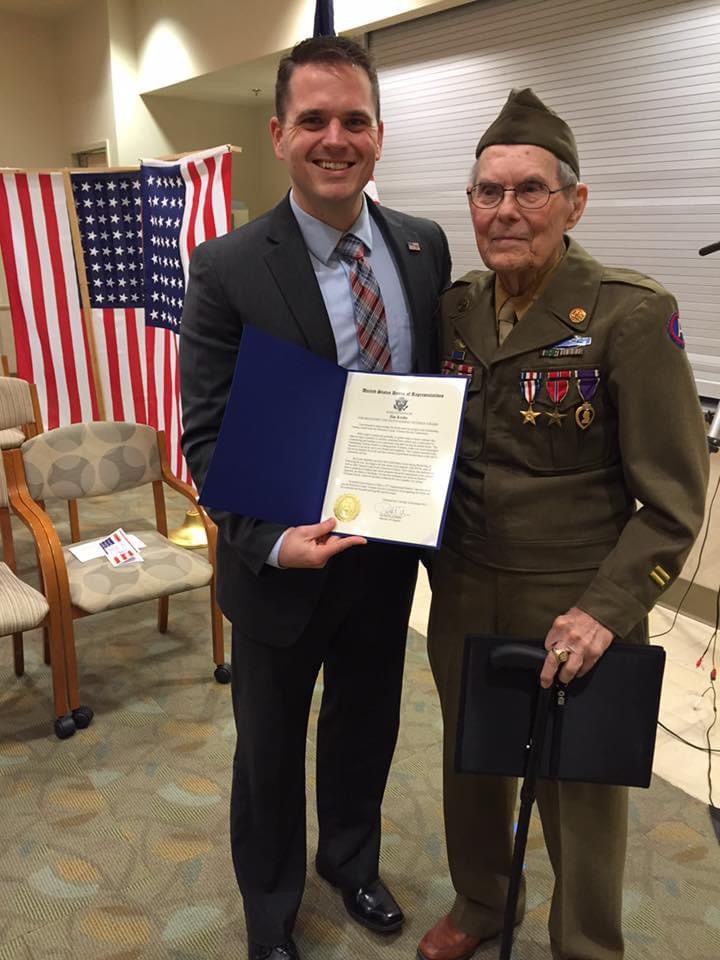
It seems like 30 years ago, but it was only 9. One of many pictures snagged while serving as a
field representative for a United States Congressman. In the photo, I’m posed with a local veteran being honored at a Veterans Day celebration. Congressional District Staff often fill in for their bosses when schedules don’t permit them to attend public events. This annual celebration was one of my favorite to join.
Photo from Luke Crumley, November 11, 2015

Recently, I tackled one of the countless books in my ever-expanding “to be read” pile, Adam Grant’s 2023 piece, Hidden Potential: The Science of Achieving Greater Things. If you haven’t read it yet, it’s well worth a spot in your rotation. There are plenty of positive points to be made for it in the organizational and personal development space. But it also led me to a metaphor I’ve been seeking out for years.

You see, when I train advocates, a key barrier for them is often a deeply held belief that engaging in advocacy is futile at best. Our system takes too long for most of us struggling with impatience. It can grind you down. And finding ways to positively contribute to a cause over and over is a daunting task. But there’s another compounding factor that’s been nagging at me for years. For some reason, many would-be world changers back away from participating after they hear an early “no.” Many of us struggle to see our way past that first roadblock and toward another path.

In Hidden Potential Grant spends some highly valuable manuscript real estate on techniques organizations can use to ensure good ideas have a pathway to decision makers. In the book, he contrasts the image of a ladder with a lattice.

In ladder organizations, when you take an idea up the rungs, at any point a big fat “no” can halt your idea. With only two directions to travel, up or down, even the best ideas have less chance of getting through. Organizations that wish to solve problems, however, need as many ideas coming through as possible. One model that Grant points to for success is using a lattice instead of a ladder in your organization. On a latticework, one decision maker is only so powerful, because you can also navigate laterally around them.

Immediately, Grant’s imagery took me back to my time in uniform when we regularly climbed cargo netting in full field gear, navigating around our teammates to get through obstacle courses. Had only one path been available to us, completing those obstacles in a timely manner could get fouled up pretty quickly if someone else froze up. But wide cargo nets, our very own lattices, gave us the freedom of movement to keep progressing forward โ€” even if that required us moving over before moving up.

I haven’t been able to shake that image since, because in my work its a phenomenal physical representation of what our political system affords us as advocates: as many pathways as we need to push a good idea forward.

(Read that again.)

Think about the issues you’ve seen linger on for years and years. Too many of us feel on the outside in the big political debates. We think we are in a ladder system, where there is only one path forward to make a difference. Maybe we assume that because one party holds a majority in one branch of our multi-faceted government, there’s just no hope on an issue they oppose. But, plainly put, that’s just not true.

Yes, there are certain duties prescribed to certain political offices. But that doesn’t mean we can’t build our advocacy efforts around pieces of an issue, to find where those jurisdictions CAN make an impact. It’s as simple as reminding ourselves that not every problem requires a piece of legislation to fix. Sometimes there’s unilateral executive action that can be taken. Sometimes the courts can intervene. Oftentimes, our federal and state governments volley issues back and forth to find the best solution for the time. What all of this equates to though is this: you have many paths available to you for some kind of forward action.

Momentum is important for advocates. Feeling like you have it can energize your cause. Feeling like you’ve lost it can crush formerly motivated volunteers. But the advocates who succeed, are in many cases the ones who are able to step back, see the bigger picture and recognize a different path. Because one, big, fat “no” is not the end of our fight, it’s often just the beginning!

In 2024, our most divisive and motivating public debates will be on full display. Because of the Presidential contest, the wedge issues will be brought out to invigorate the partisan faithful. While those contests are raging, the work of governance will also slow. But that makes this your perfect chance. This is your chance to ignore the horse race, connect to an advocacy organization, and rely on them to help you see the other paths in front of you.

If you want to make a difference in the world, our system holds more opportunity than you may think. Don’t accept the premise of the naysayers. They only see ladders. It’s up to you to find the lattice (or a good cargo net ๐Ÿ™ƒ).


Today’s post is NOT sponsored, and I am not receiving any payment to highlight Hidden Potential by Adam Grant. However, reading is a critical part of my daily routine, and from time to time I like to bring recent reads to folks’ attention. If you are curious about some of my favorites, please consider popping over to the Bookshelf page!

If your own “to be read” pile is shrinking, consider one of these for your next deep dive or shallow diversion. Each one listed has resonated with me at a specific time for a specific reason. Occasionally I’ll add another to the list, so check back from time to time.

Political Capital: Are You Building It Or Burning It?

“I’ve been fighting this issue for years and I don’t want to spend any more political capital on it.”

Last week I heard this summation for likely the thousandth time in my career. It happens all the time. An advocacy team starting to feel burned on an issue decides it may be time to walk away. It’s nothing new.

But I don’t buy into that kind of thinking.

I’ve written on this blog, and shared in my advocacy seminars, countless times about just how LONG the American political process can take. But it always bears repeating, because like you I’ve been burned out on issues too. When I’m reaching that point I always remind myself that the average length of time for a piece of federal legislation to become law is 7.5 years. That’s the AVERAGE.

Who’s got time for that?

Well you, if you’re putting yourself into the right mindset.

Yes, there are times to stop fighting. Yes, there are times when your issue is going nowhere. Yes, there are limits to how far you can really go with a cause.

But none of that means you can’t get anywhere for your issue. But too often, defeatism sets in well before you reach the limit of your effectiveness in advocacy. Years ago, I would commonly call it out as an unfortunate byproduct of the microwave oven. We’ve lived for decades now with the ability to near instantaneously address even complex cravings. But useful tools like the microwave have also made us exceedingly impatient. They’ve also helped us forget that putting in the reps matters.

I like talking even tangentially about the issues I’m working toward. I like pointing to overlapping interests. I see every interaction in my areas of focus as an opportunity to make a pitch. Probably because I’m seeing those moments as tiny investments that can yield big returns.

Politics and advocacy is first and foremost a relationship game. Building those relationships takes time, it takes effort. But few seek out the opportunities to align their causes with what other people care about. Few are willing to spend a little of their capital to help someone else’s grow. Few are eager to use more time and effort without the promise of a reasonable outcome. Far too many see it all as a zero-sum game where when one side wins, the other must lose.

I see it manifest regularly when I listen to how prospective advocates describe successful – or more commonly unsuccessful – engagements with those they’re seeking to influence. If they want Congressman John Doe to co-sponsor a bill, and the Congressman doesn’t, the average advocate will default to that as a negative outcome. But that’s just not quite right.

In very few areas of life do we enjoy instantaneous success. On the athletic fields, in the classrooms, and in our personal development each of us faces setback after setback. But because we like to swing a golf club, we don’t let one bad round turn us away from the enjoyment of the sport. Yet somehow we’ve decided that the same shouldn’t apply for the causes we hold near and dear. For some reason, missing out on an instant win in advocacy is an irreversible failure.

That doesn’t track.

I’m going to challenge you – and advocates I train in the future – to start thinking more intentionally about how they describe the use of political capital. Because politics isn’t a zero-sum game. Every chance we get to talk about, or around, our issue is an opportunity. A chance observation the 37th time you’ve talked about your cause with a target may just be the hook that grabs them and wins them to your side. Every time we willingly talk about our big, audacious goals is ripe with the opportunity to build our credibility in the eyes of those we seek to influence.

This is the difference between a growth mindset and a scarcity mindset in politics. Too many think political capital is scarce. I think the people who win in the long run will be those who believe there’s room for everyone to grow. Those are the coalition builders. Those are the problem solvers. Those are the people who keep showing up.

And those who show up hold the advantage.

In Times of Frustration, Look to Fort Ohio

I really like the small wins in politics. The wins that, for the most part go unnoticed by most. But if you’re paying attention, and follow the markers, these types of wins can point you to some reasons to stay hopeful. Hopeful despite the rancor and vitriol we see on the cable news channels covering our politics. Hopeful despite the seemingly endless stream of commentators trying to ratchet up our emotional responses. Hopeful despite being told our best days are behind us.

A few weeks ago, I got to witness the beginning of one of those small, meaningful wins, and it it took me back to my time as a young congressional staffer.

I worked for a member of Congress who was well-known for being a bridge builder. And even though he could throw a partisan punch when he needed, he excelled at finding ways to govern cooperatively with the other side of the aisle. And he said something early in my tenure with him that stuck with me throughout. When describing why he worked so well, and so often, with members of the other party from the Buckeye state he laid it out in the clearest way possible: “we all have a duty to protect Fort Ohio.”

Now, years removed from that statement, I’m pleased to report that kind of thinking – that spirit of unity – hasn’t disappeared from the halls of Congress.

This session of Congress, we’ve seen more than a few targeted, meaningful acts of bipartisanship coming from our Buckeye delegation. On issues as niche as NIL (Name, Identity, and Likeness) policy in athletics, to topics as far reaching and complicated as renewable fuels policy and railroad safety. We can point to new members of our delegation taking active roles in leading on thorny, complicated issues.

Just last week, Congresswoman Shontel Brown (D) and Congressman Max Miller (R), led a joint letter from our delegation to House leadership about the Farm Bill – laying out Ohio’s priorities for one of the largest, bi-partisan bills Congress must tackle. They were joined by most of the delegation in showing a united front on a far-reaching bill that doesn’t get nearly the headlines it deserves. While the masses debate a TikTok ban around the proverbial water cooler, a bipartisan team of Ohioan’s is defending the number one industry in Fort Ohio.

In the wake of the East Palestine rail disaster, our senators are spearheading work to address railway safety. Long after the story disappeared from national headlines, Senator Sherrod Brown (D) and Senator J.D. Vance (R) continue to build a coalition to address problems they see in the status quo that, if left alone, could leave other small communities to suffer in the wake of catastrophic mishaps. While working together on that transportation issue, they’ve also joined together to press the Biden administration on promoting renewable fuels produced from Ohio agricultural products.

Congressman Mike Carey (R) and Greg Landsman (D) are pushing for legislation to clean up the rules around NIL (name, identity and likeness) issues in college athletics. Congressman Carey is also partnered with Congresswoman Joyce Beatty (D) in continuing the efforts of the Civility and Respect caucus. And the list could go on and on…

If you haven’t heard of these partnerships, I’m not surprised. It’s the type of collegial, nuanced work that happens in the halls of congress that just isn’t newsworthy. It’s not sensational – because it’s exactly what we should EXPECT from our elected officials at every level. And more of it happens than the casual observer would ever know. These partnerships aren’t unique. They’re visible on issue after issue. Our delegation continues to practice a discipline in promoting commonsense priorities that are good for Fort Ohio.

There’s a lesson in here for all of us in advocacy too, though, because big wins are built on a foundation of small wins. When thoughtful people get in the habit of solving small problems, they’re building the necessary institutional muscle memory to tackle bigger, thornier problems down the line. They’ll know who to call when it matters. They’ll no how to put differences aside and focus on commonalities. They, and their staffs, know they can work with each other in good faith. That’s a good thing – even in a presidential election year.

When members of the Ohio delegation talk about protecting Fort Ohio, it’s not because they’re abandoning their individual principles. It’s because they’re embracing the principle that country and constituents come before partisanship. It may not look good on the litmus test of an advocacy organization, but it IS a trait we should recognize for its inherent value. Even when it means we lose a small fight from time to time.

A bill getting introduced is a small first win. A caucus getting launched is a small first win. A bi-partisan letter on a niche issue could be a small first win. But there’s nothing small about political rivals working together. There’s nothing small about opposing sides sharing meals and then sharing causes. There’s nothing small about early partnerships that open up big opportunities. If you’re feeling down and out that nothing “big” happens in DC anymore, I want to challenge you to find new vantage points. Because the big wins are out there.

Even though we’re now in the thick of the Presidential election, there are signs of the good that can come from honest dealing and hard work. I’m certain my peers around the country could point to their own delegations in a similar way. But my challenge to you today, is to look to “the heart of it all.” Because in times of frustration and challenge, Fort Ohio keeps standing strong – because our team is so often standing together.