Step 3: Get Small

I’ll never forget this one very particular experience as a junior congressional staffer – it was the day the doctors came in. (DISCLAIMER UP FRONT: I’M TALKING ABOUT PhDs, NOT MDs.)

This was maybe my second year on the job working in the district office for a sitting member of congress. I wasn’t working on policy issues, but I was on the front line in dealing with constituent interest groups. Those groups came in all forms. From well prepared veterans of the advocacy world to the most novice. In that district office, we got a taste for them all. And from time to time, they landed in a meeting with yours truly.

But the distinction between successful and not-so-successful advocacy teams almost never had to do with their experience level. In my interactions, the less experienced crews often out-performed the pros! The distinction didn’t even boil down to those who had practiced their pitches the best. I think the most successful of the teams stood out more often because of one common thread: they didn’t ask a lot, but they asked it well.

Getting volunteer advocates over the barriers they face to participate in person is tremendously difficult for any advocacy organization. It’s a real challenge to pluck someone from their daily lives and drop them into the world of political activism. It’s not comfortable. It takes time. And they will always doubt themselves and their effectiveness.

What makes it worse is that many advocacy organizations compound the problem by immediately asking too much of their volunteer teams. Cue the memorable group of PhDs!

I won’t say WHERE they were from, WHAT they were discussing, or WHO they represented. Don’t try to press me for it. But HOW they approached a day of advocacy in our office stood out for all the wrong reasons, and we can learn from their mistake (even though at face value, it may not even seem like a mistake to you).

They did what many researchers do in their daily lives. They came in to speak to a really important issue. It was one affecting a lot of people. And they came with a ton of data to back up their stance. They brought ample leave-behind materials, pamphlets, and even some video resources. From an “education” standpoint, they really crushed it. But then they also brought a shopping list of asks. More than a dozen of them. A whole list of solutions, all right there at their target’s fingertips.

And on the surface, that may seem ok to most people. But it’s part of our job as advocates to make the solutions to problems so unbelievably obvious that people want to champion them. It’s also a part of our job to remember that absolutely none of our targets owe us a damn thing.

That’s largely why showing up with a long list of action items causes a couple of key points of friction for your cause.

First, it creates confusion about your priorities. A laundry list of asks prompts predictable questions like “what’s really most important here?” That kind of question has no place in a successful meeting for your cause. There should be no ambiguity for your target. Your ask has to be clear, related to their work, actionable and measurable. And there should be as few of them as possible to focus on that day. The more educational materials, and the more asks presented, the less your target – a generalist who lacks your experience in a given field – can really hone in on what really matters.

Second, I think overwhelming your target with information to analyze and internalize runs counter to your goal of enrolling them as a champion in your cause. Remember, they don’t owe any of us a damn thing. Even if we voted for them. Especially if we contributed to them (insert here a friendly reminder that quid pro quo is illegal). They don’t owe us as constituents anything other than an ethical commitment to their oath of office. Unfortunately for those of you with a slightly less humane streak, that means they won’t be chaining themselves to a desk to learn every nook and cranny of the issues you put in front of them.

The PhDs failed to face the hard reality on both of these fronts. By giving too much information, they overdid it on education materials. A harried and overworked staffer just won’t have it in them to dive deep. And by offering such an extensive list of asks, they confused what really mattered in the moment: an upcoming vote. Their ask for action on that vote got buried in the muck of everything else they brought to the table – and it’s incredibly easy to fall into that trap.

Advocacy organizations only have you, their volunteer representatives, in front of decision makers so often. The natural temptation is to have you lay it all on the line. But my recommendation to you as an individual is to run counter to that impulse. I want you to get small.

When I train advocates, I take them through a progression of exercises. We move from the really big concepts that shape national politics down to smaller and smaller segments. I do this because I want them to land on one to three highly targeted, narrow asks for each of their respective targets. By stepping down to those atomic units over a progression of training sessions and experiences, they come to a natural understanding that yes, your asks and your approach can be – and often are – far too big.

It’s not on a volunteer advocate to deliver the entire agenda for a cause. That’s not fair, and it’s also not possible. Agendas, priorities, and political climates all change. Citizen advocates need to be in a position to be additive to a cause’s evolving response to those changes. They need to understand how a targeted ask today builds into a strategic advocacy plan that takes place over years. And that’s no small task for advocacy teams.

Getting small, getting narrow on your list of asks helps take the guesswork out of political advocacy. Crafting one to three really clean, unmistakable asks is better for everyone involved. If they are clearly worded, related to the work of the target, actionable in the moment, and measurable in any way they will help you gauge how effective your advocacy really is.

This is why it’s a really good idea to get small. Advocacy organizations and individuals alike need to see progress in their work. Narrowing the scope of our informational materials and asks alike can really help improve the feedback loop. And here’s the kicker to that…when feedback loops are positive, and people see real movement, they’re even more likely to come back and go after the next target again. That’s how we’ll eat this elephant. One bite at a time.
Bring Your Cause Home With You

The whole system is rigged. Lobbyists like me have all the access because we’re there – in the capital cities – and regular people are shut out. So, is it really worth it to travel all the way to Washington, DC, wear uncomfortable clothes, sit across from perfect strangers and talk about your issues? Does it really help at all? Do they really need to hear from you?

Yes. Unequivocally yes. There. Here. Wherever you can make a connection, your perspective matters far more than you may realize. The generalists we elect at every level will always need your specialty, your expertise. They need to learn the lessons you’ve picked up from living a real life. It’s incredibly powerful when citizen advocates make their way to Capitol Hill to share those hard-earned lessons.

But don’t forget what you can accomplish at home too. Because traveling to far-off capitals doesn’t have to be a barrier for you, or your cause.

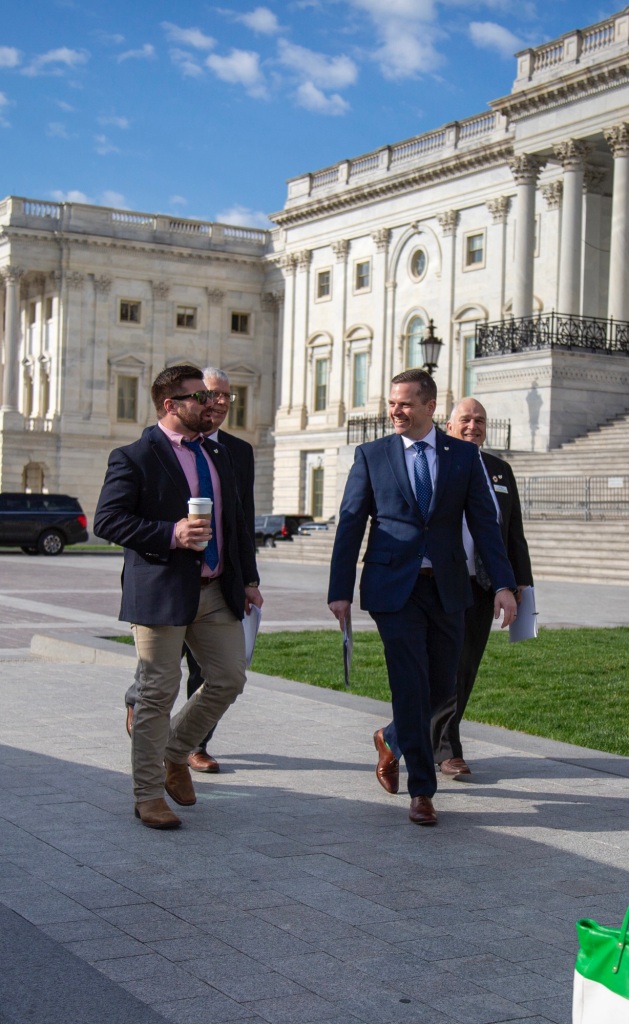
Last week, I was in Washington, DC with a group of advocates heading to Capitol Hill. We met formally with every single congressional office that represents Ohio. We took our issues to them. We sat with them and dug into the hard topics – and there’s nothing that can take the place of those intensive experiences. But there are steps we can take, right here in our own back yards to build on, and add tremendous value to that work. And finding opportunities like that is part of my job too.

Luke Crumley, with volunteer advocates outside of the US Capitol Building.
Photo Credit: Jessica Woodworth

I love getting advocates to Capitol Hill. I love seeing a courageous few stand for what matters to them. But I also recognize that’s a REALLY big step for the vast majority of people.

Most people don’t want to be in the thick of it. Most people don’t want to experience the political process in that way. But most people also DO want to feel heard on something important to them. So how do we balance that out? How can we empower the full spectrum of concerned citizens to make some kind of impact in the system?

For me the answer is simple: bring those advocacy opportunities back home.

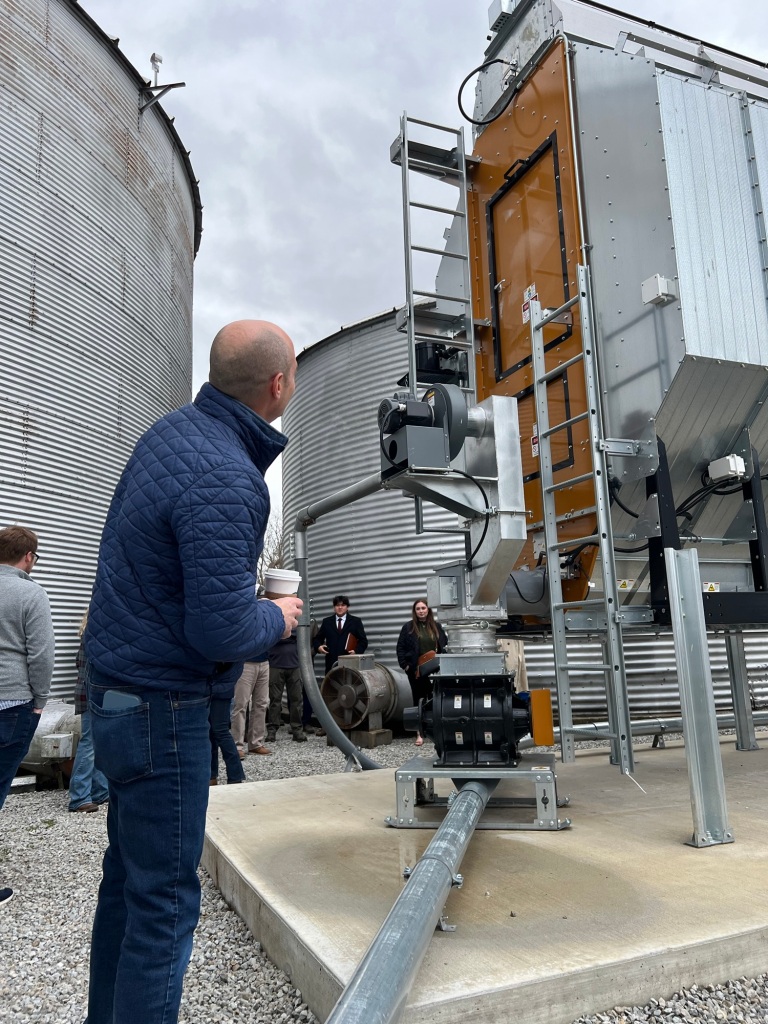
Congressman Greg Landsman (OH-1) gets a firsthand look at a piece of farm equipment made possible through a federal grant program. Photo Credit, Luke Crumley

When you’re in DC, you almost always have to speak in abstractions. You have to share a lot of information, often to new faces, and with very little time. It’s a fault in the system. The legislative work happens in a place removed from the real world applications of the policies that are adopted. But we don’t have to settle for that. We can – and should – look for opportunities to bring the real world and the policy world together.

You just have to remember: we don’t have the luxury of leaving the task to others. Helping these very real people in positions of power step back from abstraction, and into the outcomes of their work does more than just educate them on issues, it humanizes our causes. That process doesn’t happen in a vacuum. Someone has to take ownership, to take charge, and bring those moments to fruition.

That’s what I told someone just this week who – for the first time – was meeting their member of Congress. When they asked me if I really thought visits like this could help, I put it in those terms. Because it’s important for us to remember that elected officials at every level are still humans first. Humans who have to learn about new challenges and new ideas just like the rest of us.

When those public servants see and touch the results of good policy up close and personally, it makes all those abstract issues immediately more concrete. And it can make a HUGE impression.

It’s absolutely worth it to go to DC. It’s absolutely worth it to represent your cause in your own state capital. It’s absolutely worth it to get those touch points whenever you can. But don’t hesitate to bring those touch points closer to home too. That’s where being a member of a trade association, or working with a non-profit can put you into a place to make that local connection happen.

You’d be shocked how few do. And you’ll be amazed by the relationships you can build by bringing it all a little closer to home.

2024 Reminder: Your Cause Will Outlast Any Election

I’m writing this piece as results are rolling in from Super Tuesday in 2024. As expected, former President Donald Trump is the story of the week, running a near clean sweep (Nikki Haley secured 17 delegates by winning Vermont). More than 600 delegates ahead of his only remaining Republican rival, no one is giving great odds to the “what if” crowd of folks trying to make hay out of process and convince anyone that we’ll see a race other than Biden v. Trump 2.0.

But that’s what we will have. We will have the same rhetoric from four years ago. We’ll see the same foibles and follies from both sides. We’ll see die hards go all-in for their side. And we’ll hear moderates around the country groan as they prepare to pinch their noses on the way into voting booths this November.

But for issue advocates, we also know that there’s another reality below the surface now that the real competition is drawing near. We know that the calendar starts to compress, and our work gets that much harder.

My message this week is simple: focus on what you control.

Don’t get me wrong, I think a lot of really important governing will NOT happen this year. I think ongoing spending fights, leadership battles, and yes, the general election will all bring momentum to a standstill on countless issues that matter to millions of Americans. But you’ll read that negative take anywhere you look in the next 8 months. And it will usually frustrate the hell out of you.

That’s perfectly normal.

Fifteen years ago, I’d follow these races intently. I’d look at polls every day and devour every news story. But to what end?

The race itself is beyond our individual control. The outcome is beyond our control. And its impact on the rest of the governing structure during the contest is beyond our control.

A few years ago I decided I’d had enough. That was part of the reason I left partisan electoral politics and jumped into issue advocacy. I knew the issues I’d work on would transcend volatile election cycles. Because our governing system doesn’t end with the outcome on Election Day.

If you’re committed to fighting for an issue, any issue, this year you may need this reminder I share with advocates at nearly every training session. It’s a reminder that the system moves on, and that neither success nor failure is permanent.

Nearly every time I’m with aspiring advocates I share a statistic with them that causes some surprise. Did you know that the average piece of federal legislation in America takes 7.5 years to become law? No matter the group, that reality tends to shock more than a few people in the room.

With all the coverage of our national politics, we can be lulled into a false sense of productivity. We find ourselves assuming that common sense solutions are common occurrences. But new ideas and new solutions take time to germinate in DC. Lots of time in fact. The same is true in state capitals and localities, too. Change takes time. And no singular election is a slam dunk for your cause.

No singular election is the final nail in the coffin either.

If you’re frustrated with the candidate options in front of you this year you’re probably not alone. Hell you may not even be in the minority. But fixating on that external reality is playing the short game. This year’s challenge to you is practicing showing up for your cause despite that frustration. How are you going to train that mental muscle? How are you going to commit to fighting like hell regardless of the outcome in November?

In the end, we only control whether WE choose to show up for what matters most to each of us. Even if it’s an uphill battle. Even if we are a lone dissenting voice. Even if it seems pointless. If you want to tap into real optimism for the future, you’ll have to find your own path to the belief that showing up, regardless of outcome, is what really matters. It’s how we take pride in our system and continue to make it better, one hard fought day at a time.

That’s why I focus on advocacy, not partisan politics, and why I hope you’ll choose to follow along in 2024. Because we’ve seen this show before. Maybe that means we can create just a little space to let it play in the background while we work – instead of gluing ourselves to the program. I’ll be working on that in 2024, and if that sounds appealing to you, I hope you’ll subscribe and work on it with me.

Step Two: Make A Plan

Two weeks ago, I shared that our very first step to stand out as advocates should be building trust. Finding ways to connect with people before jumping into the politics of it all helps you play the long game. When you build that trust, you gain credibility over time. But what about the short game? How do you stand out in an immediate task like hosting a meeting with a legislator?

I spent years meeting with advocacy teams from countless organizations. As a young congressional staffer, it was my job to listen, take in their positions and distill them down to what was relevant to our office. Day after day, I sat down with the people who shared our priorities and more than a few of the people who despised everything about our member’s politics. It was my job to make sure they left feeling heard – especially if they were part of the latter.

Here’s the problem: I’m not a smart man. I’m not one of those geniuses blessed with a 30 pound brain.

I study. A lot. None of it comes naturally. I devour books because I HAVE to. To get introduced to a topic, digest it, and walk away with a meaningful recommendation takes a lot of work. And I think – maybe pridefully hope – that many of my peers in the congressional staff world do their own fair share of studying too. We’re an inch deep, and a mile wide on issues, much like our bosses. And we’re constantly sprinting to catch up with others who’ve been running with a given issue for years.

Political staffers are not specialists. We are by nature of the business, generalists. And generalists simply won’t know as much as you do.

The issues that were salient enough to compel citizen advocates to come see our team weren’t easy. They were complex, confounding problems. Always. Which meant even more work on my part to understand their complexities. It also meant I generally had a TON of questions to ask. Questions that took us down rabbit holes. Questions that may have led the conversation in a different direction than expected. Questions that likely proved just how not in-the-know I really was.

The difference between the really impactful advocacy groups and the rest often boiled down to one common thread: did they have a plan on how they would educate me and direct the conversation toward their ask?

I’m still quite regularly taken aback by the number of folks I meet who think we can be truly, deeply successful in advocacy by reacting and making it up on the fly. We take it for granted that our cause – our solution to really big problems – is commonsense. We assume first, that a given problem can almost exclusively be seen how we see it. Then we compound that mistake by assuming that our expertise grants us instant credibility.

BREAKING NEWS: Both of these can be false at the same time.

Those assumptions put many of us in a bad spot. Because we CAN be technical experts and know the ins-and-outs of an issue in our field. But our targets likely aren’t. Our targets, including the general public, largely don’t deal with the same types of problems we do in our own fields each day. And if we assume we can make them experts simply by showing up, we do our causes a severe disservice.

The old saying from Benjamin Franklin goes: “if you fail to plan, you are planning to fail.” Go figure, an actual smart man calls it!

Winging it when you’re actually in the room – even as experts – is a bad idea. That’s why a significant share of my training with advocates is focused on equipping them with a B.A.S.I.C. model they can use to actually plan how they. will guide a target to their conclusions.

Is it foolproof? No. Your target gets a vote in how any advocacy meeting goes down. But it’s a step toward thinking through how YOU want that meeting to go, and how YOU can control bringing it back into focus when (inevitably) a dummy like me walks into the room and leads you down a rabbit hole.

In the coming weeks, I’ll be hosting a significant round of advocacy meetings yet again. And again, I’ll be working with volunteer advocates to craft plans on how they can manage these really intimidating meetings. I’ll lean on tools I’ve created (and a few I’ve stolen from others because that’s what great advocates do) to ensure they’re better prepared to work together as teams of strangers. And I’ll remind them that they’re dealing with real people on the other side of the table, not robots.

A solid plan on how you’ll engage with those real people helps keep you accountable. It’ll help you hit all of your talking points. It’ll ensure you craft and deliver a meaningful ask. And it will give you a framework on how to get back to the point when they drag you down a different path. A good plan gives you space for people new to the topic to be curious.

Real people need time, and patience, to get into the weeds on your issue. You’ve had years to learn the material, they’ve maybe had minutes. Building a plan for how you’ll equip them to get curious about your cause needs to be an early priority. Leave winging it to the people who are willing to lose.


p.s. Interested in how to build out a plan to be more effective in any type of meeting? Check out this previous post on ways to get right to your ask!

Step One: Build Trust

Easily one of the hardest things to do in advocacy, is choosing to trust someone you do not like.

Yet that is the task at hand – as much so in 2024 as in any other time.

Recently, my work took me back to Washington, DC for a marathon week of meetings. Meetings to absorb information. Meetings to share priorities with elected officials. And meetings to learn what matters most to other interest groups. It also afforded me an opportunity to connect with advocates who were heading to the Hill.

And wouldn’t you know, I got the question.

It’s the same question – differently worded every time – that I expect to face anytime I work with advocates: “how do I get that bozo to listen to me?” All of us, deep down, are somewhere in the range between worried and absolutely certain we can’t find common ground with “the other side.”

Yet strong advocacy organizations don’t let you sit in a comfort zone. They push you. They challenge you to face opponents and adversaries head on, and in a productive way. They won’t let you hide behind your partisan or factional biases.

But that presents a problem for volunteer advocates. We have to prepare ourselves for contentious meetings, with people we simply do not like. That’s bad enough to keep prospective advocates at an arm’s length from participation. But then someone like me comes along to deliver even worse news. No, you don’t get the luxury of not liking this politician or that one. Rather, we try to highlight just where you might actually appreciate something they’ve done!

There’s a good reason why we’re going to challenge your internal biases more. The most trusted people in advocacy are the people who trust first.

This isn’t some woo-woo, feel good hokum. It’s an experiential lesson for skilled advocates to internalize. When you choose to trust first, add value first, and yes like them first, they are more likely to reciprocate.

You see, DC isn’t half as cynical a city as we make it out to be. It’s actually a city full to the brim with believers and idealists – we just may not align with their beliefs and ideals most of the time.

That’s ok.

As I sat with one group of novice advocates helping them prepare, I asked them what they thought the most important thing they could accomplish that day would be. Of course they responded that getting commitments on our issues was the pinnacle. But then I asked them how they’ll judge success when that hasn’t happened at the end of the day.

A predictable silence followed.

Of course we want clear metrics in advocacy to show we’ve made an impact. But that’s not typically in the cards. No, we’re stuck evaluating our performance by much more subjective criteria.

This group of advocates included farmers who operate family-owned farms across the Midwest. They’re the 1% of the population that provide grain and livestock to the rest of us. And since the Industrial Revolution began peeling Americans away from rural communities into cities, the work they do has become increasingly confusing (and intriguing) to all of us city folk struggling to keep a sourdough starter alive.

Therein lies an opportunity.

I’ve never met a politician who isn’t genuinely intrigued to go learn about an industry that serves a need in their community. They want to learn about the jobs real people perform and understand the challenges in your way. But not too many folks throw open the door and invite the curious to come inside and see that work.

After a few minutes of silence, one of the advocates who I’d worked with previously stumbled on where I was leading him. In his home state, there’s a representative who has a contentious relationship with agriculture. This advocate has written the legislator off. He realized that success on the Hill that day wasn’t going to be a bill sponsorship. Rather, he needed to invite that representative’s staff to come see their work in person.

Yes, in those meetings you need to talk about your issues. Yes, you need to clarify what position you think that elected official should take.

BUT BEFORE ALL OF THAT, you should search for a way to add value to their work – even if you don’t like their politics all that much. For farmers, it’s as simple as inviting someone out for a day on the farm. For a manufacturer, it’s a tour of the factory where they can meet your employees. Fascinating interactions happen at these kinds of events. And the elected official can see you as more of a resource moving forward.

Building trust oftentimes requires offering trust first. To win someone over in advocacy, you have to be willing to forget everything you disagree on, even for just a moment, and focus solely on common ground.

It’s not easy. It’s quite uncomfortable. But in the long run, it makes you more credible. And that’s what we’re after.

3 Things You DON’T Have to Do to Make An Impact In Politics, 2024 Edition

It was early 2016. I was working for a member of Congress, and all the visitors to our office that day wanted to talk about was a political candidate they didn’t like. A candidate who wasn’t my boss.

They were passionate, concerned people who wanted to be heard. But in the midst of their opportunity to speak to their issues, they got bogged down in the political chaos of the moment.

And that’s about par for the course.

When people think about politics, they usually think of it in the context of the current moment. We talk about who is leading who in the polls. We rush to argue the case for or against one of the contenders. And we respond to the news of the day by forming – and sharing – an opinion on something we may have just learned about five minutes ago.

We do all of this because we think it’s what we have to do in order to stay relevant. But it’s not. In reality, political staff don’t expect you to be an expert on the ebb and flow of campaigns. By letting go of a few hangups we commonly encounter, you can remain just as credible this year as any other.

We don’t have to make the same mistakes in 2024 that many of us did in 2020, 2016, or any other presidential election pressure cooker of a year. When I’m training advocates this year, I’ll remind them of a few things they don’t have to do this year to stay relevant. Maybe you, and a few of them, will be able to break the cycle.

If you can cut out the common, unnecessary energy sinks, you may just have a chance of making a bigger impact for your cause, while burning less of your own patience along the way. So, in 2024, don’t…

Don’t … Follow the Polls

I’m writing this the night after the Iowa caucuses. And like so many of you, I’ve spent the day bombarded by pundits breaking down the numbers, trying to read the tea leaves to determine just what those results mean for the rest of this presidential election cycle.

After months and months of polling data, we now have an entire industry dissecting last night’s caucus results. But to what end?

This same process is going to unfold again in every state, the District of Columbia, and US territories for months. And over that time, pundits, influencers, and candidates alike will be telling you how they read those polls and the results that follow.

You don’t have to care about that to make an impact in 2024. And I say that knowing full well I’ve done the same in nearly every election cycle of my adult life.

What a dweeb.

This kind of poll tracking can be informative. It also lands you into caring about things entirely out of your control. Your most dearly held issue – and how you show up for it – have almost nothing to do with the outcome of the primaries or the general election.

How can I say that?

Because an election isn’t the end of your ability to engage, it’s just another checkpoint along the way. You don’t have to track the polls, or polish your crystal ball this year. Instead, circle November 6th on your calendar. That’s the day after the election, and the first day of your next phase of engagement.

Everything else about the horse race until then is just noise.

Don’t … Voice Opinions on Issues that Aren’t Your Main Thing

Speaking of noise, you don’t, have to create more noise along the way this year. Primary after primary, debate after debate we will all have an opportunity to voice our opinions on the latest dust-up. We will have kerfuffles aplenty.

Don’t feel compelled to add to the cacophony.

I’ve spent a lot of time lately reminding folks they always have the option to not hold an opinion. It’s one of the great lessons of stoicism. You never have to react to those trying to compel you to care about something. It’s on them to convince you.

I know it’s unpopular (and often framed as unkind) to not speak up when an issue – any issue really – takes center stage. In a world increasingly hastened to react by social media culture, you won’t gain followers by staying quiet about the hot topic of the day.

But you will gain time, and preserve the energy you need to focus on your main thing.

In the words of Stephen Covey (author, The 7 Habits of Highly Effective People): “the main thing is to keep the main thing the main thing.” In 2024 this will be your biggest challenge. Can you willfully say no to taking a stance on every issue that comes out of the woodwork?

If so, you can spend more time focusing on what matters most to you, and find better ways to help others focus on – and succeed in – what matters most to them.

Don’t … Tell People Who You Plan to Support

Your ballot is anonymous and secret for a reason. I could write volumes on this, but let me be direct here: in issue advocacy your goal is to grow your base of support, and the moment you frame your issue in relation to a candidate for President (however tangentially) you’re opening up a window for half of the country to walk away from your cause.

Keep your vote secret if you can, because you don’t owe anyone that information.

American presidential politics becomes personal. We put the candidates forward to represent a platform, and we turn them into surrogate champions for some of our most deeply held beliefs. Needless to say, “the other guy” isn’t likely to be held in our highest esteem. AND WE ARE ALL SUSCEPTIBLE TO THIS – even the other elected officials we need to actually champion our cause inside other branches or levels of government.

Want to open the tent wide? Want to grow a larger base of support? Have the courage to keep your ballot as yours alone. If more of us did, we’d probably get along a lot better.

Bottom line:

If you didn’t pick up on it yet, the themes for making an impact in 2024 are the same as you’ll hear from me in 2025: only try to control what you can control; stay focused on proactively fighting for your main thing; and avoid petty personal conflicts.

But it’s a tough standard to live up to all three of these. The pressures are often overpowering to react like everyone else is reacting. But you have to remember you aren’t like everyone else. If you care enough to be reading posts like this, you’re already in a different league. You’re focused on preparing yourself to keep going when others can’t.

The rewards of resisting that pressure can be huge. You can open new relationships with candidates; you can give yourself the gift of more quality work; and you can save yourself a great many headaches. That’s a recipe for building the endurance you’ll need to show up on November 6th when everyone else shuts down on November 5th.

And you’ll have a head start on what’s next.

BONUS: Here’s How to Talk About the Presidential Election…

“But wait, how CAN I talk about the presidential election if I feel like I have to say something?”

Yeah sure, it’s easy for me to write this piece tonight and tell you to rise above. But what about the times when the opportunity is right to talk, publicly that is, about the presidential election? What about the times when doing so can bring attention to your issue?

Great question: do it.

Just don’t talk about the candidates and how they are campaigning today. Paint a picture for your audience – whatever size it may be – about an ideal world where your issue has been resolved. What does that world look like? If you can tell them that, then you can convey how you’re going to evaluate the candidates and their commitment to that changed world.

Give your audience the scorecard you’ll use, but don’t tell them the score. I’ve seen tremendously successful advocacy teams do just this. Those kinds of conversations opened the door for each of them to come away as a more credible organization.

Do this right, and you’ll still be able to keep your vote secret. You’ll still be able to keep your main thing as your main thing. You won’t be using the candidates as a proxy for your issue. And you’ll be able to set context and establish yourself as a reasonable authority. If you want examples on how I will do this in 2024, leave a comment here or on the social platform where you found this post!

Avoid the Biggest Mistake Advocates Make in Election Years

How many of us are guilty of it? I am. There’s a strong chance you are too. If you invest any of your precious time in observing American politics, you’re probably in this category. You’ve probably already – even just once along the way – made the biggest mistake an advocate can in an election year:

You’ve probably cared more about your guy winning than winning over the guy.

That’s a line I heard way back that popped in my head at the gym the other day. I was in the middle of a set and thinking about an upcoming training I’ll be providing. Should I have been more focused on the task at hand? Maybe. But here we are.

(For days I’ve been racking my brain trying to remember just who said that to me and when. Because they deserve some credit here.)

It’s silly season again. What’s been teased for months will begin coming to a head more and more in the next few weeks. As political maneuvering once again assumes prominence over governing, issue advocates are going to get sucked into the same old cycle. For far too many of us, we are going to slip into our partisan comfort zones and lose sight of how we play the longer game of successful advocacy.

But it’s still early, and maybe we can stop ourselves before we start down the wrong path. We owe it to our causes to pause, right now, and remind ourselves that influence doesn’t come from your team winning elections – those are fleeting moments. Influence is gained when you focus on building credibility that lasts.

That’s the hard work ahead of us as advocates this year.

In every election, the partisans are sure of victory for their side. Even independents start making assumptions and start to believe in the inevitable victory of “their” candidate. It’s natural. Political messaging is specifically aimed at making us feel this way. It draws on our emotional attachments to enroll us and cause us to act FOR one team or AGAINST another. (Here’s an interesting read on some dominant methods: Emotional Campaigning in Politics: Being Moved and Anger in Political Ads Motivate to Support Candidate and Party)

After months of this targeted messaging, how could we not be spun up by our own tribalism? Yet, for advocates, getting to that point can push us to act in ways that diminish our long term credibility. Because guess what? Our preferred candidate doesn’t always win.

Shocking. I know.

But when we face that electoral loss, issue advocates still have a cause that deserves our best effort. When we trade our credibility for short term political hackery, we can’t deliver the productive outcomes our issues deserve. That means we may have to just swallow some of that tribalism along the way this year.

Those focused on real influence are more concerned with the day after the election than Election Day itself. They’re more concerned with becoming the person who comes to the top of an elected official’s mind when an issue arises in their field of expertise. They’re more concerned with finding ways to show up, again and again when others have been chewed up and spat out by the partisan machine.

That’s what I’ll be focusing on this year, and it will be a theme you hear from me over and over again – even though it seems like an impossible task. Just as I sat down to write today, I saw a post from Financial Times on Instagram. The quote they shared from an editorial piece?

More and more often this year, partisan machines, campaign teams, editorial boards and others are going to appeal to our emotions. They’ll do it because it works when trying to mobilize the masses.

But when we are trying to influence policy in the long run, we have to resist the temptation to prioritize election outcomes. We have to be committed to “winning the guy” more than the guy or gal winning. It’s a labor that will be tough as hell. But I have a feeling that if you really focus, you’ll find out you’re tougher. If you avoid the traps, you’ll come out on the other side of this election cycle viewed as the credible expert your cause deserves.

And that’s the game.

Use These 3 Habits to Thrive Through the 2024 Presidential Election Cycle

It’s here.

You’ve known it’s been coming. But it’s really here. In just over a month, American politics ramps up for its most watched contest. And on January 15, the people of Iowa will kick us off with the first-in-the-nation Republican caucus. The very next week, New Hampshire will take center stage, and we’re off to the races with both major parties then in full-fledged primary campaign mode.

2024 promises to be a lot of things because of presidential politics. It promises to be disruptive. It promises to be divisive. And it also promises to be disheartening to many.

Just think back to 2020 and how you felt halfway through that tumultuous campaign year. Were you sick of it all by June 30th? By then, we’d already watched a presidential primary election partially unfold through COVID restrictions and nationwide protests over the death of George Floyd. And there were still months of new headlines to follow!

For many, 2020 was an emotional roller coaster that left them feeling depleted, with less hope for the future. As we enter 2024, I’m trying to ensure the advocates I partner with are better prepared to weather whatever storms will undoubtedly come our way in 2024.

We can’t prevent current events. History writes itself before our eyes each and every day. And while we can’t control the world around us, we can build the skills necessary to control how we respond to those events. For 2024, these are the top three habits I’ll be coaching advocates to use so they can do exactly that. These are the same habits I’ve used to improve, and even thrive, when lots of advocates are getting overwhelmed.

1. Get Grounded

Over the past few years, I’ve been in the habit of a daily reflection practice – a few actually. One is a little routine I take my daughter through every night at bedtime where we answer the same series of questions together to put us in a place of gratitude. Every night, our special questions are a temperature check for us – and a way to put her in a peaceful mood before bed. But I’ve also been investing time to do more of that grounding work for myself.

In 2021, that included reading passages from The Daily Stoic by Ryan Holiday. In 2023, I’ve returned to his work with The Daily Dad. These page-a-day reads create space for me – someone who spends all day bombarded by politics – to step away from that frenetic world and remember the much bigger arc of history.

For you, it might be more of a religious devotional text, or journaling. But in each day of 2024, I think individuals will find real value in a practice like this. Our lives take place out in the real world, constantly coming into contact with the 24 hour news cycle. Taking a moment to get grounded, to reconnect with your identity beyond all of that, will help you stay level-headed. It will also reflect in how you carry yourself through advocacy.

In 2012, 2016, and 2020 alike, I witnessed longtime advocates lose credibility. in front of congressional offices through their own action. When we give in to the potency of presidential politics, this is hard to avoid. Getting grounded will help you avoid that same outcome.

2. Get Quiet

We have two ears and one mouth so that we can listen twice as much as we speak.

Epictetus

This will be the hardest habit to build in 2024. So you should start now.

Advocates often forget (myself included) that we simply don’t have to hold an opinion on everything. And it’s especially hard to remember during a Presidential election cycle.

Every day, across the country, advocates who keep even an average finger on the pulse of the election will have a new issue to discuss. A throwaway line in a stump speech can become a front-and-center type issue in the blink of an eye. And how a candidate – how our candidate – responds, becomes personal to us. Why?

Well, during the campaign “silly season,” a lot of folks let their own identities get mixed up with their political party affiliation. And regardless of how our preferred candidate does respond to the back and forth of it all, many Americans tend to start spouting off their own ideas about the issue. Take it as the by-product of a healthy first amendment right to free speech.

But for issue advocates, we have to remember that our speech is never truly free – we’ll pay a price for everything we say. In a campaign like we’ll see in 2024, that means what we spout off while advocating for our own causes will be interpreted by the listener in whatever way they are viewing the unfolding campaign. That can put you in a real pickle if you take issue with their preferred candidate in a meeting where you could have avoided the conversation altogether.

You always have the right to refuse to talk “politics.” You can direct an advocacy discussion back to your priorities. You can opt NOT TO SPEAK when you don’t have to. Building the habit of going quiet at the right times can keep you from depleting your credibility. Especially in 2024, find ways to get quiet.

3. Get Realistic

It’s all coming to a halt. Your window for meaningful advances on your issues is shrinking, not expanding as 2024 chugs along.

Right or wrong, that’s the truth. The first two months of 2024 will be the best window for meaningful work in American politics. Beyond that, there are no guarantees that your issue will make it through all the static to come. But that’s ok, too.

Not all successful advocacy looks like a piece of legislation becoming law, or an executive order getting issued. Far from it.

For many in 2024, finding ways to simply move your issue into the discussion at all should be defined as a win. Because most politicians don’t want to talk about your issue in a campaign. They want to talk about their positions and their opponents. As frustrating, and off-putting, as that may be to most, we as advocates have to face that reality head on. Sorry.

Will you get your pet legislation across the goal line in 2024? The chances are slim. But can you build new, meaningful relationships? You betcha. Can you invite candidates and incumbents alike to see your issue up close and personal? Yeah. Could you position them to meet the people impacted by your work in their home districts, out in the real world beyond Washington? Hell yes.

2024 will demand you redefine success. Period. You’ll have to find joy in the small wins, and shake off the frustrations of stagnation.

But, but, but…

As depressing as this can all feel to novice advocates, veterans of this work know something you may not have internalized yet: we’ll get through it.

Elections are finite games. They have winners, they have losers. Most importantly, they have an end date. And after that, the nonsense pauses for a little while at least – and the system reverts back to governance mode.

In June 2016, a couple of advocates asked me why I wasn’t stressed about the results of the election that was coming in just a few months time. I don’t know if they took my response to heart, but I’ll share it with you here:

“The Republic is bigger than any one man.”

That’s the reality. Stressing over the unknown of an election cycle is fruitless, and it clouds your vision. Getting grounded in your own identity beyond politics, finding ways to stay out of the debate, and setting realistic goals for the environment at hand are all geared toward pushing back against our own tendency to stress over politics.

I hope that, wherever you are in your advocacy journey, you can find ways to put these into practice that make sense for you. Doing so may just help you think differently about politics this year, fight more effectively for the cause that matters to you most, and set you up to make real change along the way.

Make Your Point & Make it Matter

“What I have to say just won’t make a difference.”

If I had a nickel for every time a beginning advocate tried to hide behind that little lie we tell ourselves! This minor piece of self-doubt leads to big losses for the causes that are most important to us.

Because it helps keep us from showing up.

Showing up is that big, important – and often overwhelming – first step. But that’s just it; it’s ONLY a first step. When we dismiss our ability to make a meaningful difference, we are actively choosing to avoid that first step – and the second, third and every other thereafter.

We stop ourselves before we ever begin!

I spend an inordinate amount of time helping advocates just take the first big step. But then what? How do we prepare for what comes next? How do we guarantee that meeting we have with a legislator leads to more than just a photo op and a handshake on the way out the door?

How we deliver our message really does matter. Unfortunately, not enough advocates are getting equipped with the “how” of doing it better. That’s one thing I INSIST on doing differently.

It’s not enough for me to hand advocates some talking points and send them on their way. It’s not fair to them, or our cause. No, I force them into that critical next step beyond simply showing up. They have to become a guide to our targets, and set those elected officials on a pathway to becoming a champion for the cause.

We do that best through storytelling.

Telling stories may not feel comfortable to you. You may not think you do it well. But I’m here to tell you that you come from a long line of storytellers. Before we had data, we had stories. Stories that conveyed complex ideas, communicated values, and passed along wisdom.

Whether it was gathered around campfires in pre-history, or now huddled around a smart phone watching a funny TikTok, we have all been surrounded by stories for generations. You are a natural born storyteller. And the people you’re trying to influence are natural born story listeners.

That’s important to keep in the front of your mind. Because you’re vying for extremely limited bandwidth. As electoral districts balloon in population, individual opportunities to engage with key representatives shrink. We see it in Congress – where offices continue to explore new ways of engaging with ever expanding constituencies. It’s a real challenge.

So when you get the time, you have to maximize the time.

Yes, you should have data. Yes, you must deliver a clear, actionable ask. And of course, you have to walk in with a people-first mindset so you can engage with them humanely. But all of that can go to waste, if there’s no meaningful hook for you to deliver.

One of the most rewarding issues I ever worked on in a congressional office was brought to us by a veterans group trying to provide dignified burials to veterans who’d passed away poor, and with no known next of kin. They didn’t have many champions – and they weren’t working on an issue that promised to deliver a lot of votes. But they brought a powerful photo with them. That photo told a story.

Sitting on a dusty basement shelf, in a non-descript funeral home, were what looked to be dented, rusty coffee cans. They were urns. Urns carrying the cremated remains of true patriots. And they didn’t meet the perception an average person has of how we should treat our veterans. That picture was worth more than a thousand words, it was worth a multi-year legislative fight to fix the problem.

One advocacy group meeting hooked a champion and, years later, real reform happened.

I wish everyone had a chance to work for a member of congress – hell, any elected official- in their lives. The day-to-day experiences, the real work they get to do is remarkable. And all of it is informed by real people, facing real problems – but there’s one other defining characteristic for all of those real people: they showed up and maximized a fleeting opportunity. They refused to let it go to waste.

Storytelling is how you can get there, too. It’s how you can get there without being a technical expert. It’s how you can get there when you’re uncomfortable with the data. It’s how you can get there if you want to stay above the politics.

Share a story. It really is how you make your point matter.

The First Thing I Teach Advocates: What REALLY Drives American Politics? (VLOG)

So, what really controls the agenda in American politics? What really causes things to happen – or not happen – in our federal government?

If I said “money” you probably wouldn’t feel your socks being knocked off. Of course, money. Right? It’s those damn campaign contributions!

Well, wait a minute. Not THAT money. That kind of money drives campaigns. What drives AGENDAS is entirely different. It’s budgets. Budgets are how we set and advance priorities. And because taxpayer dollars are dear, and deserve to be stewarded faithfully, we need to know just what’s in the way of decision-makers using those dollars to advance our own priorities.

In the video below, I share a little bit of what my former boss in the US House of Representatives used to teach to constituents all over his district. It was an important lesson that helped countless folks understand just how difficult a task really lies ahead of us.

And it’s an extremely valuable reminder to advocates. Especially in times like this when all the news is about averting a government shutdown!

Watch below, and let me know what questions you have so I can keep pushing out longer form videos like this one to answer them.

In less than seven minutes, here’s what REALLY matters in the federal budget.

p.s. If I could make this video better for you in just one way, what would it be? Send me a note to luke@partofthepossible.com if you have a suggestion!