She was sweating, shaking, and full of equal parts doubt and determination. She slowly repeated after me: “I’m brave. I’m strong. I’m ready.” As the sidewalk beneath her began to roll by, she was the only person in the world who could feel the bumps, cracks, and crevices rattle through her handlebars. She was the only one who could see the narrow path of concrete unfold in front of her through the mental blinders she’d set in place reminding her to “paint a straight line with her front tire.”
And she was off.
Unbeknownst to my seven year old daughter, I had just fought through my own fears and let go of her seat, trusting to physics and a seven year old little girl all of her safety and success. That moment, that choice to let go, became a moment of mastery for her – and just as much for me. I just didn’t know it yet.
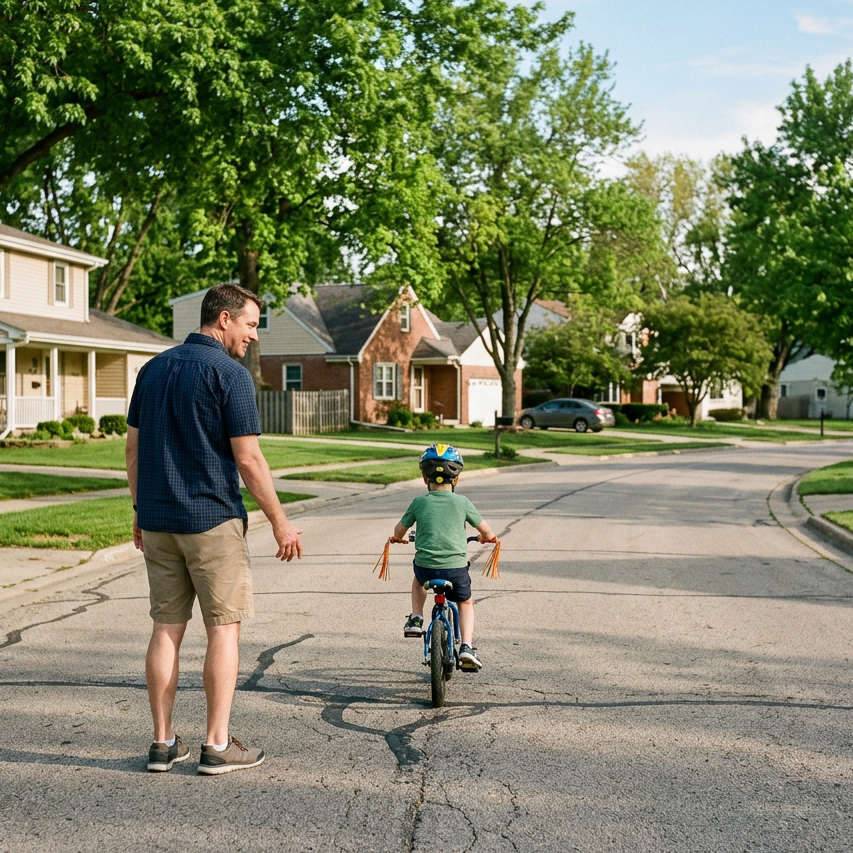
Earlier this summer, my daughter learned to ride her bike without training wheels. Not to be outdone, her four year old little brother decided to conquer the same set of skills. Their dad had to conquer something else entirely.
In the days since, those moments of letting go have kept popping into my mind. I find myself sitting down to write today – the first time in more than 18 months – because there’s a lesson resonating with me about how those first moments of letting go mean just as much to anyone who wants to find success in political advocacy, too.
There’s a common set of fears facing anyone who wants to engage in public life. Anyone who picks up their own set of pressing issues and tries to move the political football forward will have to overcome them. But they’re not necessarily what you think.
I often spend a great deal of time with individual advocates addressing the fundamental challenges that keep average people from participating in our political process. These are the things that come top of mind: the confusing process, the feeling that no one will listen to you, the expense, the time commitment. But these are challenges keeping you out. What if you’ve already committed to playing the game? What if you’re already working hard for the issues you care about?
That’s when another hurdle comes your way: trusting the process and your champions to finish the job.
Work on an issue – any issue – for long enough, and it starts to become a part of your identity. You just cannot casually relinquish control over its success or failure. I know this in my own work. Success or failure in an advocacy strategy can take hold of my thinking and it becomes difficult to separate political life from the rest of my life. No matter how hard I try, my win-loss record starts to weigh on my self-worth. And trusting that to someone else? Frightening.
Those issues we let consume us are like the bike my daughter rode this summer. They are big, meaningful accomplishments. They’re complicated. They’re scary. BUT as an advocate, it’s not our job to ride them. The bumpy solo ride and bruised knees are going to have to fall to someone else. Our job is to get our leaders pedaling on their own.
At some point in the political process, our issue has to leave us behind. I’ve seen this throughout my career, and very recently on a major portfolio item as well. After more than a dozen years of working on one narrow, niche issue, there was a window for all the many thousands of people who had contributed to the effort to witness it leap forward. Yet that leap was entirely out of our control.
In our American (lower-case) republican system of government, advocates don’t get to ride the issue home. We have all the responsibility up to a point. We provide training wheels (data, information, stories) that get our champions comfortable with an issue. We hold their hands, we nudge them, we encourage them. But as individual legislators buy into our issues, the process requires them to carry out the work that no unelected member of the public can. They have to navigate the politics. They have to carry the message to their colleagues. They have to ride on their own.
And it’s scary as hell for us, the advocates left on the outside looking in.
Letting go of the issue, and trusting your champions may just be the hardest skill of all for an advocate. We don’t jump into the fray of public debates with the intention to cede our voice to others. But in a representative system we must. And at some point, we don’t have a choice.
Because the issues we care most about are bigger than each of us individually. The thousands of advocates who had worked on the niche issue over the past dozen years? Some have retired. Some have passed on. Some are just starting in for the first time ever. And the issue persists. Because the system is structured in a way that forces long, deliberate debate we have to entrust the work to others at some point. I think the hardest moment for that trust might just be when advocates have to watch their issue head to the floor of the US House of Representatives for a standalone vote.
Representative republics aren’t comfortable because of this dynamic. They leave us to our nervous habits while our champions leverage every skill and relationship they’ve developed to finish a job others started. At the same time it is beautiful and insufferable to watch. But unless we are willing to run for, and be elected to high office, this is our fate. We have to develop the humility to leg go and let our partners take control of the handlebars for themselves.
While I’ve been plugging away at my daily work over the past 18 months, I’ve deliberately let go of posting frequently here. The nature of our current political climate demands it. There are too many moving pieces – too much intentional chaos – to allow otherwise. But as I look toward November, and the scenarios that could unfold for 2027-2028, I know this truth will remain the same: issues bigger than us will always require us to let go and count on those we elect. No matter the work we put in, and the variables we try to control, we will be called to master this skill.
So, in the coming months while I plan for what’s next after the election, I’ll be looking for other ways to build that muscle for letting go. We’re past bike-riding and solo swimming. As long as my kids don’t decide to get into skydiving anytime soon I think I can handle the training.
I initially started this post more than two months ago. In the interim, the US House passed a standalone bill on the niche issue I referenced. The bill passed 218-203 with a large bi-partisan majority. Since then, the US Senate has taken small steps forward on their own version of the legislation. Now, in the August recess, I’m struck by another metaphor. My daughter is currently refusing to ride her bike. For whatever reason, with the hurdle overcome, she’s done with that experience for now. As frustrating as it is, I know another window will open – just like the issue we’re working will get another window of opportunity in Congress. So, we’ll keep chipping away at the daily work to make that happen. And I’ll keep nagging her that it’s time to get back up in the saddle.

