Be bold. Be brief. Be gone.

“Be bold. Be brief. Be gone.” It’s a phrase I first heard as a young lieutenant. Like many graduates of liberal arts colleges, I’d mastered the art of adding more than enough fluff to any presentation to fill my allotted time. But what my classroom instruction failed to convey was the lack of patience the real world has with filibusters.

Especially in a Marine infantry battalion, violence of action is prized. Efficiently communicating issues and resolutions is key for young staffers. The officers who droned on, skirting the issues they faced, failed to make the necessary connection that their commander needed. Those commanders wanted an issue boiled down to its core, not debated and explored in the meeting room.

Now, that’s not the case in all organizations. But in advocacy, I’d argue the same principle still rings true. Delivering a clear ask concisely is an invaluable skill set. And frankly, most aren’t very good at it.

I was speaking with a legislator yesterday who brought the concept into stark relief. I’d asked him to share some observations with aspiring advocates and one of his key tips was pretty straightforward: simplify your ask, and fit it onto one page.

In my own staff experience I can assure you most advocacy groups still don’t have this down. In an effort to “maximize” their time in front of an official, they minimize their impact in three key ways:

1 – they try to cover too many issues at once

2 – they provide reports instead of stories

3 – they don’t make a clear connection to the legislator and his/her priorities/district

But here’s the real mistake: they haven’t invested the time in educating officials, earning their trust, and becoming valued sources of information before making an ask.

You’ve heard this from me before, and eventually you’ll be sick of it. But it bears repeating as often as I can – until you develop that influential relationship, you won’t have the authority to be bold, the trust to be brief, or the impact for your stories to keep resonating when you’ve left the room.

If you look back to previous posts on political action plans, you’ll see these themes running through the content. After hearing this legislator’s perspective, I hope you’ll take a step back and evaluate if your plan needs revisited.

Just a quick reader survey…

Thank you for being a part of this community! I’m eager to keep bringing topics and content that are relevant to you. Please take 5 minutes to fill out this brief survey. The first 50 respondents will be entered in a drawing to win a special “thank you” gift!

(And if you share this post on your own social media, I’ll give you a second entry for the giveaway!)

Again, THANK YOU! I genuinely appreciate your feedback.

Moments of Leadership – the one where you just keep going

I’d be lying to you if I said I knew what I wanted to write about today. I usually pull together my final draft of these posts the night before I publish them. Tonight, I was at a loss.

For a time, I thought about simply re-sharing an old post. There’s nothing wrong with that. A number of highly successful bloggers would actually recommend it as a tactic when you’re struggling to get content together. Tonight, as I’m writing this in bed, I’ve got my newest read lying open next to me on my iPad. As I was searching for the post to re-share, I read a passage on persistence.

The book, The School of Greatness by Lewis Howes compiles the stories of leaders from across many disciplines, and studies their common experiences, traits and practices that have helped them achieve greatness.

I’m new to the Lewis Howes universe still. If you haven’t heard of him before, I’d encourage you to look up his podcast, also known as The School of Greatness. Howes brings in guests with incredibly diverse backgrounds, and prompts them to share more deeply about the profound truths in their lives. He’s a great interviewer. Not because he asks the hard questions, but because he asks the meaningful questions well. He’s not searching for a gotcha moment or a headline, he’s genuinely trying to understand what has set people on a path to greatness. It’s compelling.

But getting back to the book; I just finished the second chapter which opened up the topic of adversity. Howes shares some specific lessons he learned from Angel Martinez, a tremendously successful businessman who helped launch Reebok and, at the time of Howes’ book publication, was CEO of Deckers Brands the parent company of UGG (you know, the boot brand).

In sharing Martinez’ story, Howes highlights a lesson that Martinez learned when first pursuing long distance running as a sport. Here’s the excerpt:

“In distance running, there’s no coach who is going to bench you or tell you that you can’t play. And the clock never lies. There’s no subjectivity. I remember when I started running, the older guys on the team told me, ‘We only have one rule. You can’t stop. You can go as slow as you need to go, but you cannot stop. You can never drop out.'”

Angel Martinez

On one level this REALLY appealed to me. It’s pretty simple: I am NOT a fast runner. I enjoy running – now much more than when it was required in the Marine Corps. Since leaving service, I’ve run a couple of full marathons, lots of half marathons, and typically log 12-15 miles per week in the midst of other routines.

But then I got to thinking about tonight’s post. And I realized there’d be value in just sharing this reminder with you all that sometimes, maybe a lot of times, it’s enough to just keep going. Whether it’s in advocacy, during your first marathon, when you’re studying a new topic – sometimes the simple act of showing up and following through on the routine is enough. Going slow isn’t a failure, giving up is.

For today, I hope that simply sharing this observation with you all will be enough. Enough of a reminder that it’s ok you’re tired. Enough of a boost as you continue to show up at work and for your family. Enough as you struggle to wrap your arms around what transitioning into a post-COVID world will be.

Leaders, no matter how small of a group they’re leading, have to show up. You have to place yourself at points of friction. There is power in presence – ask George Washington at the Battle of Monmouth.

That battle looms large in the American military pantheon not because it was a major victory – in fact it can largely be regarded as a stalemate and inconsequential. But the legend of Washington took on near deific qualities as he personally took charge of American troops in retreat, returning them to the front and causing the British to abandon the field of battle. By showing up, he inspired routed troops to confront their adversity and lean on the training they’d received through the cold, difficult months at Valley Forge.

Our daily adversities typically don’t compare to the battlegrounds of the 18th century. But the secret to hard won success in our daily lives, and on our own battlegrounds remains the same: Go. As slow as you must. But keep going.

It can only go so badly…

It’s important, from time to time, for advocates to be reminded that their lobbying meetings can only go so badly. The reality of our work is that the worst response we can typically get is “no.” But sometimes that’s not the low water mark of a meeting.

Over the last couple of weeks I’ve worked with several different groups to identify best practices for advocacy meetings in the still digital realm of the COVID era. Without fail, some things go wrong in the practice sessions and live meetings alike. After all, we’re all human right?

This many years in the field, I’ve reached a point where I’ve seen lots of mistakes that derail meetings. Some are simple oversights: forgetting to make an “ask” because you’re caught up in a good conversation and the clock runs out; someone has a distracting affectation or worse a stain left on their shirts from lunch; and the all time dreaded mid-meeting flatulence.

My constant reminder to my advocates is that these remain, at their core, minor issues from which they can easily recover if they have a plan for their meetings. But what do you do when malicious forces are at play and the speed bump in your meeting is more than just a minor incident?

During the height of the 2017 debates surrounding the future of the Affordable Care Act, some congressional offices saw abysmal displays from activists. In an effort to draw headlines, or engage in shock tactics, agitators subverted the hard work of issue advocates by creating public displays they thought could catch attention. I witnessed staff being followed from their offices, efforts to track their movements, and even a few not-so-veiled threats.

At the time, I decided any engagement I’d have with those groups would necessitate killing them with kindness. Our team took every note, listened to every story, and bent over backwards to remain available. As logic would have it, without a friction point to energize them, the agitators lost their zeal and melted away from the process. Eventually – and it did take a while – we developed a rapport with those would-be advocates that, if not in friendship, ended amicably.

At the time, I thought the scenes I saw then would hold the title for “worst meeting moments” in my mind for a long while. Until I heard a story from a colleague yesterday.

This friend – who will remain anonymous – told me about a public meeting held this past summer. Somehow, their zoom meeting details were forwarded beyond their control (before we all got better about preventing zoom bombers) and the meeting log-in information ended up being advertised on a website for, wait for it, voyeurs and sexual exhibitionists.

In the middle of their meeting, three men appeared in the crowd, and began, well, exhibiting themselves. Your imagination can take it from there.

And that, folks, is absolutely the undefeated champion of bad meeting moments. How do you recover from that kind of disruption?

I’m not sure any level of planning can fully prepare your team for something like that. At best, in this virtual world, it needs to serve as a stark reminder for digital security and a dedicated staffer who can boot those malcontents expeditiously. Further, you need to prepare your advocates for interruptions and how to regain their composure when those interruptions occur.

But in the meantime, you can use this story when you’re talking to your advocates. Remind them that it’s ok if they flub a talking point, or if their personal story falls flat. After all, when they’ve prepared for the worst, they’ll know a meeting can only go so badly (you hope).

Prime time with POTUS

Are you planning on watching President Biden’s prime time address tonight? If not, why?

Just a few years ago, asking that first question would prompt predictable responses. Viewership of those defining public moments was reliably high. But has it changed?

I’d offer an observation to the administration about tonight’s address. Media has changed drastically – especially in the last year. And it may be time for the Biden team to take a lesson from my favorite President, #30 Calvin Coolidge.

Before you try to give me grief about adoring Silent Cal, you need to take a moment to learn a really important fact about him. Despite his taciturn reputation, he was an early adopter for the breakthrough technology of his day: radio broadcasting.

While his predecessor, Warren Harding was the first President to ever produce a radio broadcast, it was Coolidge who implemented some of the foundational media practices we still see in use today.

Number 30 was the first to address the nation en masse from the White House – taking his agenda directly to the people in the wake of Harding’s death. When he was inaugurated in 1925, the ceremony reached an estimated 23 million listeners. Thanks to an emerging technology, a man less comfortable with public events was able to deliver his proposals direct to the American people, without pomp. And despite the moniker of “Silent Cal”, President Coolidge addressed the nation around 50 times via this new medium (by contrast, FDR only produced about 30 of his famed fireside chats).

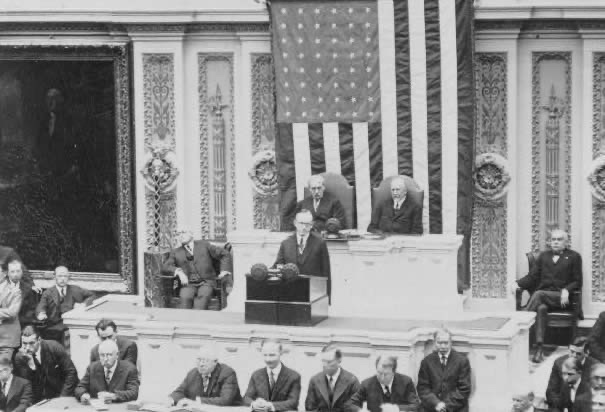
Coolidge delivers a State of the Union Address by radio. The technology was so valuable to him that he hired a consultant to develop his broadcast voice and skills.

I don’t think we’re so far removed from basic cable packages, yet, that a prime time address is worthless. Tonight’s address will certainly help set a tone for the Biden team in the wake of a legislative triumph (COVID relief) and ahead of the administration’s next major legislative target. Whether that target is a bi-partisan approach to infrastructure spending or advancing a climate change agenda, we are likely to see a significant preview of the next hundred days of the President’s agenda.

My beef is this: why stick to “traditional” or legacy media approaches at this point?

After forcing a massive spending package through on strictly partisan lines, I believe the administration owes itself a proper narrative context for laying out the road ahead. Simply talking at the American people doesn’t match, in my opinion, some of President Biden’s best skills.

That’s why this prime time address should only be one part of the program for tonight. If I was advising the team, I’d cut that address down, and build out a live event to be broadcast across multiple social media platforms.

Joe Biden the man has demonstrated an ability to establish meaningful connections with average Americans in less formal settings. A Facebook/Instagram live event would draw massive appeal – and allow him to let his hair down a bit.

In the midst of the ongoing series of posts where we’ve explored social media, I am confident in saying this: people are craving genuine moments that lack the manufactured feel of TV productions. “Going live” on social media is a palpably different experience than “being live” on TV. Take a risk and try the new media.

And that same advice goes for your own advocacy agenda. We need to begin evaluating ways to bring our advocacy programs into the lives of our advocates. Going live on your team’s social media regularly can pull back the curtain, and create a sense of buy-in for would-be advocates. It certainly worked for Coolidge – leading to his nomination and eventually his outright winning the White House in ‘24.

Bottom line: don’t shy away from new technologies and platforms. Embrace them to help bolster your advocacy agenda.

But enough of my rant: what do you think we will hear about tonight? And would you prefer some other medium? How do you think the administration could best position itself for life after COVID relief? Drop a comment below and let me know!

Content Warning: This is a Sh!tty Post

So, have you ever had a conversation with one of those 30 pound brain types? You know, the really smart folks. Did you unwittingly learn something that just astounded you?

I’ve spent the last few days drifting into a subject I could not have imagined exploring when I woke up last Friday. But a 30 minute conversation with a colleague (who easily qualifies as one of the smart ones in any room) sent me plumbing the depths of the internet to learn more about my latest bit of fascinating knowledge. It all started with this:

“The DEA is tracking our poop.”

One line, that’s all it took to ruin me for a solid 72 hours. With that one line, this colleague had me reeling. I wasn’t exactly flush with time this weekend, but what little I had available was suddenly claimed by the concept of Wastewater-based Epidemiology (WBE).

Here’s the skinny: for years now, WBE technology has existed to sample wastewater and track trends in consumption, shedding light on community health issues. Specifically, the Drug Enforcement Administration has partnered with localities to determine trends in narcotics use. The DEA is tracking our poop.

But according to this article, the concept isn’t all that new.

Here, no more false appearance, no possible plastering, the filth takes off its shirt, absolute nakedness, rout of illusions and of mirages, nothing more but what it is . . . The last veil is rent. A sewer is a cynic. It tells all. (Les Miserables; Jean Valjean, Book II, ch 2)

Victor Hugo

I’d like to thank that Stat article for pointing me in the direction of Hugo. Admittedly I haven’t searched for quotes on this topic that pre-date Jean Valjean. But for at least 176 years this has been a philosophical concept to some. I was baffled, though, to learn that modern technology has brought a microphone to our sewer systems so they can deliver their own Ted talk on these trends in community health.

I assert their shop talk would be CAPTIVATING.

By following chemical markers, researchers have been able to predict trends in drug overdoses. Equally important – the same tech has driven some of our targeted efforts to respond to COVID-19. By committing funding to this tech and research, states and localities have tailored their pop-up testing sites to the trend lines they see in the WBE.

Think about this – a program tracking community waste to fight the drug epidemic has played a key role in fighting a global pandemic, and it all hinges on our wastewater treatment infrastructure. It all boils down to our poop.

If you missed this revelation over the past several months you’re not alone. In the coverage of hospitals, stimulus checks, and mask outrage, this topic likely didn’t float to the top. But as of today, I’m calling on us all to pause and thank the real unsung heroes we’ve overlooked for the past 12 months.

Frontline workers continue to deserve their due. But I think we need to pause and consider moving that front line below ground. Somewhere, in a community near you, the wastewater folks deserve their very own round of applause.

These folks already serve as one of the pillars of modern society, allowing ever growing populations to continue living hygienically while in close proximity. But now they’re also providing the access necessary to flex public resources to where they’re most needed.

I’m a proponent of good government. I’ve never believed in one-size-fits-all policy solutions. Our communities and environments are too diverse for blanket approaches. But here is a real innovation in our lifetimes that allows us to do more with less. And while the efficacy will continue to be refined in the years to come, I think we owe it to our wastewater engineers to pause now and say thanks.

The Audacity to Lead

Back for a second contribution to our conversations, I’m proud to share this piece by my friend, Abe Jacob. Please take a moment to thank Abe and share your thoughts with him! -LC

During the 2000 Republican primary, just as I was entering my teenage years, I caught the political bug.

I recall being somewhat familiar with then Texas Governor George W. Bush due to his name and famous father. I also remember that to my teenage eyes and ears, the white-haired senator from Arizona, John McCain looked a bit old for the job and sounded like the villain out of a movie when he was being interviewed.

My choice that cycle was Elizabeth Dole who previously served as head of the American Red Cross and United States Secretary of Labor under Bush ’41. Her charisma and articulate approach to various policy questions won me over and while her campaign was short lived, I clearly knew she’d demonstrated that a woman had every ability and right to occupy the Oval Office. 

I recognize that it’s easy for me as a white man to not fully understand the uphill climb women have endured in achieving electoral success. I doubt we’ll ever know how many were told to either wait their turn or who were discouraged from running because a man was thought to be more electable.

But women leading was nothing new in my experience. My elementary school principal, teachers from pre-kindergarten to sixth grade, and city mayor were all women. Obviously, my principal and teachers weren’t elected, but they were all leaders to us kids.

When the 2006 Ohio campaign cycle kicked off, I was an undergrad student at Ohio Northern University and a proud member of the College Republicans Club. That year, Betty Montgomery was hoping that her two terms as Ohio’s first female attorney general and first female auditor of state would provide the momentum for her to make history as the state’s first elected female governor.

Unfortunately, it soon became apparent that the climate wasn’t right for her gubernatorial candidacy, and she decided to accept the party’s nomination to compete for her old job as attorney general. She was uniquely qualified for the role, having held it for two previous terms. But the 2006 election did not pan out for most Republicans up or down the ticket. Despite a powerful “Betty’s Just Better!” campaign theme, she and her GOP colleagues lost all but one statewide office.

Four years later I finally had the opportunity to meet Betty. It was in that first meeting that I learned about her audacity to lead. She told me that when it comes to holding office, the public owes us nothing. We owe the public a service that they allowed us to perform and the minute we forget that, it’s time to leave.

Despite losing her final statewide election, Betty continues to share her optimism and encourage the next generation of leaders. More than a decade later, she’s still working to promote, mentor,  and encourage women to run for office.  

I take no pride knowing that my state has never nominated, let alone elected, a female from either major party for governor or United States senator. But I take great pride in that same state producing the likes of Betty Montgomery. She stands, properly, alongside JoAnn Davidson in Ohio’s political pantheon. Neither rushed to clutch a gavel, but rather took the time to build relationships and learn the unintended consequences of bad public policy. As a result, both gained the respect of their peers and left legacies of meaningful impact.

Whether they would seek a coveted seat on city council or aim to be Commander in Chief, I’ve wondered what roadblocks continue to deter women from campaigning. It should be a point of pride for all of us when they shatter glass ceilings with their respective electoral victories. But I look forward to the day when the “shock value” wears off. Not because they don’t deserve praise, but because they finally achieved so much overwhelming encouragement and support from voters throughout the country that it becomes the norm.


As the audacity to lead becomes less of a challenge over time, it doesn’t mean anyone should take it for granted. We’ve all been blessed with a voice, mind, and individual talents to better our communities, but we need to be mindful of the times we don’t encourage one another equally. Going much further than simply inviting women to the party, we need to make sure they have a seat at the table! I am incredibly blessed to have been surrounded by strong women throughout my life and I hope ten years from now, historians will have added a plethora of new chapters on electoral achievements by remarkable ladies throughout this country and world.
Campaign in Poetry, Govern in Prose

It’s no secret that I’m a big fan of the television series The West Wing. And one of my favorite quotes from the series is a stark reminder of the differences between campaign politics and governing politics. In season 5, White House Chief of Staff Leo McGarry summons the real world’s late Governor of New York, Mario Cuomo:

“You campaign in poetry. You govern in prose’…. We run a country; we deal in abstractions.”

Leo McGarry, The West Wing, #519 “Talking Points”

This realistic take has always resonated with me. And the context of that line is just as important. In the moment, McGarry is trying to absolve one of the White House staffers in the wake of a tough decision, one that resulted in the White House abandoning a campaign promise to a key group of supporters.

I’ve straddled the line between official government roles and political campaign roles for the last decade. Before that, I saw the complex interplay between politics and policy as I watched the presidential transition between George W. Bush and Barack Obama while wearing the nation’s uniform and attempting to divine what that transition would mean for pressing challenges like total force strength and the future roles of the various military branches.

Now, weeks into the Biden administration, we’re seeing the gritty reality of governing politics come to fruition again, as we do with every new administration. Progressive advocates have clamored for years that the country should adopt a $15/hour national minimum wage. But in the face of congressional procedure, negotiators had to choose between the broader American Rescue Plan Act of 2021 (the $1.9 trillion dollar coronavirus relief bill barreling through the legislature) and a minimum wage provision that didn’t meet the mark to remain allowable under budget reconciliation.

And that’s part of the beauty of the federal budget process; no one really knows how it works. This may not be literally true, but it is practically true. And for better or worse, the negotiators and parliamentarians made a meaningful move to cast off a poison pill to advance a major win for the administration. This kind of nuance is what so often confounds those not in the political arena. So it’s probably helpful to explain briefly what budget reconciliation is.

Simply put, budget reconciliation, established under the Congressional Budget Act of 1974, creates a pathway for some spending, tax or debt limit bills to be considered in the Senate without being subject to the filibuster – needless to say the reconciliation process will stand as a major tactic for the administration and congressional Democrats who hold the slimmest of margins in the US Senate.

This will not be the last “big deal” in this congress or administration to advance through budget reconciliation. The process has big implications for President Biden’s team to advance key campaign promises like tax reform and sweeping climate change policy. Despite their wins in November and January, Democrats are nowhere near the super majorities they need to govern in poetic verse.

No, we will see continued grinding in Congress. Thankfully, that raises the stock of those in the middle. Those seeking common ground are poised to benefit from the checks and balances so dear in our system. For those who can find a linkage to budget reconciliation processes, their policies are well positioned for the administration and congressional leaders to leverage their initiatives in order to secure early wins.

But where does that leave the poets? Frustration is the name of the game for litmus-test driven purists – well, at least for those who actually want to accomplish an agenda. For some, simply having the ongoing fight is good enough. They’ll want the issue to help them remain competitive in the next election too. In the meantime, bridge builders will once again shoulder the burden of governing.

As an advocate, you’re likely asking yourself a host of questions about how you can bring your policy proposals to the front. Now would be a good time to tune into the local event schedule of your elected officials. While others throw stones for abandoned promises, provide insight on visible wins you can help a legislator bring into their district.

Right now, the size of the win won’t matter, Democrat and Republican elected officials alike are probably looking around, wondering what positive news they can share. After all, campaign season is just a few months away again. They’ll need new verses of poetry, and some triumphant lines help balance the doom and gloom.

Quit Apologizing for Living

I know the Thursday posts on this blog are typically devoted to advocacy. But I was caught in my tracks yesterday by a conversation with my spouse, and frankly it’s stuck in my craw. So this is a bit of a rant.

In short, we were chatting about the challenges that working parents face with regard to establishing boundaries between career and home life. Considering the ubiquity of work-life balance conversations happening in the professional sphere, it’s astounding to me that I’m still seeing colleagues, specifically women, feel as if they need to apologize for having a life outside of work.

We all know those cringeworthy moments witnessing a co-worker suffer through the roller coaster of responding to a school emergency or child’s sickness. Just as concerning, though, are the challenges to balance the mundane events in ordinary, everyday life.

By the nature of my own work and the organizations with which I partner, I coordinate with colleagues in multiple time zones every day. We are constantly balancing schedules, and are often called on to hold early meetings. Needless to say, early in the Eastern time zone is even earlier in Central and Mountain time. Without fail, those early call times overlap with the school drop-offs, breakfast times, and daily routines of my co-workers out west.

Because of those overlaps, one of my female colleagues is almost always forced to join our zoom meetings via audio only, and often cannot weigh in on a question in real time. And somehow, every time we have one of those calls, she feels obligated to apologize for providing for her family. Thankfully she hears from senior leaders that those apologies aren’t necessary, that our family commitments come first.

Most importantly, it’s regularly conveyed in our organization that we are trusted to judge for ourselves what meetings we absolutely need to attend. I can speak from personal experience in uniform and while working in Congress that such trust is an uncommon organizational culture trait. Thank goodness I’ve joined a flatter organization, that has its priorities straight.

Listen, I understand the social pressure, the politeness gene that pushes us to apologize in those moments. But if we are truly serious about work-life balance and encouraging working parents to continue to advance their careers, it’s absolutely unreasonable to create cultural environments where that type of pressure is allowed. Leaders owe it to their teams to account for the more important job, that of parent, that we hold outside of our working day.

The toxicity of poor work-life balance, and the cultures that perpetuate it, are often unrecognized until too late. Good employees tend to leave organizations after having been drawn too thin over years. Great organizations, and those that would aspire to greatness, need to take a hard look at how they’re continuing through the ongoing pandemic. We need to figure out sooner, rather than later, if we are ignoring an opportunity to provide our teams the most tangible employee benefit: time.

There’s no one-size-fits-all solution to work schedules. Manufacturing, tech, agriculture, sales – every industry faces unique circumstances. But they all face a culture where a growing number of families rely on dual income streams, and we have to get serious about our cultures. The companies that move forward, developing innovative approaches to scheduling are destined to draw top performers. Those that don’t are going to lose out on the talent race.

But until those changes start to happen, I have a bit of unsolicited advice to my fellow working parents. Quit apologizing for living. We owe it to our employers to deliver on our work. But more importantly, we owe it to our children to deliver the best version of ourselves. Parenting is a full contact sport, don’t apologize for trying to make it to the championship.

It’s quiet…a little too quiet…

If you’re a parent, you’ve come to know the duplicitous nature of silence. At one and the same time, silence is a blessed reprieve and an ominous cloud on the horizon. But in those waking hours, silence leaves us asking “what could those little disaster factories be getting themselves into now?”

Except when we can account for them being safely snuggled in their beds at night, parents won’t find peace in silence. We’ll search frantically in those rare moments of daytime silence, equal parts fear for their safety and dread for what damage could be occurring to our home.

It seems to me that a lot of folks are having a similar reaction to the relative quiet coming from Washington, DC right now.

Democrats and Republicans alike find themselves playing the waiting game to see what policies the new administration, now well into its first 100 days, will prioritize. Trying to read the tea leaves of senior appointments and not-so-public negotiations on stimulus spending, lobbyists and government affairs types find themselves speculating on next moves. But worse, John Q. Public finds himself concerned at an apparent lack of activity right now.

I hear it in my daily calls. Everyone is asking roughly the same question: when will we see something happening on policy X? Unfortunately the answer is quite mixed.

For instance, many folks are wondering about implementation of spending set aside in December as part of the final Trump-era coronavirus relief bill. Some aspects of that relief bill have been paused for agency regulatory review. And because the average Joe or Jane doesn’t concern themselves with knowledge of administrative processes, it’s easy to assume the worst – that relief has been maliciously canceled. That’s simply not true. Neither would it be fair to say that bureaucrats have simply fallen asleep at the wheel.

Rather, we are simply in the second half of transition.

When we think about Presidential transitions, we almost exclusively focus on what happens before Inauguration Day. We seem to expect that Day 1 means activity can resume and that the gears of government will begin turning. Unfortunately we forget that those gears still move at the speed of government.

Traditionally, what we are seeing in DC right now is nothing new. The Biden administration is plugging its way through a backlog of proposed regulations. Coupled with the theatrics of the recent impeachment proceedings, that would be enough to grant us an uneasy silence. But we are also experiencing a significant congressional transition, and the rise of new committee chairs and caucus leadership.

You see, it’s not that our “kids” are necessarily on the verge of a dangerous stunt. They may not be finding their way to mischief. Right now, they’re more likely to be over stimulated, stressed from a frenetic pace and lack of routine.

But don’t fret! We’re starting to see those early signs of life and movement again. Regulatory proposals are starting to come forward. By the end of this month they’ll be getting back into stride. As advocates, we’ll be in the thick of appropriations season in just a moment’s notice. Before you know it we’ll be back to the bombast and back room dealing we embrace as a source of national entertainment and angst.

For what it’s worth, I recommend taking a moment to enjoy the relative calm. Call me an idealist, but maybe, for just a couple more days we can try to find a bit of peace in this ominous silence. Let’s hold onto it for a bit longer please.