I’m lucky to have some really great best friends. There’s a group of us from college who have only gotten closer through the years. But the college years hold some of our clearest memories together (surprisingly considering the beverages consumed during those years).
One of those friends in particular, Matt, has been on my mind a lot in the last few days. Not for any other reason than I’ve spent the last week living alongside, so to speak, one of his man crushes.
You see, Matt was an early devotee of the school of “livin” embodied by then rom-com heartthrob Matthew McConaughey.
I’m not going to hide it from you – we gave him more than his fair share of grief over his…obsession? That may sound stronger than it’s meant.
But now, years removed, I have to admit that Matt may have been right about McConaughey. Certainly we’ve all taken note of his more dramatic films since returning to Hollywood after a self-imposed “unbranding”, but Matt was far ahead of the curve. It turns out we were all sleeping on this actor, and I’m only just waking up after emerging from his recent memoir titled Greenlights.
I’m admittedly not one who typically picks up a Hollywood memoir. The genre rarely appeals to me, with the notable exception of fellow Ohioans like Rob Lowe. But when I took in some recent interviews of McConaughey while he was digitally “touring” to promote it, my interest was piqued. I was drawn into his very public assessments of our recent failures to improve the political dialogue in our country.
More poetry than prose, McConaughey takes you through much of his non-professional life. He welcomes you into his rural Texas childhood, invites you to walk through deserts, hike mountains, swim the Amazon and wrestle African tribesmen. All the while, you can find yourself willingly accepting the adventure and giving yourself the green light to answer your own challenges.
Maybe that’s the secret sauce to why this particular Hollywood memoir stuck out to me: most of it was not about Hollywood. Instead, the piece communicated and fostered a deeper emotional connection than I would expect from most. Raw, honest, masculine. Exactly what I, perhaps, should have expected from one of our most accomplished leading men.
I dig McConaughey’s vibe in this work. I’m not ready to declare fandom on my buddy Matt’s level, but I think I get it now. I get where my buddy Matt found a kindred spirit. It also doesn’t hurt that McConaughey crossed over into genres more my speed with Interstellar and Free State of Jones. I don’t think I’ll join Matt in his annual viewing of The Wedding Planner, but I won’t be giving him as hard a time moving forward.
For now though, I’m happy to add Greenlights to the Bookshelf and recommend it to you as well. It’s my third book so far in 2021 and I’m glad I picked it up.
Greenlights is my third book so far in 2021. How are your reading goals going? What pieces have surprised you so far? I know it’s early, but maybe there’s a carryover from last year you’d be willing to recommend. Drop a note in the comments below and let me know what you’re consuming!
It’s challenging enough to not remember President Harry S. Truman simply through the prism of “FDR’s successor”. It’s nearly impossible to not fall into the trap of discussing his role in ending the second World War and stumbling toward the Korean War. His terms in office so saturated with conflict, he is often quoted by Americans in pride as we reference his resolve and willingness to make, and live with, impossible decisions. But little is discussed of his other accomplishments, challenges, and failures.
Early in the 2020 quarantine, I read a great piece on President Truman by H. W. Brands, one of my preferred historians, titled The General and the President. Not solely focused on the 33rd President, it instead dives into the tumultuous, fractious relationship between Truman and General Douglas MacArthur. The two suffered through much together, disagreeing frequently and publicly, and Brands’ work is definitely worth your time.
Prior to that book, I hadn’t spent much time living with Harry Truman. The 20th century’s second interwar period hasn’t dominated my own studies like our fledgling country’s war for independence. But I absolutely enjoyed diving into the personal dynamic between these two titans whose legacies formed alongside our nation’s emergence as the dominant nation in the Western world.
So, since March 2020, I’ve been a little more attuned to the frequency of Harry Truman quotes. Including the other night when one of his lines sprung forth from the dialogue of a hit television show, seemingly penned for just this moment in our modern republic’s growth:
Considering the martial themes that bookend President Truman’s tenure, it’s not a stretch to think most would read these words and assume he was bolstering the spirits of soldiers, sailors, airmen and Marines heading to the far East. How often do we hear “Give ’em hell, Harry” and make the same jump? We are now so generationally removed from that event we can easily overlook the incident occurring in the 1948 presidential election and referencing incidents of opposition from Republicans.
Similarly, the quote above leaps at us not from a call to arms, but a rather (admittedly only by machismo comparison) boring economic report to Congress.
On January 8, 1947, Truman was tasked with delivering a special message to Congress on the President’s First Economic Report. If you click on that link it will take you to the website for Truman’s Presidential Library and you can dive into the nitty gritty with old 33. Assuming you may not want to travel down that particular rabbit hole, here’s the skinny:
In 1946, Congress passed the Employment Act geared toward placing the burden of economic stability and inflation management squarely on the shoulders of the federal government; implementing such tools as a council of economic advisors for the President and a Joint Economic Committee for Congress.
I’m not going to spend this post boring you to tears over the Employment Act of 1946. But let’s talk about seizing a moment.
Go back up, and re-read the quote on that graphic. What does it say to you? Does it spur an idealism in you? Does it make you want to march with Truman or against him?
Here’s Truman, in the afterglow of stunning victory over the Axis powers, and before becoming mired in the Korean peninsula pushing against the tide of a militant China. He’s in the midst of reporting to Congress that more people are employed in America than ever before (great news). But he’s doing it while announcing the first data set developed by new, untested tools. And in the second line of the speech he begins painting a rather grim picture:
“Yet in the minds of a great many of us there is a fear of another depression, the loss of our jobs, our farms, our businesses.”
What does he do? Does he dwell on this sense of doom and gloom? No – he gives us hell and reminds us of our national pride. Our quote from the graphic above is sentence 3. He reminds us we have a spine, we hold the keys to innovation and that our work ethic is unmatched. Chills.
This coming week, we gather as a nation to celebrate a peaceful transition of power in a ceremony that, while evolving drastically over the generations, holds the same promise it did when Jefferson assumed the reins of the executive on March 4, 1801. Much like that day in the beginning of a new century, President Truman had – and President-Elect Biden has – a moment to call us together.
Certainly we will continue our disagreements and squabbles. Undoubtedly this weekend and inauguration day will see sparks fly through the continued factional activity advanced by tribalism. But we have a moment to remember our founding principles and to live up to them.
We were not formed into a union through fear, but hope. We did not hide from our oppressors or traitors in the past, but rose to meet their challenge. We have not fallen comfortable in our success but striven generation after generation to reach new heights, including the heavens themselves. And always, we’ve put our shoulders to the wheel and accomplished the job at hand.
Welcome back to a series focused on helping you shape your political action plans. If you need to knock off some cobwebs at the start of the new year, here’s the first post in this series.
Originally, I was going to post this last week, but the events that occurred on the Capitol grounds prompted a last minute replacement post. But, it’s time for us to jump back in!
With the new year, comes a new legislative calendar, new budget debates in the states and Congress, and a whole host of new decision makers you’ll have to engage. In previous posts we’ve talked about identifying your targets and some of the tactics you can use to approach them. But today, let’s talk about when.
Here’s a quick re-fresher on this, the third of the 4Ts:
Timing
And while we’re thinking about what tactics we can and can’t pursue, we should also take measure of when we can or can’t pursue them. Your team needs to take honest stock of whether your issue is salient to the broader trends you’re seeing in the legislature. Is this the time to push a specific bill, or should you re-trench and focus on educating stakeholders and decision makers?
The bottom line is that your issue is not always at the top of mind for most other people, including elected officials or bureaucrats. Identifying your targets opens the door to understanding their priorities, and attaining that understanding will help you divine whether now is the moment to strike. Building in structured feedback loops to evaluate your timing will drive home the last and most important aspect of your plan.
Of the 4Ts, I’m inclined to say that Timing is the hardest to master. Figuring out the timing of your agenda faces too many variables, too much impatience from our activists, and often much too little understanding of the broader political picture.
Seemingly, our national discourse drags on, and on, and on and on, leaving so many of us wondering what in the world elected officials do with all that time, and why they are always in a rush to the finish line at the end of session. A fellow lobbyist once described it best: the public policy process moves insufferably slow, until it doesn’t.
The whiplash effect of 24 hour news cycles, coupled with growing tribalism in our body politic has only intensified the challenges of finding the right time to proceed on the various phases of your political action plan. It’s not a science, it’s a fine art.
But, just like music and art, there are foundational principles (not quite rules) that, when observed, can help you improvise. They make order-ish out of chaos.
Rule 1: There’s no right time for a bill, but there are wrong times
Your legislative agenda will be in flux. Debates and priorities change, disasters happen and your team has to adjust on the fly. That’s why there’s no perfect, or absolutely right, time to introduce a legislative measure. But there are absolutely times your team should avoid.
One is obvious – in the middle of an emergency, avoid introducing your measure unless it helps solve the most salient problems facing your community. It doesn’t matter how good your political action plan looked in January, a natural disaster in May is not a good time to go talk about anything other than how your organization can help serve those impacted.
Another is fairly straightforward – don’t announce an agenda item right before a major recess in an election year. You instantly cut your own legs out from under you because you won’t have the attention of those you need. They’re out advocating for their own jobs, and you’ve missed your window.
Rule 2: As you can, educate often and introduce early
Let’s start with the latter – for the same reason you shouldn’t wait until the last quarter of a session introduce a piece of legislation, you should endeavor to introduce your “known” measures as early in the cycle as possible. The “known” measures are the ones you’ve already developed in your policy prioritization efforts within the organization.
If you’ve got a willing representative ready to go, work to provide them everything they need to get a bill drafted and in the process within the first 3 months of a new session. Quit letting the perfect be the enemy of the good; get ink on paper.
But whether you have a known measure or not; in fact whether you have a BILL or not, educate often. This is going to sound strange, because many would likely think that you wouldn’t want to waste a member’s, or their staff’s, time without a firm ask.
Trust me, with a lot of staff time under my belt I can assure you, you’re better poised to begin educating those staffers on a concept long before you’ve got a firm piece of legislation for them to consider. By developing those staff in a way that they understand the particular problems you’re trying to solve, and serving as a resource with them early, you are laying the groundwork to win them to your cause sooner rather than later.
Rule 3: Read the room
A dirty little secret about politics? Both major parties have mechanisms in place to help their members navigate the communications realm and the issues calendar. Caucus leadership knows their members cannot be subject matter experts on every issue, so they provide significant help. Listen to feedback from your advocates. Are you hearing the same talking points on a loop? It’s time to re-evaluate your timeline with those legislators. They may not be ready for your ask, you need to go back to educating them on the problem and helping them take ownership of it.
Rule three is honestly the hardest to internalize. Next week, we’re going to talk about testing your plan because rule three is so hard to learn. But if you go back to one of my earliest posts,Activism vs. Advocacy, you’ll be reminded of a simple reality: successful advocates “develop a plan for engagement that is non-partisan, and respects decision makers for what they are first – human beings.”
Timing is incredibly challenging because humans are too varied, and too susceptive to the whims of a moment for us to ever have a perfect plan. As you’re building your plan, keep the rules in mind and when in doubt, offer educational events and opportunities to put those elected officials in front of their constituents. You can never go wrong with helping an official learn your industry and earn new votes.
Originally, I had a much different post compiled for today. Barring some incredible circumstance, I was poised to share some thoughts with you today about Political Action Plans and how to consider the timing of your advocacy efforts. Well, then something incredible happened – and you all probably couldn’t escape the news of it in the last 12+ hours.
At the risk of simply becoming white noise at this point, I’m going to share a few thoughts with you here. I hope you’ll forgive the tangent, but I also hope that you’ll grant that it was a necessary pause.
You see, the US Capitol building has, for many years, played a pretty central role in my daily life. Not in the same sense as those who live and work in DC, I can’t claim that level of connection to it. However, working in federal level politics for more than a decade now, and having sworn an oath as a Marine Officer, the Capitol has certainly played an outsized symbolic role in my life when compared to many.
I can almost remember my first visit to the Hill. I say almost because no thirty-five year old should have a crystal clear memory of their 8th grade class trip to Washington, DC. But I do have incredibly vivid recollections of that trip. I recall one of our teacher’s calling in a special favor to a Senate staffer friend and getting our class onto the Senate floor. I also remember the moment that staffer let me sit at then Senator Mike DeWine’s desk. That was the moment I really fell in love with the traditions of American politics.
But I have a much more vivid memory of the Capitol, one that stands apart from the countless times I’ve walked through the Rotunda, or roamed the tunnels between legislative office buildings. I’d dare to say it’s more clearly defined in my mind than the times I’ve been able to stand on the Speaker’s balcony and take in the sweeping views of our capital city. It was actually a time when I couldn’t go into the Capitol complex at all, after hours, and during an August recess.
On August 10, 2007, my Officer Candidate class graduated from the first stage of Marine Officer Training, known as Officer Candidate School (OCS). OCS is located at Marine Corps Base Quantico, just a short drive from Washington, DC. As you can imagine, graduating from OCS is a fairly special moment, made all the more so by having your family there to join in the spectacle. For me, the night after graduation carried another treasure because that night I was able to take my dad on his very first trip to Washington.
It wasn’t ideal. First and foremost, it was AUGUST in DC and that meant a special level of sweltering humidity. Secondly, we only had one night to be in DC so we could be back on the road to Columbus and home for a short leave between OCS and my next round of training. But Washington, DC is a city that truly never sleeps. It’s a character trait that I adore in our nation’s capital and abhor basically anywhere else but Rome.
Ideal or not, there we were – fueled up on cheap-ish cheeseburgers and trekking from our hotel to the National Mall so I could show my dad a handful of our national monuments.
It was incredible to be in this position. I’d say that usually, children don’t have many opportunities to see their parents in a state of wide-eyed wonder. The role reversal wasn’t as apparent to me then as it is now that I’m a parent myself; but even then, I realized my dad was feeling a sense of awe that I’m pleased to know still resonates with me every time I jog around the Mall while in DC on business.
There’s a magnitude to the Washington monument that you’d be hard pressed to describe when seeing it for the first time. A nearly crushing sense of solemnity confronts you at the war memorials and while standing at Lincoln’s feet, reading his great charges to our nation. The ethereal quality of the reflecting pool at night can bring the most loquacious of visitors to a reverent, pensive silence. And then, after walking East along the length of the Mall, you arrive at the base of the Capitol complex and are enveloped in a majesty unique to our republic.
Taken at face value, the marble, steel and concrete of the Capitol building don’t stand out among national monuments. I’ve been to enough national capitals that I’ve lost count – each has their awe inspiring sight or experience. Building-for-building, I’d not be surprised if foreign visitors look down their nose at the seat of our legislature. But that’s just it, our Capitol building isn’t just brick and mortar. It stands as a physical embodiment of ideals – ideals that remain unique in human history.
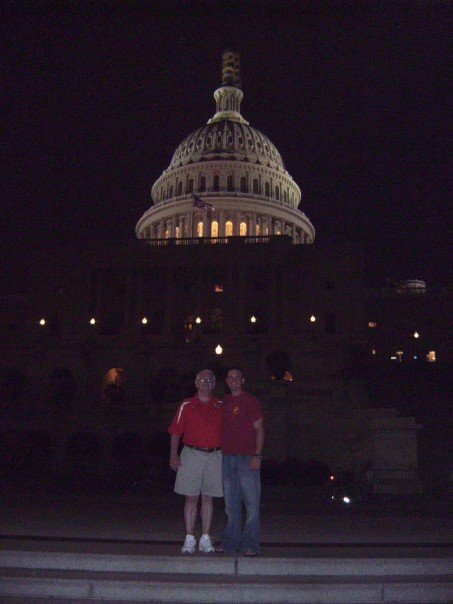
That August night in 2007, my dad and I started walking around the Capitol grounds taking it all in. He let me rattle off my trivial facts, to a point. That point was when we moved from the House side to the Senate along the western steps of the Capitol. This is the face of the Capitol that you know from inauguration days, iconic in its role facilitating peaceful transitions of power. But that night, the western face of the Capitol assumed a new role as stage for a performance from a military band.
Nice that we’ve gotten better camera phones since 2007, am I right?
Here I am, standing in flip flops, jeans and a t-shirt for the first time since late May. Alongside, my dad who just witnessed me swear an oath to defend our constitution, hearing the tune of the Marine’s Hymn as I stood at attention. At the foot of the halls of Congress, where every day diverse citizens from across a vast nation, all of whom face unique challenges and experiences, come together to carry on an audacious experiment in self governance.
Yesterday’s violence at the Capitol seems to have struck a chord with so many of us. The reason is pretty simple, it flies in the face of that audacious experiment. For nearly 245 years, our nation has worked to form a more perfect union. We’ve done that through fractious, vehement debate – some of which resulted in violence. But on the whole, those 245 years of self government have yielded a society that stands at odds with the vast majority of human history.
Most of our time on this earth has been driven by tribalism. Tribalism is the easy, default, setting of our race – I and my kin will take what’s ours, and yours be damned. Acting in concert as a broader society is the much more difficult path. One which we’ve endeavored to refine for generations. What we saw yesterday was a visible backward slide into the lesser form of our beings, and it should have upset us. It should have awoken us.
From my vantage point yesterday, it seemed to have, if only momentarily. Republicans and Democrats alike called out these thugs, and their despicable actions, for exactly what they were – an assault not on a building, but on the ideals lived out within that building.
Our system is far from perfect – and as long as we remain mortal humans, it will always be. But now, on the verge of another transition of power between political rivals, we’re faced with a clear challenge. Will we shoulder the burden of living out those ideals, or will we let the institutions, buildings and our fellow citizens continue under siege.
The tribalism on display yesterday is not new. We’ve accepted it in dribs and drabs, gradually buying into cults of personality masquerading as ideologies. We’ve allowed strong men to let us rest on our laurels and recuse ourselves from the process of citizenship. We’ve accepted a falsehood that because someone “votes for the other guy” that we are not beholden to engaging with those fellow countrymen to build better solutions for the problems we face.
Now, more than ever, we owe ourselves an elevation in our national discourse. When I think back to that night in August 2007, I think of the immense weight my dad and I both felt in that moment and never talked about. In the years since, I’ve been placed in positions where I can engage in the process. Now, more than ever, I feel committed to furthering our audacious national experiment.
I hope, as you’ve read this, that you’ve been able to step away, just a little bit, from all of the vitriol of yesterday, and to reminisce about your own experiences in our nation’s capital region. Each of us has a role to play moving forward, participating in the long, slow (too slow) bending arc of history that Dr. King conjured in our minds. Your frustrations with the events of yesterday are a great reflection on you: you’re committed to the experiment. Now let’s work on what’s possible together.
If we’re connected on social media, you probably know I’m pretty excited that the Cleveland Browns have broken an 18 year streak by making it to this year’s NFL playoffs.
I’m a lifelong Browns fan. I came by it honest, being indoctrinated into the faith by my parents. It certainly hasn’t been the easiest cross to bear in life. But this coming Sunday, America’s team (yeah I said that) gets a chance to accomplish something truly spectacular. I cannot think of a better set of motivating factors: 1) a chance to knock off your division rival and end their season; 2) advancing to the next round of the playoffs; 3) ending the generational sadness of a great city; and 4) doing it all on their opponent’s home turf. You can almost smell the ink drying on the movie script.
But today, the other foot dropped – we learned that the Head Coach who has made such an impact in his first season, has tested positive for Coronavirus. A coach who won more games in his first NFL season than the venerable Paul Brown himself (I know that’s a wild stat) is sidelined for, arguably, one of the biggest moments in franchise history.
In the wake of the news, there was a predictable slide toward depression across all of #Browns social media discussion. It was pretty dire stuff.
But I’m going to challenge us all to take a moment to think about this news differently. And even if you’re not lucky enough to be a Browns fan, there’s a leadership lesson in this situation for all of us.
The true reflection of sound leadership is how your organization operates in your absence.
This is a lesson drilled into young Marine officers, so I’ve dwelled on this idea for some time now. If you think about your own work, you’ve likely seen examples of this principle, or its opposite, in action somewhere along the way in your career. Organizations can be crippled by cult-like belief in a given individual. When that individual leaves, or gets sidelined temporarily, seemingly expert teams can crumble. If, however, a sound leader has been at the helm, they have undoubtedly invested countless hours and resources to develop their team to operate without them.
As young officers, we trained on this principle to an obsessive degree. Unlike most professions, we all faced a very stark reality that our Marines could have to carry on without us, instantaneously, and while under fire. For a 22 year old training to lead men in combat, that means our live exercises always included scenarios in which key leaders were “killed” in action. We tested the soundness of their leadership potential on the principle that good leaders prepare subordinates to replace them.
In a world where we crave security, job security especially, it could be a foreign concept to some that you would develop your subordinates to carry on without you, and even to exceed your own accomplishments.
But I don’t think we are seeing that dawg-eat-dawg (see what I did there?) approach in the new Browns culture. If I’m sure of absolutely anything about this team without a shred of evidence it’s this: Kevin Stefanski is a sound leader, and has prepared for this eventuality.
I freely admit – this next challenge in the season was going to be tough enough on its own. The Steelers, painful as it is to say yet again, are a really good team. This coming game has too many variables to count. I’m not worried about the end result because I know that this season is still only the beginning. But I am watching for how the team, my team, responds. I’m pretty confident you’re going to see one very locked-in quarterback, let’s see how they do.
In the meantime, evaluate how you’re preparing for the own eventuality within your own life and career. Are you training your replacement? Are you preparing them for the inevitable? Or are you afraid to hand over the reins? I bet this weekend you’ll see a great lesson from Kevin Stefanski.
Like so many of you, I decided to take some much needed time away from work in the past couple of weeks. For me, that included a brief hiatus from posting on this site. Strangely, despite only being at this for a couple of months, taking a break from blogging was surprisingly difficult.
I’ve never been much of a journal keeper, and that’s why I find it so strange that I’ve had to consciously stop myself from coming back to the blog and posting new material. This may be a bit of my naiveté shining through, but I’m taking it as a signal that I’m on a good path and finding energy in this project. And at the end of a tumultuous 2020, and a rather hopeful beginning for 2021, I couldn’t possibly ask for more than that outcome.
In late August, I jumped into this rather abruptly. Last week I took a moment to go back to my very first post and re-read my goals. Even before I could dive in though, I was taken aback my the amount of content I produced in just a few months. I almost feel as if I owe you all an apology. Originally I planned on posting *maybe* once per week. We’ve seemed to have ballooned a bit from there. I hope you haven’t minded my more frequent posts – especially when so many have diverged from the original intent of this blog. I also hope you’ve enjoyed getting to know the different sides of me outside of political advocacy.
But where do we stand?
This all started with two primary goals: 1) help others identify strategies to become more effective advocates; and 2) begin the long work of building a community dedicated to finding ways to bridge divides and work together.
So far, I think we are making progress on the first, and I’m encouraged by the seeds I’m seeing planted for the second. Over the last few months I’ve seen a broader reach than I expected and heard from folks across the country who are gaining from the content.
As I look at 2021, though, I know there’s a lot more to do. I’m doubling down on my commitment to this site and investing in community building. I’m thinking through opportunities to bring you content in new ways. I’m not sure what form that will take as yet – but am looking forward to stretching my legs, and bringing in some other folks to help add value to your own life and work.
As I explore new opportunities for the site, I hope you’ll continue to provide feedback – positive or otherwise – because this community will be nothing if it’s not creating value for you. S0, please don’t hesitate – let me know what you think in the comments on posts or email me directly at luke@partofthepossible.com.
In the meantime, I’ll leave you with a couple of observations that are sticking with me, and exciting me, at the beginning of this new year:
1. 2020 wasn’t all bad, and 2021 isn’t a rebuilding year. A bit in the realm of the “power of positivity” here, but I hope you’ve taken some time to take stock of the good things that did come out of 2020 for you. Whether that was more family time, less busy-ness, or more books read, I’m certain we all have something that we can carry positively into 2021.
2. Congress is poised to be a circus yet again. But that doesn’t mean your agenda is stalled from the get go. A divided government forces extremes to the middle and that is good for policy compromises. Ignore the theater, focus on relationships. Good hunting!
3. There will be a ton of news in the space industry this year. I’ll share some along the way.
4. THE FREAKING CLEVELAND BROWNS MADE THE FREAKING PLAYOFFS. If that’s not a sign that good things lie ahead, I don’t know what else I can do for you.
I hope you and yours enjoyed some time together during this very strange holiday season. But, it’s time to return from our hiatus and get back at it. I’ll see you back here on Thursday as we continue the series on Political Action Plans.
My favorite Christmas movie of all time, including Die Hard 1 and 2, is still White Christmas. I’ll admit it, I’m a sap. The classic checks every major box for me during the holidays. In fact I struggle to really reach peak Christmas spirit until I’ve had a chance to watch it every year.
There are scenes that everyone recognizes: Bing and Danny Kaye performing “Sisters”; the General coming down the stairs in his uniform to the adoration of his granddaughter (that’s the scene that hits me every year); and the finale performance of the titular song complete with Santa garb and a real slam bang finish (I hope you got that reference).
But often times, people skip right past Danny Kaye’s performance of “Choreography” in which the writers bemoan the devolution of the performing arts in the beatnik era. A bit tongue in cheek, but I like it nonetheless.
When I woke up this morning, I was immediately reminded of Kaye’s opening line in the piece: “The theater, the theater, what’s happened to the theater?”
Kaye was singing about the performing arts. Today, I’m bemoaning the devolution of the political performing arts.
You probably woke up this morning to the news of a late night vote by the US Congress to approved roughly 2.3 TRILLION dollars in spending – a deal that provided $900 billion in stimulus program funding as well as $1.4 trillion in an omnibus spending package. The amounts are staggering, and so was the 5,000+ page bill to appropriate all those funds.
This morning, social media is rampant with complaints from across the political spectrum, to the point where the far right and far left BOTH are seemingly sharing talking points. All factions seem to be crying foul that they faced a massive spending bill at the last minute with mere hours to consume the final agreement. But if you ask me, this particular brand of political theater has just grown stale.
Congress is committee driven. Committees of both houses have spent months digesting different aspects of these two separate proposals. Committee and member staffs have been able to condense the material into one or two-page briefing memos by section, bringing the material into neat talking points for all. Conveniently, those briefing memos were already in hand when the bill was introduced yesterday. And they were able to do so because an omnibus bill like this is standard procedure.
Aside from the sticker shock, this omnibus bill is really just business as usual; providing funding for federal projects through to next September in a staggering victory for those of us who actually like seeing budgets passed.
Omnibus deals like this one contain countless separate measures that congressional committees and their staff have been considering throughout the year. Yes, there are probably portions of the bill I won’t like and that many advocates will have to work to repeal or overturn. But, on the whole, Congress functioned just about how we can expect a massive deliberative body to function when faced with a federal budget dealing in a nearly unfathomable amount of national pecuniary resources.
And this morning, we are left with the attempts of individual members to capture attention by decrying the final package as being written behind closed doors. Well, frankly, we’re not buying the frustration.
It’s been nearly 50 years since Congress started divesting its power through actions like the Administrative Procedures Act of 1974 that granted much broader authority to federal agencies. When the Congress of yesteryear accepted that premise, it began its long slide toward establishing a new culture. Being “hands-off” on today’s spending measures is just the next order of consequence. We’re also not buying it because the measure passed overwhelmingly (92-6 in the Senate, and 359-53 in the House).
The omnibus bill, and how it came to be, is not the problem. The size and scope of federal activities is.. Until we’re ready to tackle that preeminent issue, we’ll simply have to sit back and enjoy the theater – predictable and less entertaining as it may be.
If you’ve been checking in each Thursday while I write about Political Action Plans, you’re probably expecting me to hit on the next of our 4 Ts, Timing. Well, gotcha!
I absolutely will be doing a post on Timing and continuing this series in a couple of weeks. But I’m pretty sure that you, like me, are about burnt out for the year. It’s showing on every zoom call, and every digital holiday happy hour. People. Are. Done.
Don’t get me wrong. I’d love to keep plugging away on the advocacy pieces, but I think we’re all at the point where we need something lighter. So, how about we talk about resting during the holidays.
I’m not sure what, if any, holidays you are celebrating. But regardless of one’s personal practices, this time of year it’s pretty universally acceptable to “check out” a bit at work. In talking with a colleague the other day, he was regaling me of his company’s longstanding practice of letting folks flex their schedules with impunity this time of year – and also how that’s not really an employee perk in 2020. So true.
For many of us, a real break this holiday season might actually look like returning to our offices for some quiet time. What a year.
But however you’re approaching the holiday season, I hope you’ll take time to invest in quality active rest. And before you ask, no that does not mean binging Queen’s Gambit in one sitting. I get it – we’re all going to do our fair share of couch surfing since we’re so much more homebound this holiday season. But I want to challenge you to rest differently.
While on active duty, one of my favorite descriptions of the challenges facing leaders is that they are constantly forced to draw from their well of fortitude. That well is what empowers you to make positive decisions, what keeps you from losing your cool under pressure, what allows you to keep helping others achieve. But if your well runs dry, game over, everyone’s going to be thirsty.
So, recognizing that well has to be filled back up, why not make the conscious choice to do just that this year? It’s something we should consider especially in what promises to be a very different holiday season. If you’re anything like me, you have gone from 7-8 major holiday celebrations to 1. Whatever will you do to occupy your time?
Here’s my recommendation: Invest in a Masterclass membership.
I bought in to Masterclass earlier this year when it became painfully obvious that we would have so much more time on our hands. It gave me a great platform for expanding my learning opportunities in a digital environment. It gave me new topics to explore and ways to productively entertain instead of simply amuse myself.
There’s a tremendously big difference – well at least if you go back to the original french etymology of amuse. Over time we’ve divorced this word from its foundation. In the beginning, to be amused was to “stare stupidly” (Netflix sound familiar?). Even worse, as it evolved it took on a more malicious quality: to fool, tease, hoax, entrap or deceive. Well shoot, that sounds a lot like cable news.
No, we should not solely seek amusement this holiday season. We should lean in on our traditions as we can. And in the added hours that we have at hand, we should find a way to fill up our wells. Masterclass may just be that avenue for you. You can still couch surf with it. You can still binge. But it may also challenge you to think about something new.
Here are just a few that I’ve gone through this year: Screenwriting with Aaron Sorkin, Writing with Malcolm Gladwell, Space Exploration with Astronaut Chris Hadfield (worth two watches), Campaign Strategy with David Axelrod and Karl Rove, the Art of Negotiation with FBI Hostage Negotiator Chris Voss. They have a deep bench of experts ready to share their lives, professions and experiences with you. There’s even a business leadership class by Howard Schultz of Starbucks so you can blend your learning with a healthy dose of coffee.
It gets even better: right now, they are running a 2 for 1 Membership deal that you could consider gifting to a colleague, employee, friend in business. Just a thought.
Well, now you know that I’ll be spending some of my down time watching Masterclass, and also taking some more targeted professional development courses. What are you going to be doing to rest differently this year? How are you going to actively engage your mind and help jumpstart 2021? Share it with me and everyone else in the comments below. I think we’re all looking for ideas!
A few weeks ago, I launched a new page on this site called the Bookshelf – an evolving reading list of sorts that I’ve promised to update periodically with pieces that may appeal to those checking in on this community regularly. This morning, I’m writing to you a little bleary-eyed, having not quite broken out of my Monday Night Football induced fog. But as I’ve been thinking through my morning study time, I’m realizing this Browns team, My Browns Team, is living up to many of the lessons available in the latest addition to the Bookshelf.
Last night, my Cleveland Browns lost a close game. For so many years, Browns losses have been the norm. This year, though, a loss like last night’s can be a much harder pill to swallow.
First year Head Coach, Kevin Stefanski is putting together a team like we haven’t seen in a long time as Browns fans. He’s cultivating a culture that reflects what we as a fan base have wanted for all too long. It’s clear he understands his job is much bigger than simply calling plays – he’s here to serve as a transformational leader.
I especially appreciate two of his comments during his post-game media availability late last night. First, he refused to focus on moral victories. I think this is important because players, staff and fans alike have, for all too long, set our goals too low. In the Stefanski era of the Browns, “being competitive” isn’t going to be sufficient – we’re here to compete and win in big games on the national stage. Big shift.
Secondly, he never hesitated about taking the blame for missed opportunities or to share praise for his players. When questioned about a pivotal interception that resulted in a Baltimore touchdown, he immediately attributed the play to a coaching mistake. Regardless of fault in a negative situation, he assumed responsibility. When you’re transforming a culture, living out these two aspects of transformational leadership is absolutely non-negotiable.
And that brings me to today’s book recommendation, and latest addition to the Bookshelf.
Those who know me well, know that I’m often reading 4-5 books at a time. I’ve got an extensive and evolving reading list. But that means I’m also often well behind the curve of “new releases”. Here I am, 2 years removed from its release and just now getting to share Leadership in Turbulent Times by Doris Kearns Goodwin. Goodwin is a familiar face on the Bookshelf for her incredibly detailed, deep historical dive into the dynamics of Lincoln’s cabinet in Team of Rivals.
By contrast, Leadership in Turbulent Times is a lighter study of the leadership styles of four different US Presidents: Abraham Lincoln, Theodore Roosevelt, Franklin Delano Roosevelt and Lyndon B. Johnson. Broken into sections on their early lives, political careers, and time in the White House, Goodwin draws clear lines of connection between their experiences and how those experiences shaped their varied leadership styles.
Of particular resonance to me were her lessons from the lives of Lincoln and LBJ – who she’s studied extensively and worked for respectively. And today, her focus on Lincoln has me appreciating our Head Coach even more. Without giving spoilers away, I’ll share that I’m almost convinced he’s read the book and internalized the lessons – or, more likely, his own life experiences have helped prepare him for this team, at this time.
If you can’t tell, I’m not brokenhearted over last night’s loss. I slept just fine (if a bit short). For the first time in years I’m trusting that this team will actually bounce back and keep fighting for the rest of the season and potentially a wild card playoff spot. And from what I’m seeing on social media today, I’m not alone. Our fan base is reflecting the cultural transformation that Stefanski has been spearheading. And that, in and of itself, feels really good.
I’d recommend you pick up a copy of Leadership in Turbulent Times, and check out some of the other options I highlight on the Bookshelf. You may just find that next good read that helps you be a better advocate, a better leader, or – just like today – a better fan.
p.s. Last week, I shared a special offer for an end of the year gift. I’m extending the offer! Anyone on my email list, those who have liked this blog on wordpress, and those who comment on any post between now and Thursday’s regular post will be eligible to win a special gift from my favorite coffee company. I’ll plan to draw a winner this coming weekend. So, hit like on this blog page, comment on this post or sign up for my regular emails. No purchase necessary!


 Part of the Possible