What do I do when a federal agency isn’t helping me?

For the better part of a decade I had a really special opportunity. Each and every work day, I was in a position to help people.

Not because I had a special set of skills. Not because I was uniquely equipped. No. None of that. The opportunity was in front of me because I’d accepted a position working in the district office of a member of the US House of Representatives. Their name and their position gave me the chance to serve in a way few will ever get to experience.

If you didn’t know already, the district – sometimes called local or home – offices of Members of Congress are not just simply extensions of their presence in Washington, DC. In fact, many district offices won’t be aggressively engaged in the legislative work that happens in the Capitol. Where these district offices often focus is in providing constituent services. These small teams exist to help constituents who are in need of some kind of help with federal agencies.

When people say “call your congressman” because of a difficult situation, they’re telling you to call those local offices. Why?

Because they have authority.

Congress holds the purse strings. They decide the funding of federal agencies and programs. And because of that, Congress is entrusted with the oversight of those programs. How do they do it?

Well, what you see on TV in Congressional hearings is one way. Committee leadership can use the committee agenda to haul executive agencies in to explain their activities. But these moments are not as common as you may think. Congress has a limited calendar of business days. Because of that, committee time is precious.

Where your Representatives and Senators can have a daily impact is the congressional inquiry process – a formal style of communicating to federal agencies and seeking their response to issues raised by constituents. It’s not sexy. But it is often quite effective. (If you missed the time I wrote about one of the more complex cases I ever handled, you should check it out here.)

The congressional inquiry process is so effective that, often times, when members retire, their accomplishments through this oversight tool are what they highlight as some of the most impactful aspects of their work. Winning in constituent services means you’re helping real people, with real problems, at the times when it matters most.

Yet, that rewarding work only exists because there are real pain points that manifest when those real people have to confront the federal bureaucracy. Social security benefits, medicare claims, veterans healthcare and pension issues, tax problems; even getting a new passport can take unexpected turns. And when these problems arise, it’s almost never at a convenient time.

So what should you do when you find yourself in that situation? If the feds aren’t helping you, how can you react? And what can you expect?

What to Do

The first step is pretty simple: pick up your smartphone. If you go to house.gov, you can search for your representative and find all of their office locations – including those back home in your district. Call any one of those local offices, and ask someone to help you with a problem. It’s that simple. That’s all it takes to get started: pick up the phone.

Those constituent services representatives will then walk you through some paperwork. You’ll have to sign a waiver for them to communicate on your behalf. You may have to supply some evidence to substantiate your claims. But once you’re past that hurdle, they can try to get to the bottom of the issue.

When to Do It

What’s important is that you don’t wait for the situation to get worse.

Too many times I heard constituents say “I wish I’d called sooner.” They added needless months of confusion and suffering to their situation. Simply because they thought their issue wouldn’t be “important” enough to warrant the attention of a member of Congress.

Malarkey.

We are not subjects of our government. We own the responsibility of holding them accountable. And any member of Congress who doesn’t believe that shouldn’t be in the game in the first place.

What You Can Expect

There’s bad news though. The process is almost never straightforward. I had an old boss who would say “we don’t do one thing a thousand times around here – we do a thousand things one time.”

Every person’s experience with a federal agency can be different. There are different factors that bring you to a point of friction. That means the solution is almost always unique to the situation. And the solution isn’t always going to be in your favor. It’s difficult to know exactly what to expect when you get started.

What you can absolutely expect is this: you’ll still have to wait a little while. Agencies are granted time periods to respond to these inquiries. So it’s not a snap of the fingers and your problem disappears. But what you gain is this: you now have an advocate on your behalf.

That staffer helping you can now be in your corner. They can help those nameless, faceless bureaucrats understand the reality of your situation. They can also help senior leaders in agencies to better develop their actions in really uncomfortable gray-area situations. Having that person at your side could just make all the difference your problem needs.

I’ll tell you straight: it’s not a perfect system. It won’t always pan out in your favor. But don’t forget this option. It’s here for you to use. Big and small problems alike – they’re all worth it. They deserve the attention of our elected officials. Use it, don’t abuse it, and it’s going to help you get past those hard times.

One Size Fits One; and How Schoolhouse Rock! Lied To You

A big challenge for me as I train prospective advocates is nailing down just what barriers stand in their way and keep them from taking action on the causes that are most important to them. These barriers are incredibly important for us to understand because there is no substitute for the effectiveness of a real person, telling their story, to show how a political issue is playing out in the real world.

The reality of these barriers is that they often go unstated – almost intentionally hidden – and we have to work to tease them out. That means I find myself asking leading questions to help folks dig deeper. Sometimes I have to come right out and ask something like: “is this the question you really want to ask me? Or is there something more?”

In doing so lately, I’ve noticed that my training needed to speak directly to one barrier in particular – just how damn confusing our policy system (the actual legislative process) can really be.

Too often, as we consume the soundbites of back-to-back panels of pundits on the news, we can find ourselves confused as to why the politics we see playing out on the screen don’t align with the process we’re taught in civics class. For me the answer is just a given. I live in this work and it isn’t surprising. But for the vast majority of folks who casually follow the political world, this reality can be infuriating.

I’m about to make it worse.

Take this quote, directly from Congress.gov:

“The process by which a bill becomes law is rarely predictable and can vary significantly from bill to bill. In fact, for many bills, the process will not follow the sequence of congressional stages that are often understood to make up the legislative process.

Overview of the legislative Process, congress.gov

I want you to read that again. Just like I ask the advocates I train to do. Then maybe read it a third time. Because right there, on the official, public-facing website of our legislative branch, Congress admits to the public: we don’t work the way you think we work; the way you’re taught we work.

In essence? Schoolhouse Rock! lied to you.

Yes, there’s an overall trajectory that legislation follows. But the details of the process? Almost never the same from one bill to another. Our process is not “one size fits all.” The hard reality is that our policy process is more like “one size fits one.” If we don’t acknowledge that, and prepare ourselves for it, the process alone becomes a daunting barrier. It will frustrate us, and keep us from showing up.

So what do we do?

If you care deeply about an issue, so much so that you’re willing to pick up the phone, write a letter, or even go meet with an elected official about it, you’re going to confront this barrier. You’re going to meet it head on. In this case, the action you can take is pretty straightforward: ask the questions you feel embarrassed to ask.

The real problem with this particular barrier to advocacy is that it makes us feel small, even uninformed. When we have to ask questions that seem basic, we feel basic. We don’t feel like we are equipped to be a part of the debate. And that will throw up just enough friction to keep us out of it.

To overcome that friction, we have to embrace the discomfort of asking those questions. Like so many other things we face in life, the obstacle is the way. Asking some key questions as you prepare to participate can help you move past this friction before it ever becomes a problem. Here are a few to ask your advocacy team to help you get started:

  • What are the most important steps in the process for this bill?
  • What committees will this bill face and who are the elected officials we need to work with on those committees?
  • Can this bill be introduced in both houses of the legislature, or do we need to focus on one house at a time?
  • How many hearings will this bill need under normal rules?
  • Is this a bill that could be wrapped into another bill that’s moving?

These are going to seem basic. But their value is their simplicity – they are all focused on “this bill” and it’s unique path in the legislative process. How we ask these questions matters. We have to think in the context of One Size Fits One. When we focus the conversation on one measure, and not all the ephemera that surround it’s process, we can manage our expectations and focus our efforts. We can live in the context that matters to this one issue, and not get frustrated, or distracted, by the “should be” conversations when the process doesn’t match our expectations.

Give it a shot. See if it helps make your efforts a little more attainable! More importantly, see if if makes you feel just a smidge more ready to jump into the fray yourself.

Can you plan too much as an advocate?

I had to do it again this week. I had to share with folks just why I can’t stand talking points. It’s personal. At this point it’s almost as if I’m on a vendetta against bullet pointed communication in general.

And before you tell me, yes, I know and recognize that this is a strange grudge to hold.

But as I was sitting with a group of prospective advocates, discussing their views on an issue and making plans for upcoming advocacy engagements, they kept asking me to help them write out what they should say to a key decision-making target.

Not today, you devil!

When folks ask me for talking points, the easy way out would be to do just what they ask. To help them craft a sound byte seems like a perfectly reasonable approach. But give me the hard right over the easy wrong on this one, folks.

Talking points can be a great tool. They can help distill the most salient points of an argument. They can even, if crafted well, draw a linear argument that is both succinct and compelling. But the downside of all that scripting is a big, messy, important truth: talking points can erode our ability to tell our own stories.

The natural thing to do with talking points is memorize them. We’ve all done it – even those who’ve never fought for a cause through advocacy. It’s like learning your lines for the middle school play. You take your medicine, internalize the messaging, and when you’re finally on stage you’ll deliver your lines, more or less, flawlessly.

There’s a big glaring problem with that. When we are in an advocacy setting, we are absolutely NOT on stage. It’s not a monologue. In those critical moments we have to be empowered to engage in a bilateral, even multilateral conversation. A dialogue.

When those prospective advocates ask me to write talking points, I almost always move them into a scenario to pressure test those “talkers.” I place them into a contentious meeting setting and I intentionally aim to derail them. Just to see how “off-script” I can take them.

What happens next?

Invariably they reassess and make a big change. Through the evolution of my training they will realize they can’t effectively tell someone else’s story. Even for the organization or cause they are representing. It’s just not natural to speak beyond our lived experiences. Ultimately, that means it’s not compelling either.

So they plan a new way to go about it. That’s where I help. I work with them to build a plan on how to manage the meeting effectively so they have both time and space to break away from “messaging,” and into storytelling.

By the next phase of training – and a new practical meeting session – they’ve often come to a realization: you can, in fact, be too well “planned” to succeed in an advocacy meeting. You can be too scripted, too animatronic.

Planning in the right way doesn’t mean your team will perform flawlessly, rather it means that your team doesn’t need to perform at all; they need to be allowed to make the material their own. And while that may seem uncomfortable for them in theory, in practice it delivers opportunities for us as advocates to let our personalities exceed our politics.

Like in so many other parts of our lives, moderation is the key here. Yes we have to prepare ourselves for these exchanges with elected officials. That’s a credibility play. But we must keep that preparation in check as well. We have to allow room for our own humanity. That’s also a credibility play – and a likability one to boot.

Make an Impression: 3 Ways to Make Them Care About Your Data

There’s no easy, soft way to tell you this. So here goes.

No one cares about your data.

Now, let me clarify a bit. I’m not saying your data isn’t important. I’m not questioning its validity. And I’m certainly not claiming that good data can’t drive better policy decisions. In fact, quite the opposite. Sound data, asking the right questions, and informing the debate are crucial if we’re going to level up our performance as advocates.

But data and jargon both hold the potential to throw up a barrier between you and a target in the advocacy world. When we acknowledge that reality we can take active steps to mitigate the risk that our message gets lost in transmission. We can start to remind ourselves: what we need to say may be important, but how we deliver it is significant.

Significance is a different game altogether. Significance is the difference between completing a pass and completing the game winning pass. Significance leaves a lasting impression. If you want to generate those lasting impressions, below are a few ways you can get there.

Plan to Speak in Terms that Matter to Them

Advocates are passionate. We know our issues inside and out – many of us because we’ve lived with the fallout that accompanies bad policies. But all of that passion can pigeon hole the way we frame conversations. Without a conscious effort, we can often place our own important issues at the center of a conversation without ever asking: “how does this relate to what they care about?

It’s easy to fall into this trap. It’s made all the easier by our efforts to distill complex issues into bite-sized talking points. And in many ways those talking points are incredibly valuable. But, strict adherence to the messaging on the page in front of us isn’t the way to develop a discourse. No, it sets us up for a monologue.

If you want to stand out as an advocate, you have to take specific steps to make sure you don’t come up short in this way. Spend time getting to know the issues that matter most to your targets. How can you connect your goals to theirs? Develop a running set of notes about your conversations with them. What questions are they asking? Is there a theme? By accumulating that intel on what they want, you’ll be able to better evolve your talking points to a new version that more closely relates to what your target sees as meaningful.

Tell a Story with Significance

Confident storytellers are a wonderful resource. Those who can spin a yarn really do have a leg up in the relationship building game.

But we all don’t have it. I certainly don’t. It’s something I’ve always been self-conscious about. I’m constantly reading the folks around me to see if my story isn’t hitting. I’m trying to be self aware. But I consistently come up short.

Except when I remember another great acronym: CRAM.

Clear, Relevant, Actionable & Measurable.

Good stories in advocacy don’t leave the listener searching for what matters. They are tailored to the known needs of a listener, they deliver a call to action, and they set up a way to continue the conversation in the future.

When a good story is clear, the listener walks away knowing there is something that matters to the people in their district. When it is relevant, the listener knows that the way to be the hero in the story fits within their job description. If it’s actionable, that means there is an observable path forward. And if the action spurred by the story is measurable, you set up a path toward accountability and future discourse.

You don’t have to cram the story down their throats – but crafting a short story that meets these standards sets you up for an ask that meets the same guidance. You can mirror the story telling with the call to action you have for the listener. And that rhythm activates their brain to retain more of what you say. Tell a good story, and make it significant: make it clear, ensure it’s relevant, draw a straight line to the action you’re seeking, and communicate how success can be measured.

Value Their Time

This last observation goes to how we can consistently build credibility with others. It’s near and dear to my heart. And those in my circle have heard me say this too many times to mention. But we only have one truly non-renewable resource in each of our lives: time.

Time is precious. Even more so when you get the rare opportunity to sit in front of a decision-maker in the policy world. Just how precious?

If you take the total number of constituents for a member of congress, and gave them an equal amount of time with that member every year, each of those constituents would get 45 seconds. Forty-five. And that’s if we never let the representative stop to eat, sleep, or hit the head.

So when you’ve gotten a 15 minute coffee meeting instead of the hour you’d hoped for, have a plan. In other posts, and in my live trainings, I share some simple planning tactics that how you can maximize meetings of any length. Sometimes, those 15 minute coffees turn into 8 minute walks to the floor for a vote. Sometimes, they turn into 45 minutes with a staffer instead. Regardless of the time you get, having a sound plan will help ensure you don’t waste it.

One Final Thought

These three tools are simply that. They are tactics you can utilize in a very practical way. The real challenge comes not with implementing these, but understanding that they’re part of a much, much bigger picture. When we’re trying to make an impression, there is absolutely no substitute for consistently showing up.

You’ll have meetings that flop. You’ll have targets who ignore you. You’ll have issues where you run against the wall over, and over again. But you can’t make an impression if you’re not willing to accept that reality.

This is why I talk about skillful advocacy as both cumulative and iterative. It takes reps and learning from the times we come up short. It requires us evolving what we do, what we say, and how we say it. And it is terribly uncomfortable. But when we commit to improving at it, showing up will be both important and significant.

“What do I do when…?”

One of my absolute favorite things to do professionally is training aspiring advocates.

For me, there is no replacement for stretching the relationship building muscles and helping folks understand just how natural it can be to stand up for their cause. The trainings I do almost always center on the importance of practical application because that’s precisely the hurdle we have to overcome most often: making it all feel natural.

I started approaching the problem this way because I was witnessing divergent trends while I was a congressional staffer. Either advocates were coming in over-prepared and over scripted, unable to deviate from their prepared talking points. Or, just as frequently, coming in under-prepared and unable to effectively share their own stories.

It was clear to me that we have a major gap when it comes to how advocacy organizations engage their volunteer advocates to step up to the proverbial plate.

Now that I’ve begun providing these trainings I’m watching for new and emerging trends. I’m constantly evaluating the questions I receive in those live sessions and trying to figure out just what’s most important to the very real people in the seats – because understanding those trends is a key component of crafting a training that helps them find the sweet spot between preparation and natural delivery. If I can meet them where they are, with the questions they have, maybe I can make it all seem just a little less daunting.

Over the course of 2023, I periodically want to bring some of those questions to you. I want to share with you some of the exchanges these trainings provide, and offer up the answers I give those real life advocates to you as well.

What I’ve found is that, in session after session, the questions I’m answering are at such a universal level, that there must be value here for loads of people. For instance, here’s a version of one I hear all the time:

“What do I do when the Congressman asks me questions about something I don’t want to talk about?

This is a very real possibility in just about any advocacy scenario.

Despite our best planning, practice, and scripting we have to remember that advocacy isn’t a staged performance. It’s a conversation. Conversations require dialogue between players. Those other players always get some level of say in how the conversation goes.

In my own meetings (both as a staffer and now as a lobbyist) I’ve been on both sides of this experience. As a staffer, I’ve been able to direct conversations away from contentious issues. As a lobbyist, I’ve dealt with elected officials and their staffs who succumb to tangential thoughts and – often unknowingly – cut away from the main point of the meeting at hand.

So what do you do when that happens?

A lot of advocates fall into the trap of deference. Because we don’t want to offend a target audience (understandably), we allow these tangents to take hold and derail the conversation. And this happens all. the. time.

In this case, the simplest answer is the best; politely redirect. Like Don Draper said in Mad Men: “if you don’t like what is being said, then change the conversation.”

As tempting as it can be to join the target on a partisan diatribe, as enjoyable as it can be to listen to their homespun anecdotes, at the end of the day success in your meeting is judged by whether or not you delivered a clear, relevant, and measurable ask. You can’t do that when they control the tone and tempo of the conversation.

How do you do it? Practice.

I spend a lot of time in my trainings putting advocates into scenario based training where I employ this tactic in particular. When they first try to tackle a mock meeting, they’re often unfamiliar with how to plan for the meeting as a group. They don’t know their assignments, and instead everyone prepares to deliver on every aspect of a meeting. When we break the meeting down into segments, and help the team learn to specialize, then we help their team learn how to react and redirect in these moments.

But it’s a perishable skill.

If you want to be at your best, you have to put in the reps. It’s easier for lobbyists because we do just that. We’re regularly in these conversations. We get used to the ebb and flow and we learn the nuances of our targets. If you want to get to that level, you have to be prepared to get into some uncomfortable practice so you can get those reps yourself.

The more you do, the less effort it will take to put it into practice. And even in moments when you’re getting frustrated, you’ll be more likely to handle it in the right way.


p.s. I’d love to know your “what do I do when…” questions. There’s nothing off limits here – and you’ll always get my straightforward take. If you have one in mind, send it my way! Either drop a comment below or, hit me up on social or luke@partofthepossible.com. Looking forward to hearing from you!

3 Ways to Put the US House Speaker Contest in Context

By now, I’m almost certain you’ve heard the news that the US House has failed to select a Speaker on its first session day of the new Congress. And like most people keeping even a casual eye on politics, you probably have a lot of questions over just what the heck is going on in the Capitol.

I’ll leave it to the pundits to speculate on the horse trading to come. But I do want to share some contextual thoughts that I think might just help you think differently about what’s going on. My hope is that you’ll walk away from today’s post with a little more zen than you may be finding elsewhere. I may come up short, but if I do, I want you to leave a comment on this post with your thoughts!

The Bigger Math Hasn’t Changed

Let’s get the actual speaker votes out of the way. To gain the gavel and lead the Republican majority, a successful candidate must earn 218 votes. Only one Republican is close to that threshold right now – Kevin McCarthy of California. Jim Jordan from right here in my home state of Ohio lags far behind with less than 10% of McCarthy’s current vote total. But that margin is enough to keep the final decision at bay.

A lot of talk on social media and the 24-hour news outlets has revolved around the spoiler role Democrats could play. With 212-ish votes at their current disposal, House Democrats theoretically could do just that. They could align with an alternative candidate and maybe, just maybe, set a new course for the votes to come. But not too many in political circles take that seriously. After all, derailing agendas is the name of the day in current DC politics. Keeping the Republicans in a state of chaos is an incredibly powerful tool.

But while others focus on the vote counts, I have been challenging advocates to keep the bigger math in mind. Regardless of who eventually wins the Speakership, they will lead one house, of one branch, of a divided government. That’s not an environment for broad, sweeping government reforms. To get anything of substance done will require consensus building. And in this environment “anything of substance” may just be limited to keeping the government funded.

A Problem Bigger than Any Speaker

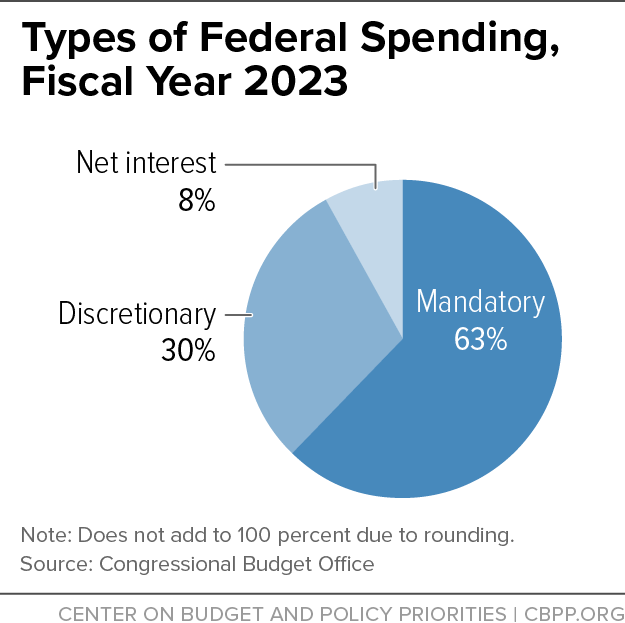
The challenge of federal spending, is that each successive Speaker has fewer pecuniary resources than their predecessors. It’s a numbers game. Check out these two figures from the non-partisan Peter G. Peterson Foundation for context:

The federal government has three primary categories of spending: mandatory, discretionary, and interest service on the national debt. Mandatory spending is established by statute in ways that prevent Congress from allocating those funds on an annual basis – they are essentially on autopilot. And it’s driven by four main categories: Social Security, Medicare, Medicaid block grants to the states, and Department of Defense retirement pension funding.

Coupled with interest on the national debt, these two categories of spending account for more than 70% of our federal spending each and every year – leaving a paltry 30% available for discretionary spending each year to fund everything else the government does:

That’s right. Everything else the federal government does, from NASA and Veterans Affairs, to managing our relations with other countries, falls into a slice of the pie that’s getting smaller and smaller. Regardless of your feelings on so-called ‘entitlement’ programs, the picture should be clear: any leader of the legislative bodies has a significant challenge in front of them – the federal budget.

And Those are the Same Challenges Facing Your Agenda…Still

I talk about these realities with advocates almost every day – yes, even on days without a dramatic contest for a top legislative leadership role. I’m consistently reminding folks of these two bigger pictures because the challenge isn’t the Speaker’s alone. This challenge faces any of us who would engage in the public policy process.

Our elected representatives drive the agenda through their institutional processes. But those processes are constrained by the reality that even we – the wealthiest country in the known history of the world – can’t have it all. And for every issue that you may care about, you have to keep this context in mind. Because you are fighting for dollars that are more dear than we often realize.

Right now, the circus of the Speaker’s race is front and center. And for the duration of the debate, it will remain so. But in a day or two, a week or two, or however long it takes, a new leadership team will be stepping into the same challenges as those who’ve come before: prioritizing what’s important through their most valuable tool – the budget.

Our task as advocates is to not get caught up in the drama and the theatrics. Those are beyond our control. What we can control is how we react to them. That’s why I’m coaching my advocates to use this time as a bonus round. We get more time to prepare ourselves for the hard work of storytelling and relationship building that comes with new members of a new congress.

Like the Stoic philosophers teach us: the obstacle is the way. This is simply a new form of gridlock. But gridlock gives us something precious: time. Time to engage, educate and recruit new champions to our causes. Focus on that and you’ll be less fazed, and more prepared to show up in a credible way for what matters most to you.

What to Say When You Don’t Know the Answer

This week I got to do what I love most in my work – train aspiring advocates. And this time, that training session was focused on an exceptionally bright, and engaged group of college students.

What they lacked in direct experience with political issues, they were eager to make up for in vim and vigor. But that shortcoming of technical knowledge lends itself to fostering a sense of real discomfort at the idea of having to go present oneself as a subject matter expert to decision-makers. That’s a pretty common feeling for advocates. So, leaning into the discomfort of in-person advocacy, I threw them into scenario-based training designed to put them on their heels.

See, that’s one of my favorite tactics. It’s perfectly natural for folks to build up pressure around the idea of going and talking about their challenges. When we think about the legislative environment in particular, we must acknowledge that it’s confusing, complex and intimidating just to go to a state capital or Washington. And when we finally do find ourselves in the physical environment of the process, the pressure of meeting such public figures only compounds the problem of personal doubt. And regardless how much we prepare, there’s almost always room for a bit of nervousness to set in.

But instead of calming the nerves of prospective advocates, I try to find their individual pressure points. I create a scenario where they have little time to prepare, and then I place them in a contentious interaction based on some of the worst behaviors I’ve seen from those in the political arena. From simple distractions like looking at a text on a cell phone, to outright confrontation with the advocates, I intentionally work them into the worst case scenario.

Why would I do that? Why wouldn’t I ease them into the work and build up to that challenge? Well, because it worked on me.

As a junior Marine officer, this was a common tactic thrown at us. We’d face ‘on-call’ missions in the schoolhouse when we’d have limited time and resources to respond to a specific scenario. It happened regularly in the field, and helped us break away from the predictability of a particular training evolution. It was such a common, and effective, approach in our experience that when I re-entered the civilian world, I was surprised to see this tool so infrequently used!

So, in my own work, I insist on bringing this particular weapon to bear. This week, it yielded a familiar result: frustration.

So many of us focus on a perfect delivery when we’re speaking. And that’s understandable. But the purpose of my training module is to demonstrate how that particular quest for perfection doesn’t get you any closer to moving the needle on your agenda. Instead, I aim to help my would-be advocates understand the need to prepare to respond to the natural moments that arise in meetings: the interruptions, the awkward pauses, the off-the-cuff responses. You don’t do that by following a script, you do it by learning to improvise. It’s the difference between playing in a classical symphony and a jazz ensemble.

As advocates progress through the module they see how even a minimal amount of thoughtful planning can help a team coalesce around their message while each individual remains free to be imperfect in the moment. But after the first contentious meeting, I almost always hear the same question from a group of trainees:

What do I say when I don’t know an answer to one of their questions?

You can almost feel the desire for perfection when this question comes up. It’s palpable. And it’s the first habit many of us have to break. I know I had to!

But we have to reframe how we define success in advocacy meetings. Too often, the pressure for perfection stems from a belief that a singular moment can deliver a win on an issue. That’s simply not the reality of the deliberative legislative process. One advocacy meeting is a link in a chain – a chain I refer to as a cumulative and iterative approach to advocacy.

When we adopt that new perspective, we can properly place our priority on one simple goal: building credibility.

Credibility in advocacy has almost nothing to do with winning an argument or a debate. Sure, those things can help in some situations. But in relational advocacy, building credibility is all about consistency in how we show up. One great trait to have when showing up is humility. And in the case of not knowing the answer to a question, the proper, humble answer is simple:

“I don’t know.” Admit it, and commit to getting the right answer to them.

I know, that doesn’t sound right. In politics, isn’t the goal to win? How does admitting you simply don’t know an answer serve that end? We wouldn’t reward a candidate for saying “I don’t know” on a debate stage, why should we treat our performance advocacy meetings any differently?

Plainly, that tale is conflating politics and policy. If you want to survive the long game of policy, you must change your definition of winning. Doing so allows you to embrace the idea that it’s better to win the person than win the debate. That’s easier to do when you treat yourself as a person too – a perfectly fallible human. Coincidentally, this paradigm shift will also help you realize it’s more important to keep showing up – over and over again – than letting the debate happen without you.

So, the next time you don’t know the answer in a meeting – at work, or when talking about your cause – give it a shot. Tell them you don’t know, but want to get back to them with an answer within the week. Not only will you actively show humility and gain credibility, you will also open the door for another touch point (aka another link in your chain).

Try it out. Then, let me know how they respond.

The Do’s and Dont’s to Survive Political Division and Help Your Cause Succeed

As I’ve chatted with advocates and volunteers since the most recent US election, one thing is clear: no one really knows what to expect in 2023. Many Americans are looking around and scratching their heads. Even those who were pleasantly surprised by the outcome are coming to the realization that we dialed up two more years of gridlock because neither major party has a mandate to govern.

But on top of that, we’re already jumping headfirst into the next Presidential election cycle.

Never willing to give up the spotlight, the pundits began predicting the 2024 contest as early as election night 2022. Unfortunately for real people, that abrupt transition is causing whiplash. As volunteers for issue campaigns sit and wait for their next bite at the advocacy apple, they may be feeling more than a bit overwhelmed in preparing for 2023 and beyond.

So what can you do? How can you set yourself up to get above those overwhelming pressures? How can you maintain your sanity and thrive through the next season of political tension?

Here are a few do’s and dont’s where you could start:

First up, don’t go it alone any more. A sad reality I see in American life is that most of us live our civic lives in a deeply private way. I get it. We keep our politics private because issues make us uncomfortable. They can reveal us as uninformed on a topic, or they can drive wedges between us and others in our lives. That’s not terribly appealing. So it’s perfectly understandable that we push our politics aside in our daily lives.

But that choice places us in a strange spot. By not finding our tribes – by staying private – we ignore a truism of the human experience: engaging with others makes us better. Even in groups of like-minded individuals, opportunities arise to expand our understanding of issues and refine how we talk about them. But by going it alone, we opt out of those chances to get even just a little bit better.

Instead, go find a tribe that works on issues important to you. Find a trade association, support a non-profit, join your local civic organizations like the Rotary. Do put yourself out there and join a team. Find the group that can challenge you and keep you motivated to keep showing up for what’s most important to you.

Next up, don’t put your hope in someone else to lead. Just yesterday I fielded a question after a speech: “how do we get better people to run for office?” I’m not sure the crowd liked my response – I told them we can’t.

It’s a free will thing. Not all politicians are bad. Not all successful people want to live with a public profile. Both of those things can be, and are, true at the same time. We cannot expect flawed human beings to constantly live up to each of our individual ideals. Instead we can live up to our end of the bargain in public life. We can own our responsibility to improve how we participate.

In 2023, do the work and own your cause. Whether it’s talking to others about the tough subjects, or actually lobbying an elected official about a bill, each of us can own showing up more responsibly in the public discourse. But that requires us assuming our role in the process. We have to become better storytellers, better relationship builders, and most importantly more consistent participants. From my point of view, in 2023 and beyond, it’s simply not good enough to blame politicians anymore. We have to recognize our reflection in their behavior.

And that leads to the final recommendation I have for you. If you really want to maintain your sanity about politics in the new year, don’t be willing to excuse yourself from the process anymore.

You have a set of experiences in this life that are wholly your own. You’ve lived with the impacts of laws in a way unique to your experience. You are the proof of what works and what can work better. But are you willing to practice the most sincere form of ownership in our public life by showing up to share those experiences in a productive way?

In 2023 and beyond, I want to challenge you to stop doubting the importance of your lived experience. Your story can be incredibly powerful. When you use it to inform decision-makers, you have a real opening to changing opinions and winning champions to your cause. Practice moving away from the sterile world of data and statistics and move toward storytelling. You’ll tap into a much more natural way of relating to people. You may even stumble onto a bit of humanity in an inhumane arena.

And ultimately, that’s the secret. If you want to be engaged in the causes that matter most to you, you have to find ways for that advocacy work to be sustainable. It has to add value back into your life, and the process itself needs to mean something to you. That begins and ends with how we – individually – decide to opt in or out of the work. It centers on our willingness to put ourselves out there, to partner with others, to accept ownership and to tell our stories.

Do that. I’m not saying you’ll always win. But that mentality will help you stay in the fight.

Stories from Congress: the one where a guy handed me a spine

Yes. He handed me a spine.

I’ll say that again.

Yes. A spinal cord. A protester once handed me a spinal cord. There I was, offering a friendly smile, and the guy hands me a model spinal cord – thinking he was about to embarrass me into agreeing with him on an issue.

You have questions right now, I’m sure. Let me back up.

It was 2017, and Congress was in the middle of a major national debate over healthcare reform. Citizen groups were mobilized trying to influence decision-makers on both sides of the issue. In-person protests, letter-writing campaigns, phone banks – you name the grassroots tactic, they were all doing it all. Some went as far as physically occupying offices of members of Congress in a variation of the classic sit-ins of the civil rights movement.

I don’t blame them. For activists along the entire spectrum of this one issue, there was a narrow opportunity to impact national policy, and everyone felt the urgency.

As a congressional staffer at the time, I was right in the middle of this at the local district office. We were the team closest to those local advocacy groups – and that made us the focal point of much of their activity. Which brings us to one activist in particular – let’s call him John – who thought he’d try to embarrass us with a bit of gotcha activism.

You see, John thought it would be effective to hit me with a zinger. Just days before the vote, he joined a rather large group in our office. And he brought a model spinal cord.

“I brought this as a gift for the Congressman because it seems he doesn’t have a spine of his own.”

Activist “John”

John was well-intentioned. And certainly memorable. But he also made the mistake activists often do: he forgot the real world isn’t Twitter.

Too many activists fall into this trap. When we disagree with someone, we’re too eager to score quick points by embarrassing them. It can take a lot of forms. We try to trip them up in their words so we can make them look ill-informed. We even go so far as to call their character into question. Because we are so focused on winning the argument, we forget that the business of advocacy isn’t about the argument – it’s about people.

In that moment with John I was certainly taken aback (see what I did there?). Not because anything that John had said was compelling, rather because this guy had taken time out of his day to participate in the process just to throw all of that effort away with a single, bizarre joke. In a moment with someone he was aiming to influence, he chose this?!

As I look back on it, I think that’s the moment I realized I needed to help people understand this work better.

You see, John was simply playing an extreme variation on a theme I’ve seen far too many times. He was so focused on demonstrating how he disagreed with a stance on an issue, he forgot to try to bring me to his side of the issue. He became memorable not for the story he could tell about the issue, but for perpetuating the use of crazy antics.

In the real world of politics, our goal cannot simply be to get under the skin of the other side. Our goal must be the pursuit of real connection that allows us to win champions to our cause.

After the group of protesters left that day, I made sure to reach back out to John. Legally I had to – the value of the spinal cord model exceeded the financial limitations of the US House of Representatives gift rule. But more importantly, I wanted to give him a chance to come in and really share his story.

Real people deserve to be heard by their representatives. Too often, advocacy organizations spin their volunteers into a frenzy and cheer when they see moments like this one occur. I don’t like that. I don’t like them using people.

John had some serious concerns. He had some issues that needed real, immediate help. Help we could provide outside of the legislative process. Help making sure his insurance company was held accountable. Help with benefits claims. And a lot of help in simply being a place he could finally be heard above the cacophony of all that “activism.”

I sat down with John for more than an hour. I told him up front that it wasn’t likely to change how my boss was going to vote – because he deserved to know that. But I also wanted to hear the rest of his story when he didn’t feel the pressure of the group so maybe we could find some common ground to work together. Oh and I returned the spine.

Too many people out there are being pushed to participate in our system in the wrong way. John – from my point of view – was a prime example. When we spoke one-on-one he was a deeply thoughtful advocate for his cause. He raised some personal perspectives on the issue I hadn’t heard before. With time, we could have maybe made some real progress on that common ground. But I never saw John again.

For whatever reason, he opted out of the process. I hope he felt heard – but I doubt I’ll ever really know that. If I saw him now, I’d tell him he only made one catastrophic mistake – and it wasn’t handing me a spinal cord (that certainly got him noticed).

No, John’s only critical mistake is what came later – he never showed back up. He didn’t buy into the idea of cumulative and iterative advocacy. Despite having a personal connection at that point, he chose not to dive in further. That’s fine. It’s his call. But when that door is open to you, I hope you’ll show some real backbone and keep showing up.

A Beginner’s Guide to Building Credibility: Stop Using This One Word if You Want to Win Champions to your Cause

Credibility. Credibility is the foundation of becoming a more effective spokesperson for any cause. How we pursue credibility is a fundamental trait that separates advocates from activists. Effective advocates hunt for opportunities to build their credibility.

Yet finding ways to develop credibility is also one of the most common challenges I hear from the prospective issue champions I train. So many of them have one common desire: to be just a little bit better, have just a little sharper edge so their solution to a problem can stand out above the rest.

So how do you get even just 1% better? How do you become even just 1% more credible? Would you believe me if I told you it’s as easy as eliminating one word from your vocabulary?

Through my late twenties and early thirties I worked for members of Congress. I can’t even begin to count the number of regular folks I met with over the course of that near decade of service. Even though the vast majority of them were NOT professional lobbyists, there they were showing up time and time again for the cause.

That, in and of itself, is commendable. But it’s just the first half of the battle. The rest of the battle centers on how we demonstrate our value as a partner to our targeted decision-makers. We do that by striving to earn credibility in their eyes.

But that can seem…well…a bit daunting. It doesn’t have to be. You can absolutely begin building your credibility with small changes. And where I like to train advocates to start is very simple. We ban the word ‘should’.

‘Should’ may not seem all that harmful to you. After all, how often do you use it in your daily conversations? I’m betting there’s a chance it slips into your dialogue fairly regularly. So why would it be holding advocates back as they weigh in on their issues?

‘Should’ is a cornerstone of normative statements and normative thinking. If you’re not familiar with that term, here’s the gist: normative statements make value judgments – and value judgments, held in the opinion of the speaker, cannot be tested or verified as ‘true’ or ‘false’. They are, in essence, statements about how we individually perceive a perfect world. Here’s an example – “interest rates are too high and they should be brought down.”

If I’m a congressional staffer listening to you utter that line, I’ll undoubtedly have some follow-up questions. Too high compared to what? How far should they be brought down? What’s the value added if they are brought down? I may agree with you, but to be a credible advocate for action, I need more. I need verifiable, credible information that can support the argument. I need to know that you as an advocate can provide it to me. And if you can’t do that in the moment, I need a reason to believe you’ll follow through on delivering it to me later.

It’s our natural inclination to try and capture moments. We want to use powerful language. We want to win the moment. Winning feels good. But we also need to re-think what that win really means.

Credible trumps clever. When we take a longer view of advocacy, it becomes easier for us to realize that winning the moment may lose us an opportunity to bring a new champion to our cause. Speaking in powerful, normative statements of how we think the world should work can actually engage our listeners in an unforeseen way. It can back them away from our issue.

Normative statements declare to the listener: this is the way I think works best, and if you don’t agree you are wrong. We are unconsciously backing our targets into a corner. We’re limiting their choices, and not in a positive way that could drive them to our side of an issue. We’re likely putting them into a defensive posture. By banning the concept of normative statements when engaging in advocacy, we can instead force ourselves to take on a posture of compromise. We open the door to collaborate instead of dictate.

That is a much harder route to follow emotionally, but it’s a much more fulfilling route to take when we are seeking credibility. By looking at our default language, and challenging how we deliver our message we can flip the script. Instead of backing others into a corner, we can begin inviting them into a coalition.

I know it works because I’ve seen it work in myself. I used to speak boldly in normative tones. It was really helpful in partisan politics when motivating members of a base. It didn’t serve me well when I first moved into professional advocacy. On the other side of the table I was able to observe the reaction of colleagues to those normative assertions. It wasn’t good.

As I did the work on knowing my issues better, learning this one approach altered how I digested information and how I engaged with differing views. It’s made showing up for my causes easier – and that’s kept me energized in campaigns that drag into year after year. That kind of stamina is what you’ll need to start banking credibility. And after all, credibility is the name of the game.