Advocacy Meetings 105: Build a System

As I think about the advocates I’ve trained through the years, there’s a certain trend that sticks out to me. In the period leading up to an advocacy event, volunteers often project an air of confidence that evaporates the moment we walk into the actual meeting. When face to face with their target, the sense of self-assuredness fades away and a few things almost always follow.

First, they lose control of the clock. They allow themselves to dwell too long in the comfort zone created by exchanging pleasantries, and before they know it their time is up. Secondly, they will often bury their ask, rushing to squeeze it in at the end and not allowing time to tell their story. And finally, they fail to get personal in their storytelling, defaulting to the pre-approved talking points. This last one leaves them sounding like an automaton and negates the real value of their lived experience with an issue.

Does this sound familiar to you? Even outside of the advocacy realm, I think these same trends have a tendency of popping up in meetings across industries. Are your business meetings dragging on too long? Are too many precious moments wasted before you get to the meat of your discussion? Are people just reading their PowerPoint slides verbatim?

I don’t know a single person who likes when those things happen. So why don’t we change it?
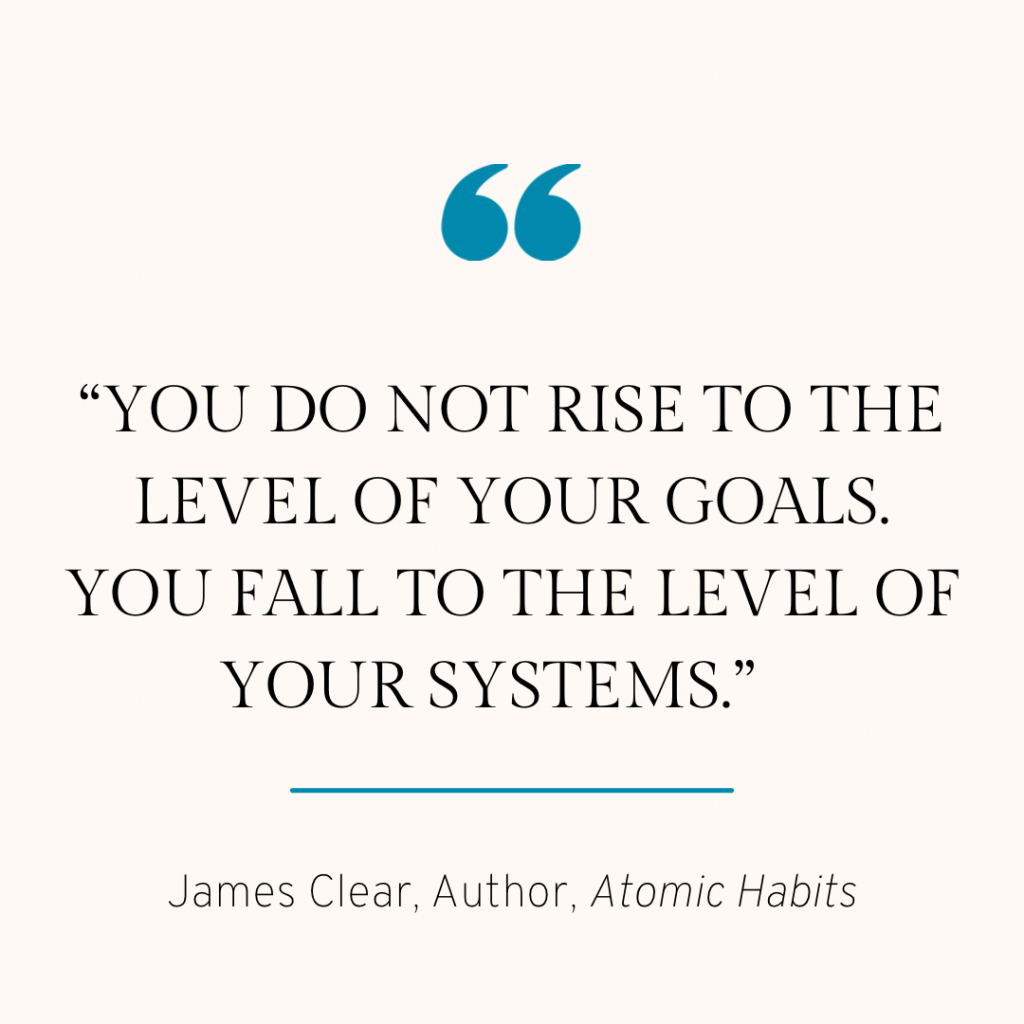
So much of the content we consume to improve ourselves directly translates to the work we do to serve others as advocates. Case in point, the quote above from Atomic Habits: An Easy & Proven Way to Build Good Habits & Break Bad Ones. Creating a streamlined systems approach to planning and executing conversations with key decision makers can empower you, and your volunteer advocates, to remain focused and deliberate in your advocacy work. Here’s how:

You Eliminate the Guessing Game

Building a systems template for your meetings will allow you to train your advocates to sing from the same sheet of music. When the key points of a meeting are mapped out and duties are assigned, each member of your team can maximize the value of their participation by specializing in an aspect of the meeting. You can identify who will introduce the BLUF (see this previous post for more on presenting your Bottom Line Up Front). Each team member will know who is telling the impactful story. You can gain confidence that one key player will deliver the ask no matter what. These are the basics that deliver meaningful results in any meeting.

When you get really good at that, then you can systematize your follow up work as well. In the Marines we’d call this an After Action Report, or AAR. A good AAR for professional meetings – advocacy or otherwise – will identify the who, what, when and, most importantly, the why of any follow up actions that need to be taken. All of this eliminates the confusion that so often plagues advocacy organizations before, during, and (critically) after your advocacy day.

You Create Room for Personal Stories and Improvisation

A quality systems approach to advocacy meetings frees your team from the burden of talking points. You know, those pesky bullet point riddled one-pagers that try to distill complex issues into snappy sound bytes. Guess what, talking points aren’t nearly as effective as a good personal story that’s relatable to your target.

A sound approach to meeting planning assigns key responsibilities, affording your team that opportunity to specialize. In advocacy, that means you don’t have to expect every team member to become an expert on delivering statistics and talking points. Instead, they can zero in on key functions. By identifying each team member’s role in advance, you can build meaningful opportunities for practice sessions into your preparation.

I’m confident that those substantive rehearsals will take you a lot further than a perfectly crafted talking points memo. They will allow your team to develop a message built on their own skills – and you need to embrace that improvisation. [If you need help in crafting that kind of resource, be sure to connect with me by sending an email to luke@partofthepossible.com and subscribing to my email list below.]

You’ll Have More Actionable Feedback

This is the intangible of advocacy work. It’s rare that you’ll get a verbal commitment on an issue in any given meeting – unless the target has a clearly defined public policy on the issue already. Because of that rarity, it’s difficult to always capture just what constitutes a “win” for a given meeting.

But a systems approach can empower your team to identify your best listeners. Those folks can facilitate the crucial clarifying moments of a meeting. They can help you close by making sure your team re-states your ask. They can reiterate any offers you’ve made to assist the target with a problem. And most importantly they can identify a process and timeline for following up on the discussion.

Advocacy is nothing without follow through. Unfortunately the “fly by the seat of your pants” approach does nothing to facilitate that follow through. A basic plan for meetings can make all the difference – and if you need help getting there, sign up below and get in touch.

Go back

Your message has been sent

New posts to your inbox

Warning
Warning
Warning.

Looking Back, Leaning Forward

It’s that time again. Tomorrow we celebrate the incoming new year, and bid adieu to 2021. Yep, another one in the books. A big year of growth for me, and I hope the same for you.

In keeping with the custom of the season, I thought I’d use today’s entry to look back on a few of my favorite blog posts from the past year. So here goes!

Do you remember how the year started? Probably. We all spent some time processing the acts of violence we witnessed at the US Capitol. In this post, I shared some personal history with the Capitol complex.

But it wasn’t just my work this year. I was proud to host posts from my good friends, Abe Jacob and Tyler Ferhman. Both are committed to the people they serve. Abe shared some insights on leadership in public office. And Tyler wrote about the importance of putting people at the center of our politics.

In August though, the country was reeling again in the wake of the Afghanistan withdraw. While I shared this post, friends and fellow Marines were still manning the watch in country. We held our collective breath for weeks as we waited for Americans to make it home safely.

There was a lot of content to sift through from 2021. But through everything that transpired in the year, I’m proud that this blog became a resource for aspiring advocates. I’m thrilled that, week after week, I’ve been able to share posts like this one that help folks become more involved in fighting for their issues. I’ve heard from more than I could have imagined that the posts here helped them keep focused, and make improvements in their work. That’s what this is all about.

As I’m writing this, I’m overwhelmed with gratitude. Gratitude for each of you reading. Gratitude for my peers contributing and encouraging me along the way. Gratitude for countless new friends made in just a short time. Gratitude for being nationally recognized within my field by contemporaries across the country.

2021 was big for me. I hope it was for you as well. But we have a lot of work ahead of us in 2022. Another important election will just be one part of it. Along the way, I hope you’ll keep checking in – I’ll be here to serve you. And in some new ways to boot.

Until then, a happy, healthy, and prosperous New Year to each of you!

Three New Year’s Resolutions to Survive the 2022 Election

Well, we’re here again. Looking forward to a new year and all the potential it brings. It’s a great time of year. We’re waking from the holiday coma, striking out on new adventures, and pursuing new goals. What a season!

It’s no different in politics. After an end of year respite, those in advocacy are gearing up for what’s next. In 2022, that means a year full of speculation over what will happen next November. We’ve got 10 full months ahead of us when pundits and politicos will tell us just how crucial this election is. I have a prediction: more than a few will say this is the biggest election in our history.

But for those just seeking to stay informed and not inundated by politics this year, I think a few key new year’s resolutions might help you keep a level head in 2022. Here are my top three.

Follow the Consumers, Not the Polls

Polling results will maintain their ubiquity in the coming year. We’ll hear leaked internals as candidates jockey for position in contested primaries. We’ll endure every West Wing fan’s favorite “right direction/wrong track” language. And more than a few times we’ll watch campaign representatives dodge questions about underperforming expectations. Polls will be everywhere.

At the same time, they’ll take you no where at all. That’s because the only poll that really matters happens on Election Day – and that’s a long way off. So how can you reliably gauge where people are this year? Focus more on financials – and I don’t mean just the stock market. Pay attention to a couple of key indicators where you can: are people spending more, or saving more? Are they investing in their businesses, or shoring up reserves? The answers to those questions will tell you a much more honest picture of just how Americans are feeling.

How we spend our money reveals our level of optimism for the future. If you want to feel informed, watch those trends.

Make It About Your Bottom Line, Not the Party Line

This resolution will be tough for a lot of folks this year. Big elections always draw on our propensity to marginalize, even demonize, the other side. After about mid-May you’ll be hard pressed to have a meeting that doesn’t get sprinkled with partisan commentary. Commit yourself now to not take the bait.

Your issues deserve the best delivery you can provide, to any party willing to listen. Avoid unforced errors by practicing your talking points so you can steer clear of improvisation induced faux pas. Build in clear asks, get yourself right to the point, and tailor your stories to the audience. If you need more on this, look back through my recent posts on advocacy meetings (starting with this one).

Build at Least One New Bridge

There’s no better way to advance your agenda than to build broad, diverse coalitions to support your cause. Building new relationships – especially those that span the political divide – are always in season. Unfortunately major election cycles force too many to find greater differences with their neighbors than commonalities. That kind of thinking will make successful advocacy darn near impossible in 2022.

Instead, commit yourself to identifying one (yes, even just one) group outside of your network and start a conversation with their team. Share a meal, talk about your goals, and see if there’s even one item out of ten where you can support each other’s legislative endeavors. That’s the real work of successful advocacy organizations. They reach beyond their sphere in a concerted effort to grow their influence. You should too – especially in a year when you’ll be pushed and prodded toward partisanship.

Bonus: Subscribe to My Email List

Listen, I’m simply not above shameless self promotion. But more importantly, I want to be of service to you in the coming year. I want my content to help you – whether you’re involved in advocacy, looking to develop new soft skills, or just need a balanced perspective on current events from time to time. The best way to stay connected is to get on my email list. I’m committed to only sending you ONE per week, and they’ll have the links you need to survive another wild election cycle.

In November 2022, I don’t want you feeling like you’re still guessing how to recover from another whirlwind year in politics. I’m aiming to provide you with some new resources this year. New content, in new formats that, I hope, will add real value to you. So, do the thing and sign up here!

Go back

Your message has been sent

New posts to your inbox

Warning
Warning
Warning.

Dear Santa, Check Your Flight Plan

In a couple of days, eight tiny reindeer had better check their six if they’re anywhere near French Guiana in the 7 o’clock hour (EST). If their flight plan has them remotely nearby, they may just get caught on camera.

That’s because the entire space industry will be keenly watching the sky as the work of decades culminates, and takes flight on an Ariane 5 rocket.

The James Webb Space Telescope (JWST)

The James Webb Space Telescope, the next generation of satellite observatory.
Credits: NASA/Chris Gunn

For the last quarter century, the astronomical and astrophysical communities have toiled away on a project you may have never even heard about. They’ve built, scrapped, re-designed and finally completed the successor to the vaunted Hubble telescope. And this successor is impressive.

Nearly tripling the lens size of Hubble, JWST will be able to observe the physical universe in a broader spectrum, promising to dramatically increase our understanding of our galaxy and the cosmos. It’s massive compared to Hubble. But size isn’t everything.

Even in the expanses of outer space, it’s all about location, location, location. For JWST, that means parking in a solar orbit at the Sun-Earth Lagrange (L2) point about 1 million miles from Earth. That position, more than four times distant than the moon, will allow JWST to orbit the sun in line with the Earth. That distance, and a really awesome sun shield, will keep the satellite protected from the light of the Sun, and it’s reflection from the Moon and Earth.

Keeping all that light away will help the satellite see further, and observe more detail in our night sky than humanity has ever accomplished before. But the distance means we won’t be able to just send a few Astronauts up to conduct repairs like the shuttle did for Hubble. Hence the quarter century of delays.

A Bumpy Road

JWTS has to be a survivor.

More than just a fiery ascent into the heavens stands in its way. After the shock of launch, the telescope will have to endure a substantial trip (30 days) to its intended orbit at L2. And even after it arrives, the struggle isn’t over. It will spend an estimated 5-10 years in temperatures around 50 Kelvin (that’s -370° F or -223° C).

For those of you wondering just how cold that is, I’d tell you that at those temperatures Midwestern males would no longer wear gym shorts with their hoodies. No way.

Those extreme environments – launch, transit, and operational orbit – all require a different type of survivability. It’s taken a long time to get to this point because the developers know they have to make this system resilient. After all, it’s beyond our current human spaceflight capabilities to send folks to L2.

Image Credit: NASA

How You Can Watch

By now you may know I love a good rocket launch. And this one should be pretty cool – if not the biggest, most powerful rocket. This one will stand out because of the unique way it’s bringing international partners together.

JWST is a partnership mission between NASA, the European Space Agency and the Canadian Space Agency. That partnership is working hard to make sure people all over the globe can have a piece of the action. They’ll be hosting live coverage on NASA TV, Facebook, Twitter, Twitch, Space.com and Daily Motion.

If you think you’ll be able to pull away from presents for just a moment on Saturday, I’d encourage you to hop on one of those NASA channels and witness a little history in action. And who knows, you might see a few reindeer.

Constituency of One

In yet another bizarre twist, real life politics is once again imitating art. Yesterday, talks about the Build Back Better Act derailed in Congress with the announcement that West Virginia Senator Joe Manchin would not support the legislation as currently written. If I wasn’t paying attention, I would have mistaken the entire day for an episode of The West Wing.

For those watching the progress on this bill, yesterday’s news shouldn’t have been a surprise. Senator Manchin’s messaging has been consistent from the beginning. He’s wanted the Congress to pursue these proposals through regular order and earn Republican buy-in through the committee process.

That’s not an unreasonable stance – but it is one that has him squarely in the crosshairs of some in his party. Such procedural demands would force the negotiators to reach a 60 vote majority instead of a preferred simple majority route available through budget reconciliation.

Here’s the problem: threats and pressure aren’t the way to work with the only statewide Democrat officeholder in the Mountaineer state. That’s a big mistake – especially at a point when West Virginia Republicans have taken a lead in voter registrations in the state, their first time doing so since 1932.

Yes, you read that right. As recently as 2018 Democrats still held a registration advantage in West Virginia, despite Donald Trump winning the state by 42 points in 2016. Now, that tactical advantage has been erased – and Joe Manchin looks a lot like a one-off character from my favorite show.

I present to you, season 5, episode 5 of The West WingConstituency of One. In that episode, White House staffer Josh Lyman calls an audible on how to pressure a fictional Idaho Democrat into supporting a key piece of President Bartlet’s agenda. By the end of the episode, the play falls apart around Josh and the targeted Senator leaves the Democrat party. More than just egg on his face, the professional and political fallout from this move sets up Josh Lyman’s eventual departure from the White House.

Now, watch this quick clip from some of the coverage of Senator Manchin yesterday.

“This is staff. And they drove some things, and they put some things out that were absolutely inexcusable.”

Senator Joe Manchin

That quote sounds an awful lot like someone’s audible play call falling apart around them.

I don’t think Senator Joe Manchin will leave the Democrat party, and that shouldn’t be your takeaway from today’s post. What I do think is that he cares deeply about the future of the party of FDR and the New Deal. The same party that no longer holds a tactical advantage – like, ahem, voter registration – in a state that used to run reliably blue.

Say what you want about the Senator from West Virginia, but from my outsider vantage point he’s operating with an infinite mindset. It’s not about winning one piece of legislation, but rather working to build an alternate proposal that can draw support across the partisan divide. That may not be sexy enough for some, but the practice has a track record of delivering substantive measures with sufficient public support to outlive a given political moment. Those kind of wins are the stuff of legacy building.

Unfortunately for the administration, staff are seemingly more concerned about a finite, short term victory than building the future of their party. That mindset won’t serve them well in the long run.

I have a feeling Joe Manchin is on the right path, and his party would do well to listen a little more, and mock a little less. With congressional retirements, a lagging economy, the looming threat of interest rate hikes, and a third year of COVID in the making, Democrat leaders and staff alike would do well to look beyond the finite moment and consider the position of their party beyond the 2022 midterm election.

Joe Manchin seems to be doing so, and that makes him an incredibly valuable constituency of one.

Advocacy Meetings 104: Know Your Ask and Get to It

I had a healthy reminder in a meeting with a legislator recently. The group I was with was a bit…long winded…when it came to introductions. Which prompted a question I hate to hear from the elected official: “so, are you going to tell me why you’re here?”

You could immediately feel the momentum of the meeting shift. Advocates who were relatively prepared were taken off their game. They realized, a bit too late that they’d erred.

To the official’s credit, they were in no way rude – but it was clear we’d seen some precious time wasted. In advocacy meetings, this is nearly a sin. Managing the clock and maximizing the value of your target’s time is one of the simplest ways you can add value for decision makers. When we don’t, our efforts suffer.

That’s why it’s so important to know your ask, and build a plan for your meeting that allows you to get right to it. I call this meeting hack the BLUF.

The BLUF is an acronym well known to Marines everywhere. When we talk about a BLUF, we’re saying Bottom Line Up Front. That one acronym reminds us that the time we have to discuss a problem is finite, and we need to get folks thinking about the answer to that problem right away. It helps us identify and understand just what is most important for the meeting. It helps the listener understand just what we need to decide for the exchange to be successful.

Successful advocates will inherently know the value of a good BLUF. It helps set the tone for a meeting early, and allows for a planned transition away from pleasantries and toward business. The really beautiful part of a BLUF though, is that you don’t need to overthink it. Here’s what I mean:

Legislator: “Thank you all for coming in today, what brings you in?”

Advocate: “Thank you for having us today. I’m a volunteer advocate for [organization], and I’m here to ask you to vote in favor of HR 1234 that will help fix [problem].”

Yeah, you read that right, it really is that simple. A good BLUF will concisely allow you to introduce you or your team, what you want, and the specific action you’d like that decision maker to take. Let’s break it down.

Get Yourself Out of the Way

Advocacy is deeply personal. Taking the step to participate and lobby for change puts you into the ring. It’s also likely to draw you right into telling your own story. There’s nothing wrong with that – but you need to have a plan on how you’ll get there without forgetting to give context to the conversation.

Your BLUF is a critical piece to that plan. It forces you to state the matter up front, and save your story for later. Stories are powerful – but they don’t serve us well if we never get to our ask. The elected official, and their staff, are going to take better notes at the top of the meeting. Putting your BLUF ahead of yourself capitalizes on that limited window.

Know Your Ask

On the surface, this comes across as more plainly obvious than it seems to be in practice. I can’t begin to recount the number of times folks came to me as a staffer, demanding change, without knowing what they wanted to accomplish. Worse yet were the times when they’d be seeking help outside of our constitutional lane – limiting our ability to assist them.

A little forethought goes a long way in advancing your agenda. If you’re meeting with a legislator, is there already a piece of legislation you can ask them to support? Or do you need them to craft a bill? When talking to an executive agency, are you seeking a rule change or help navigating a bureaucratic issue? Knowing the problem, and crafting an achievable outcome relevant to their position will help you stand out in the crowd.

Keep it Simple

The best BLUFs, though, boil the problem down to a yes or no proposition. It can’t always be as easy as asking them to vote for or against an issue – sometimes there’s a lot more to the ask. This is especially true when you’re bringing a new problem to someone’s attention.

But where you can, the ask you make should be as simple, and straightforward as possible. Stating “I’d like you to vote in favor of Bill X” is a concrete, tangible ask. It narrows the scope of the meeting and propels you into an opportunity to share your story about the issue by getting the meat of your meeting out of the way.

A Good Habit

Getting good at BLUFs takes work. It’s a practice you have to internalize through repetition. Luckily, it can apply in just about any meeting setting – not just advocacy.

I’d challenge you to find a way to incorporate BLUFs in other professional communications. I often include a BLUF at the beginning of an email that runs longer than I’d like. It’s an easy way to grab the right attention at the beginning of the text, and before you ask the reader to dive in. Little moves like this are going to help you develop a keener sense of the value of time in your professional communication and your advocacy work.

Let me know how it works out for you!

What we get wrong about optimism

“You’re being a bit optimistic aren’t you?”

Even though I’m far from the bubbliest person, it’s a question I’ve heard quite a bit in life. It comes most often from people who think I’m being naive about a given situation. Maybe they’re right. But a lot of times they are wrong. I think I know why.

There’s a misconception about optimism. We’ve conflated it with a sense of toxic positivity, even effusive happiness. But optimism has almost nothing to do with how we feel, how we emote, in a given moment. It’s not an emotional response to stimuli, it’s a purposeful belief.

“Thou must be like a promontory of the sea, against which though the waves beat continually, yet it both itself stands, and about it are those swelling waves stilled and quieted.”

Marcus Aurelius

In my view, optimism is rooted in a very simple assumption: regardless of the moment you face, a brighter future is yours to create. It’s this implacable belief that allows you to weather the swelling, beating waves of Aurelius’ allegory above. Even if those waves are a tough Monday with stale coffee, a bad commute, and a head cold.

Sure, all of those things suck. But you don’t have to be trapped in an emotional response to those external factors that saps your energy. The trick is finding your just cause, your vision, your something that moves your mentality beyond the current moment.

Advocacy work is full of moments that can tear you down. A bill fails to get traction. A regulation gets proposed that could cause a set back for your industry or mission. An election upends your agenda. All of those, and many more, are moments ripe for a negative emotional response. But an optimistic, future oriented mindset will help you move past the crisis.

Such a mindset will also help you better embrace the process of your work. As a volunteer, it will help keep you grounded for the long haul. As an advocacy manager, it will help you ditch reactionary approaches and move toward proactive processes. Strangely enough, when you do that you’ll likely start seeing more wins too.

I’m not an optimist because I always win. I have more chances to win because my optimism keeps me moving forward.

I’m not an optimist because I’m happy-go-lucky. I’m an optimist because it makes my work worthy — worthy of the time, worthy of the effort, worthy of my pride.

I’m not an optimist because everything is right in my world. I’m an optimist because it’s in our power to change what’s wrong.

If you’re feeling down, especially here at the end of the year, it’s time to change the way you think about the future. A few weeks ago I recommended a simple approach, one that can put you on the path to a more optimistic mindset. I hope you’ll spend the waning days of 2021 in gratitude, and work on unlocking that optimism available to all of us.

Advocacy Meetings 103: Be of Service

Do you find yourself feeling a bit nervous when you think about sharing your thoughts with others? I’d bet that same nervousness strikes if you even think about sharing your views on politics – especially with an elected official.

Let’s start with the good news.

You’re Not Alone

Choosing to participate in our system of government is, well, intimidating. That intimidation starts before you even get in the door. The architecture of our capitols alone causes us to take pause. The buildings, let alone the people working in them, can be overwhelming. And in that suffocating setting, average joes and janes find themselves preparing to spar over the issues of the day.

For many, it would surely cause the yips just thinking about it. We fret over the smallest details, determined to be perfect in our delivery, flawless in our messaging. But what if I told you there was an easier way to take the edge off those nerves? That’s the better news.

Be of Service

If we admit to ourselves that talking politics is daunting, we can start to find ways to get past that hang up. The trick to overcome that feeling? Plan to position yourself to be of service to your target. Help them meet a need.

Politicians – despite what we say about them – are people too. They, and their staffers, have goals and priorities just like we do. And they are always in need of people willing to participate in the process to refine those goals and work toward accomplishing them. Where those goals align with your priorities and your mission find a way to help.

It doesn’t require what you may be thinking. You don’t have to host an event, testify before a committee, or contribute financially. There are simpler ways.

Can you connect that official with people in your network who are championing similar work?

Are you willing to provide your story to a staffer to help them capture the narrative surrounding that goal?

Can the decision maker come visit your business to hear from others facing the same challenge?

You’d be surprised how few of these opportunities are presented by advocates. For some reason, many of us assume that a politician doesn’t need our help. But that’s simply a false assumption.

The job for an elected official is almost always bigger than we think. There’s the day-to-day tasks, sure. But it’s the other things – the campaigning, the fundraising, the community events, the conferences – that make the job so much more.

When you consider the size of their constituencies, and the budgets that limit their staff, it’s an impossible puzzle for them to solve. They simply can’t think of every group, and every outlet they can pursue to advance their agenda. A little help goes a long way toward building trust.

To stand out as an advocate, help them bridge that gap.

The side benefit for you is pretty incredible too. People think politics is a shameless self promotion game. But volunteer advocates often struggle to keep asking for more. It adds undue, nerve wracking pressure to always present a problem. And that pressure causes fatigue, and eventually burnout.

As you plan your advocacy meetings, spend some time thinking about an offer you can make for that decision maker or their team. If it’s a new relationship you’re building, you may not have enough information to do so – but what a great conversation starter! I think you’ll find yourself feeling more empowered than before – and a bit less intimidated.

Bottom line: if you don’t want to be nervous, find a way to be of service.

Advocacy Meetings 102: Your Story Is Your Superpower

Don’t tell any of my lobbyist friends I said this, but more often than not a volunteer advocate holds greater sway with elected officials than a paid lobbyist.

Constituencies are inherently important to politicians. Losing touch with those they represent is usually the short road to losing the next election. This pressure to connect can quickly forge a bond between elected officials and those constituents who choose to show up and participate in the process. The volunteer advocates who do so can often enjoy an outsized level of influence.

Successful advocacy organizations know this and place their volunteer advocates in positions to be present in front of elected officials. They remove the focus from their paid staff and shift it toward those they serve.

But don’t worry, the pressure isn’t as severe as you may think – you don’t have to become the subject matter expert on every aspect of a piece of legislation. In your role as an advocate you have two main duties: establish trust and tell your story.

Trust building takes a long time. It takes participating in the full spectrum of advocacy: educational events, campaign support, volunteering, etc. But telling your story is the superpower you can tap into right away to convey your issue, reinforce the organization’s messaging, and influence decision makers.

In the course of an advocacy meeting, at least one volunteer advocate should be sharing a quick story. By that I mean a narrative that shares a current problem relevant to the elected official’s work, its impact on the volunteer, and what benefits could develop if a change occurred. The more tightly you can convey those points, the more effective your meetings will become. Don’t worry, there’s a formula you can follow:

Act 1: Tell Where You’ve Been

It’s simple – start with the way things were. This is your “once upon a time moment” where you can relay the conditions of your life, business, neighborhood, etc. You start with the status quo and share it in simple language, with an aim to connect it to the listener’s own life experiences. Connect with them as parents, business owners, public school students – whatever makes your status quo relatable to them will make the change in conditions that much more personal for them.

Act 2: Explain What’s Changed

For whatever reason, a change in the status quo has, or will have, occurred. After all, if everything was a-okay you wouldn’t be there would you? Quickly convey the specific problem that has arisen from the change (e.g. you can’t stay in business, a medical condition arose, your children are at risk). Because you shared a relatable condition in act 1, the listener can now picture the problems you’re experiencing in their own way. It’s now relevant to them, and they can surmise how other constituents may be affected. You’ve touched on what matters.

Act 3: Share How They Can Help

But it’s not good enough to leave it at the problem. You have to propose some kind of specific action. If there’s a bill to address the issue, ask them to co-sponsor or vote for it on the floor. If you’re seeking help with the bureaucracy, ask for them to help you inquire into the matter. If you’re requesting a letter of support, provide them sample language they could adopt to stand with your cause. It’s not good enough to just present a problem, you have to provide a solution they can embrace.

You Don’t Have to be Perfect

Never let the perfect become the enemy of the good. You may be a terrible narrative storyteller – I sure am. But if you can make it relatable to them, relevant to their work, and provide a course of action you’ll be more engaged than 9 out of 10 people. Easily.

Most people don’t show up in politics. Most never participate beyond voting in elections. You, as a constituent and volunteer advocate, benefit from tremendous credibility by simply joining the conversation. You aren’t required to have all the answers. But you do have to tell your story. It makes all the difference.

The Real Reason We Can’t Pay Attention to Politics

In a bit of good news, it seems more Americans are at least claiming they’re paying closer attention to political news. A recent study by Gallup showed 38% of respondents say they are following political news “very closely”. That’s up from most years without a presidential election.

The not so great news though is this: the remaining 62% fall somewhere along a political attentiveness spectrum of “somewhat closely” to “not at all”. When you dig deeper into the numbers you see less than 1-in-4 of those under the age of 34 are paying “very close” attention to political news. Their elders are a little better with just shy of half saying they follow politics very closely.

I promise this isn’t a hit piece on younger Americans. Rather, it’s a challenge to the rest of us to not simply chalk up their lack of attention (or our own for that matter) to vapid obsessions with TikTok and Instagram fame. There’s a bigger reason. And, like all the finer things in life, it’s got an acronym.

VUCA

Volatile. Uncertain. Complex. Ambiguous.

First coined during the Cold War, propagated by the Army War College, and now returning to the more fashionable circles of leadership and management training thanks to COVID, I think it holds some promise for informing advocacy organizations on how we can better engage our volunteers. Hear me out.

VUCA represents the four conditions that ultimately degrade our ability to pay attention and problem solve. Those conditions, when in play, trigger our threat and stress responses, negatively impacting our mindset. That degradation brings on what we Marines would call the “fog of war.”

Our brains are incredible – but they take in way too much for us to process at all times. So the brain filters things out – and our attention is drawn to the most pressing triggers around us. In VUCA situations your brain becomes overwhelmed with all the stimuli and you zero in on what’s closest to you – unfortunately you can only do that for so long before your attention span diminishes beyond a point of positive return. When that happens, your brain tells you to move on, and to pay attention to something else.

American politics is the perfect arena for long term VUCA exposure

Think about politics as you read these abbreviated descriptions.

Volatility: the rate of change in a given situation. The challenge faced can be unexpected, unstable, and of unknown duration.

Uncertainty: a lack of clarity surrounding the here and now. Change in the situation is possible, but not guaranteed.

Complexity: the situation encompasses multiple variables that are often interconnected. The volume of information about the problem can exceed your ability to process.

Ambiguity: the situation doesn’t follow a clear cause and effect pattern. The situation can have you dealing with issues outside of your core competencies.

As you think about your own participation in politics, do these conditions sound familiar? Even the pursuit of passing a single piece of legislation can touch on each of these conditions. Couple that with the sheer volume of issues being publicly debated and you have a recipe for disaster when it comes to our attention spans.

For individuals and advocacy organizations alike, the VUCA conditions lead us to a point where we tune out. We opt to “let someone else worry about it.” And that shouldn’t be surprising. It’s also not the end of the world.

Our system is built to facilitate that detachment so we can pursue our own private ventures. We leverage a republican (small r) form of government that allows us to entrust navigating those particular VUCA stressors to public servants. It doesn’t always work perfectly, but it certainly has its benefits.

Help Your Advocates Step Away

If you’re an individual feeling like you just can’t keep up with it all, here’s your takeaway: you’re not alone. Our politics are clearly volatile, uncertain, complex and ambiguous. If you find yourself rationing your exposure, take a moment to thank your brain for helping you filter some of the madness out. It’s ok to break away, to reset. In fact, it’s pretty necessary.

For those grassroots managers struggling to keep advocates engaged, I’d argue we actually need to find ways to help them detach from time to time. We have to help them break away from the grind by digesting as much as we can for them, and limiting their exposure to the VUCA conditions. We need to be pouring into their individual cups more often than we may be already. Focus on building community, and play time, into your advocacy strategies.

If you don’t, you’ll likely face a grim prospect: they’ll tune out for good on their own.


If you like this subject, I’d like to point you to a real expert on the topic. I’ve been dwelling on the topic since listening to an episode of the Lewis Howes School of Greatness podcast where he interviewed Amishi Jha. That episode can be found here.

If you’re more in the mood for a quick read on the subject, you can check out a short piece by Jha here.