A Few Things to Know About the Budget Process

The beauty of the federal budget process is that no one really knows how the budget works. There’s a great scene in, the much bemoaned, season 5 of The West Wing where Josh Lyman relays just that sentiment. And I’d argue, that at the federal level, not much has changed since that episode aired.

Contrary to popular thought, the American government doesn’t have a single line-item budget like you’d expect for any other enterprise. The voluminous proposal offered by the Executive Branch each year is precisely that, a proposal. Congress, holding the ultimate power of appropriations, is on the hook for developing federal spending plans on an annual basis through a series of omnibus spending bills. Each of these represents only a portion of total federal spending. They are developed separate from each other; and while not quite done in a vacuum, there is certainly a disconnect.

But as complicated and unknowable as the federal process may seem, our individual state budgets fall much more clearly into the realm of the comprehensible.

I asked Abe Jacob to sit down and share some perspectives on how advocacy groups can best leverage themselves through the state budget process here in Ohio. We talked at length about how groups can maximize the likelihood of their policy initiatives being enacted through this “must-pass” legislation. I hope you enjoy this excerpt from our conversation on this topic:


LC: Abe, if you had one observation to share with the readers about the state budget, what would it be?

AJ: I’d say to they need to keep in mind that the process is fluid.

Many organizations focus on the “as introduced” version of the budget. This is the version presented by the Governor and their team. If your proposal is included in this version, you are much better positioned to survive the long negotiations of the state budget process. By no means are you “safe” in this version – especially when you consider the impacts of things like a global pandemic on public budgeting – but you are maximizing your opportunities to remain at the table.

But even if you aren’t included in that “as introduced” version, you have opportunities within both houses of the legislature to have your proposal included as an amendment. Too many organizations fail to effectively navigate all of these opportunities to leverage their champions to keep their initiative positively supported in the ways you need to have your proposals implemented.

LC: Ok, so the process is fluid, but how do organizations who can’t afford a lobbying team stay on top of the debate? I’m thinking specifically about non-profits here. How do organizations with limited resources, and many other demands on their time, stay competitive in this sphere?

AJ: The easiest way is to invest in decent media tracking – and that doesn’t mean you have to break the bank.

Let’s face it, most non-profits won’t have dedicated staff resources devoted to legislative work. And if they can’t afford the services of a lobbying firm, that will place them at a disadvantage in the budget process. But they can use existing services like GONGWER here in Ohio to stay on top of the latest issues.

GONGWER compiles more than just headlines. It also tracks legislation through the entirety of the process and can help you better understand the committee process. There’s no perfect system, but for organizations that are already stretched thin, a subscription like this can go a long way in helping you be proactive through the fluidity of the process instead of reactive to it.

LC: So, let’s talk about that fluidity with a little more granularity. Who are the key players and what are the key committees that organizations should target for engagement? Let’s assume their proposal hasn’t been included in the “as introduced” version.

AJ: In large measure, I don’t think organizations need to overthink this – the committee process in Ohio is *mostly* straightforward.

Budget related issues flow most directly through the House of Representatives Finance Committee. This is a coveted committee assignment because of that. You may see a need for some issues to work with other committees on specific issues, but in large measure the Finance Committee and its subcommittees will be your bread and butter on the budget.

Organizations need to do a better job honing relationships with that committee chair like they generally do with other committee chairs. And then, of course, other key leadership position holders in the chamber: Speaker, Whip, etc. Those are the folks who influence the calendar, debate, and the like. Especially in the era of term limits, these leadership positions hold significant sway. Your conversation will likely bounce between all of these key players as they look to each other for counsel on budget priorities.

I’d encourage advocacy groups to look soberly beyond their existing champions. Those champions may not be properly placed for a budget push. In that case, you may be looking at a multi-year, multi-term plan to engage the appropriate influencers.

LC: That’s a really great point, Abe. And I’d like to wrap with this question to build on it. If you wait until the budget has been introduced to propose an agenda item, have you already lost?

AJ: Maybe, but maybe not.

The process, like I said earlier, is fluid. There are other opportunities in both chambers to interject with new ideas. But I would argue you’re in a far more defensible position if you begin targeting the administration and likely leaders on your issues at least 6-12 months before the next budget cycle. Successful advocacy is built on solid education surrounding your issues. If you don’t start that early, you’ll still be spinning your wheels while others are nearing the finish line.

And that’s what I’d end with: introducing legislation is only the beginning of the formal legislative process. Our work starts long before and is built on what your readers have come to hear often: relationship building and storytelling.  Those educational pieces have to start long before the budget cycle.


I hope you enjoyed these insights! I’m grateful for Abe continuing to contribute his voice to the community – and I know he’d like to hear your thoughts on his observations. Consider dropping a line in the comment section below. Do you have questions you’d like he and I to cover in the future? You can send those to luke@partofthepossible.com.
In Hard Times, Break Bread Together

Last week, I wrote about The Weight of Our Words, and the importance of semantics, or ensuring that we place the appropriate context and gravity on the words we choose in advocacy. In that piece, I indicated that today I’d be writing about how to engage with those who we expect to oppose our issues.

Then on Tuesday, in a single 12 hour news cycle, we saw the pendulum swing fully from the sense of relief felt by many in the Derek Chauvin trial to the breaking story of a tragic, officer involved shooting here in Columbus, OH. The cases are as different as can be, and I’m going to choose to not dive into the specifics here. Those conversations are best held in person, where we can break bread together as fallible humans, ready to learn from one another.

And that’s what we should do on any issue. Hear me out.

A few weeks ago, I had an opportunity to have breakfast with an influential individual whose voice has been used to oppose some of my issues in the past. In coaching the volunteer advocate joining me for that meeting, I reinforced three simple truths about engaging with those who oppose us:

1. Start with common ground

2. For the duration of the meeting ignore the past, focus on the future

3. Even the smallest movement toward relationship is a win

There’s really something quite special about a breakfast meeting. At the beginning of your day, those meetings seem to allow a singular level of focus. Sharing a meal ahead of the stressors of a work day, all parties seem to come to the table a little more prepared to focus on relationship building. Something about the ambience and intimacy of a local diner draws you into talking about life before issues.

You can never write off an opponent on 100 percent of your issues. To do so would be a terrible mistake. Unfortunately, the ever intensifying move toward tribalism is causing many advocacy organizations, both formal and informal, to do just that. Instead of relationship building, too many are defaulting to litmus tests. Pure allegiance is valued over all. This is groupthink at its very worst.

The problem with litmus tests is that they assume perfectibility. Speaking only for myself, I’m all too aware of my inability to meet that standard. And if we’re waiting for others to reach it, we will be shutting them out of the possibility of any relationship with us or those we represent.

I’d challenge anyone to sit back and ask themselves if they’ve committed to the real work of advocacy. That real work is the long, arduous labor of relationship building. Those strategic partnerships don’t evolve overnight, and they demand we abandon our comfort zones more often than we care to admit. They also demand we continue to show up, even if we think the party across the table will never come around on our issue.

As our communities across the country continue to wrestle with the social issues of our time, it’s imperative we cast off the litmus tests that have torn us apart. You want to know how to win opponents to your side, and how to start bridging the gap? Break bread together. I recommend you start with breakfast.

Yes, It’s OK to Share the Character of Your Culture

A couple of weeks ago I had a first. For the first time since launching Part of the Possible I had an opportunity to present an advocacy seminar for a group of aspiring advocates.

The group included college students who hail from the agricultural sector. They come largely from small family farms across the Buckeye state. All are student members of professional associations that lobby on behalf of those operations. In the coming years, these young men and women will have the opportunity to join the fight – so to speak – to protect their livelihoods.

For the past year and a half, I’ve had greater exposure to the agriculture industry than ever before in my life. I’ve gotten to know the members of these associations and work alongside them. Without fail, the opportunities to do so have been some of the most rewarding moments of my time in politics and advocacy. Speaking with these students was another eye-opening, highly rewarding experience.

Despite the sprawling farmlands across our country, only about 1.3% of our fellow Americans are employed as farmers. As such a small subset of the population, they face an uphill battle in advocacy – constantly working inside and outside of their industry to demonstrate the advances of American agriculture. But, in addition to the technical side of their work, American agriculture now has to bridge the divide between producers and the growing suburban and urban communities who consume their products.

As Americans continue to centralize their population centers, there’s an acute, emerging disconnect between these communities. For good reason, American agriculture is working to reconnect – and been doing so for years. But one aspect of that reconnect is sharing and exposing the rest of the country to their lifestyle.

In the last year alone, TikTok has developed into a platform for growers like the Richlands Dairy family in Virginia to welcome us into that lifestyle. Part of their massive appeal in the past year is that they’ve opened the digital farm gate and invited every one of us into their daily routines. Perfectly timed with the spike in food consciousness spurred by the pandemic, the Richlands Dairy Family have become de-facto voices of American agriculture.

So it’s not a surprise that their platform came to mind when fielding a question from one of those student advocates. The question was loaded: “is it ok to wear boots when I meet with a legislator?”

The short answer is yes – just make sure they’re not the same ones you use to muck out the stalls.

But the more thorough answer is, “Yes, it’s OK to share the character of your culture.” We’ve been talking a lot about storytelling lately. The easiest ways to launch into successful storytelling are to a) have your advocates comfortable; and b) leverage their culture as a starting point.

In fact, the only cautionary tale I would offer is to us on the professional side of advocacy. We must avoid disingenuous adaptations of the styles, cultural influences and trends of those we represent. Often times we are not a part of those cultures – and trying to be so won’t win us friends. We must pursue being our own genuine selves at the same time we push our advocates to be theirs.

It should go without saying that the clothes you wear, and how you present yourself in public reflect the gravity you personally believe surrounds a meeting. Your presentation will communicate how much, or how little, you respect the target of your advocacy event. But yes, it is ok to introduce your culture in respectful, professional ways. I would go further and say that for groups as marginalized as American agriculture today, it’s almost imperative that you do so.

So yes, shine your boots, don your favorite buckle and go fight for your livelihood.

Another Day in Ohio Politics…

You know, I had a plan for this week. I knew just what I was going to write about. Wouldn’t you know it, I even had one of my posts DRAFTED 3 days early. And then Ohio political news struck AGAIN!

This morning, over his various social media platforms, Ohio Congressman Steve Stivers announced he would be leaving office to pursue a private sector opportunity. This one, much like US Senator Rob Portman’s announcement earlier this year, strikes very close to home – Representative Stivers is my Congressman, and has been a good friend over the years. I cannot say “thank you” enough for all he has done on issues near and dear to me.

An Army Reserve General officer and former state senator, Steve Stivers is one of those rare politicians who entered the fray for the right reason: helping others. His motivation was strong, and as a result his team earned a reputation as hard-chargers. When others strayed away from out-of-the-box approaches, they went all in. They sprinted to keep up with the service-driven ambition of their boss. It was something to see – especially when reflected in their campaign team. Steve literally “ran” for congress in 2010, jogging through parade after parade shaking more hands, and making more meaningful connections as a result.

As, yet another, Ohio political family prepares to endure the challenges of breaking up the band, I’ll ask you to go back and read this post, You Win with People, about Sen. Portman’s team that largely applies here as well. But because we’ve been spending time together in the past few months, you’ll probably also expect me to ask you to think about what this means for you and your advocacy teams moving forward.

Shakeups in the delegation are hard. Transitions like this are fraught with peril. Not the least of which is the natural tendency for us all to immediately begin thinking about who the most promising contenders will be for the special election ahead of us.

That’s all fine and dandy, but I’d ask you to think about an even harder topic: what does this mean to the political landscape in Ohio as the General Assembly proceeds toward the already contentious re-districting process? More than the counties covered by Ohio’s 15th district, this move could yield tremendous fallout across the entire buckeye state.

Your advocacy team, like mine, probably had a strong working relationship with someone in Team Stivers. They were responsive, diligent and thoughtful in their work – and I’m certain they will be so until the office finally transitions to a new member. But in the months ahead, focus less on the horse race and more on the evolving talks with regard to the entire state’s congressional district map. While ultimately who replaces this team does hold ramifications for all of us, that same team could be facing an entirely new district just a few months from winning a special election to fulfill the remainder of this term.

That reality presents a massive opportunity for effective advocates to broaden their messaging and engage in more fruitful, long term relationships. Ignore that opportunity at your own peril.

The Weight of Our Words

Words have meaning.

That’s a pretty simple statement, right? Obviously words have meaning, or else we wouldn’t use them. But sit with the phrase a little longer, and you may just stumble on to why this statement is drilled into the minds of leaders at every level of our military.

As a Marine officer, you go through a substantial amount of training. Of course there are the topics you’d expect: tactics, communication, weapons systems, etc. But a lion’s share of your time is focused on learning how to lead, how to communicate your intent, and how to shape your subordinates in a way that you can trust they will deliver on your intent in your absence. You spend the most time in the fleet, training your subordinate small unit leaders in the same.

During my time in uniform, the buzz word was “strategic corporals.” Corporals in the Marine Corps are those entrusted with leading the small fireteams that build the basis of any unit. Those teams train together relentlessly to maximize their ability to operate independently. But those units almost exclusively train in the tactical level of warfare. That level of warfare is focused on the immediate firefight, whereas the strategic level of warfare is focused on advancing national agendas.

Think about it like this, at the tactical level, you’re focused on capturing the next hill. Strategic leadership is focused on delivering the blow that will end the need to capture that hill. So why the term “Strategic Corporal”?

Call it a symptom of the times, but I think the lesson about strategic corporals will outlast my generation. For twenty years now we’ve been engaged in asymmetric warfare, where major set piece battles don’t define success. Rather, we’ve been nation building – a strategic goal if there ever was one. Especially in the dispersed, mountain communities of Afghanistan small unit leaders assume an outsized level of command. Suddenly in 2001, we began seeing the need for small unit leaders to make decisions that could shape public sentiment across entire regions of a foreign land.

The need became pretty clear, pretty quickly: we invest in teaching our people how to make difficult decisions, bounded by ethical standards, and then communicate those decisions in a way that supports local buy-in. In effect, we were giving 19-22 year olds a crash course in public advocacy with the highest stakes on the line.

So, we dedicated significant resources – the most precious being time in the training schedule – on how to communicate. We taught them how to lean on interpreters, how to build relationships, how to recognize local customs, and how to respect their environment (both social and physical).

In these environments, semantics mean a great deal. Placing your words, your thoughts, into a proper context and affording them the proper weight could, literally, mean everything in the moment. There’s a lesson in that for our advocates.

As we train our people, we need to invest in helping them to understand the importance, the weight, of their words. This isn’t because we’re being politically correct. Semantics are paramount because you never know when the wrong joke, at the right time, will sink your cause.

Next week, I plan on spending some time writing about engaging with those you think will oppose your cause. I hope in that post, you’ll see the connection to this simple idea. Semantics can make or break you. They can win you friends, or influence others into becoming opponents. Tend to your semantics. We won’t always get it right, but the investment in the principle will always be right.

Complicated Cal

You may not be able to judge a book by its cover, but you can judge it by the wear and tear.

I don’t really care for clean books. Yes, I absolutely want to pass along an extensive library to my kids some day. But under no circumstance should they expect those books to be in “collector” condition. Save for a few signed copies, my collection is dog-eared and note-filled.

Over the years, I’ve strayed further from scrawling in the margins and more toward dog-earing. Those dog-ears are a signal to me. At the top of a page? That’s where I last left off. But at the bottom of the page? Well, that’s my way of indicating to a future self “pay attention to this whole page for context, something’s about to stick out to you again.”

Underlining and scrawling were limited because they focused on fragments instead of forcing me to open my eyes and see those fragments as part of a larger whole. So my system evolved. But now, you have a really easy way to know if I’ve enjoyed a non-fiction piece of work. Those are where you’ll find the real meaty dog-ears.

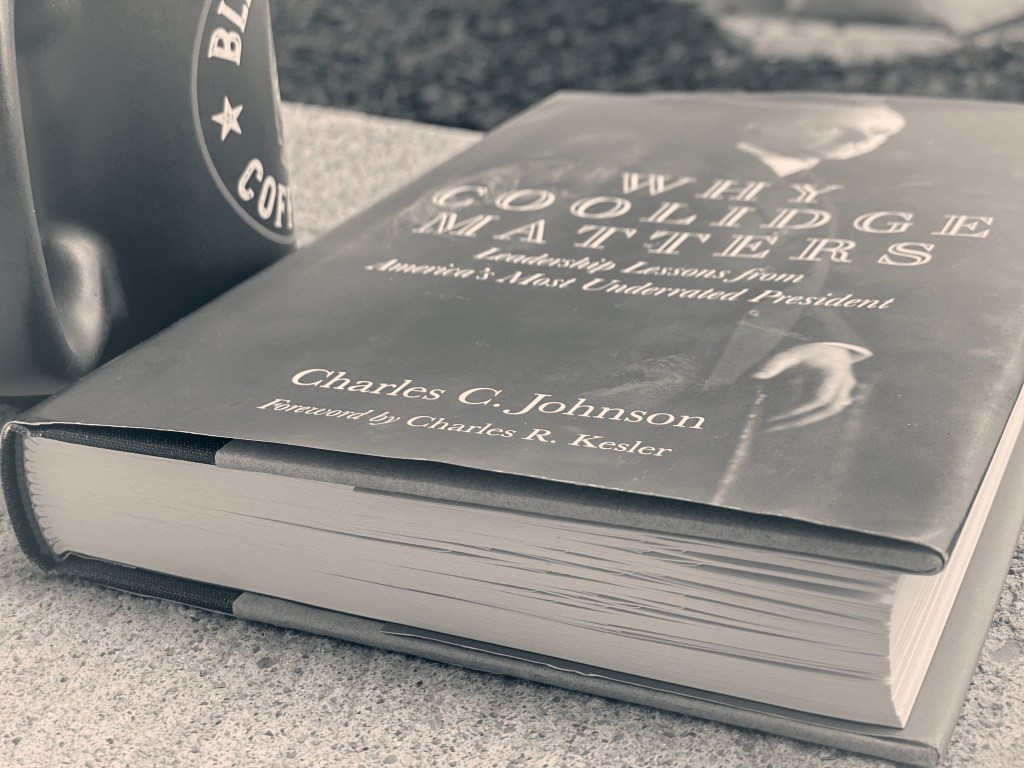
Today, I’m sharing a new book with you that’s earned its place on the Bookshelf: Why Coolidge Matters – Leadership Lessons from America’s Most Underrated President, by Charles C. Johnson. And this book earned itself an impressive number of dog-ears.

If you’ve been checking into this blog regularly, you’ve likely picked up on my affinity for our 30th President, Calvin Coolidge. In recent years, his record has been re-examined and public opinion has evolved on Silent Cal. But I’m no Johnny Come Lately on this particular bandwagon. I’ve been Keeping Cool with Coolidge for a long while now – I’m even a contributor to his Presidential foundation (the only presidential museum that doesn’t receive federal funding).

But, so far, I’ve been limited in my recommendations to you all on notable pieces to consume when it comes to, who I’ve come to dub, Complicated Cal.

Johnson’s biography deftly navigates the complexities of Coolidge’s life and times, fearlessly diving into challenging topics that face us still today: race relations, labor policy, fundamental questions surrounding the role of government, and much more. I especially appreciated his work to show the unintended consequences of the 17th amendment on foreign policy.

Instead of judging a book by it’s cover, I’ll help you judge it here by teasing you with a blurb from its dust jacket:

“Imagine a country where strikes by public-sector unions occupy the public square; where foreign policy wanders aimlessly as America disentangles itself from wars abroad and a potential civil war on its southern border; where racial and ethnic groups jostle for political influence; where a war on illicit substances leads to urban violence; where technology is dramatically changing how people everywhere communicate and move about…”

Sound familiar? I’m fairly confident if you pick up this particular read, you’ll find some meaningful ties to our own times. Cal’s legacy, though distorted in the subsequent decades, can shed light on meaningful approaches to thoughtful leadership in any century.

Pair this biography with the incomparable Coolidge by Amity Shlaes and I’m willing to bet you’ll open up space in the Presidential pantheon for a quiet farmer from Vermont. In the meantime, maybe send a condolence card to my daughter for receiving yet another well-worn book.

Sam’s Formula for Storytelling

Do you have a scene from a television show or movie that continues to live rent free in your mind?

Mine’s pretty easy to pick. It’s stood the test of time with me – a regularly reviewed inspiration and simultaneous rebuke against me when I’m falling short. You’ll probably be able to guess that it’s from The West Wing.

You see, Rob Lowe’s character, Sam Seaborn, has always appealed to me. He was the idealist among idealists. He was the embodiment of the presidential voice. He understood the value of words. If I can ever thank Aaron Sorkin for one archetype on a The West Wing, it’d be Sam’s (with Charlie Young in a VERY close second).

In one scene he captured what I wish I could when it comes to storytelling – and he did it about a fictional spacecraft (bonus points to you, Mr. Sorkin).

You can watch the clip here. (No, seriously you should watch it or the rest of this may not make sense.)

A few observations. First, I recognize Sam comes off a bit cocky here. His character is naturally competitive. What if I told you that’s ok? Even in the world of advocacy, it’s ok to have a competitive streak. We should want to be the best at what we do – but humility will allow us to place that competitive edge in the service of others.

In Sam’s case, he’s directly serving the President. By way of extension he’s also serving the students participating in the virtual classroom session. But he’s only there because he’s accepted his competitive streak and found an avenue to put it to good use.

Secondly, if you’re paying attention, he doesn’t conflate grand ideas with grandiloquent language. None of his wording is especially high brow. He’s not searching for polysyllabic words. Rather, in a few lines, he paints a simple, compelling, and beautiful picture.

I wanted to share that observation with you because, at its core, advocacy is about storytelling. Yet for some reason, advocates (and many elected officials) default to a different setting than Sam when communicating their agendas. I’m certain you’ve noticed it. Why do we approach communicating our proposals as if we’re trying to add a new paragraph to the Declaration of Independence?

Storytelling is most effective when done simply. Take Sam’s formula as an example:

Scope – he demonstrates the scale of the undertaking, placing it in terms middle schoolers could grasp.

Ask – he invites the students to participate in the viewing.

Meaning – he drives home what all of that preceding work will allow the participants to experience that day.

Advocacy requires storytelling. We are compelled to relay ideas in the hope that those ideas will inspire action. That requires us capturing the scope of our issues, delivering a thoughtful ask, and clearly laying out what it means to the listener. Sadly, data shows that very few organizations are empowering their advocates to do just that.

How are you investing in tactics to de-mystify storytelling for your advocates? How are you bringing it to their level of comfort? In the end, their genuine, relatable experiences will carry them further than your talking points.

Second and Third Order Consequences

If you take a moment to browse the Bookshelf page on this site, you’ll note the opening section includes a reference to the Thomas Sowell Reader. Dr. Sowell stands as one of those influencing figures in my life whose words continue to come back to me time and time again.

A prior Marine himself, Dr. Sowell leveraged his GI Bill benefits to pursue higher education in the field of economics. Born a black man in the South, Dr. Sowell’s life – what he references as his personal odyssey – saw him move to New York City as a youngster, enlist in the Marine Corps, enter college as a Marxist, and ultimately become evolve into a leading voice in the libertarian community.

Whether you agree with his ultimate stance on individual policies, I’m willing to bet you’ll find Sowell’s work both approachable and thoughtful. For me, consistent themes in his writings have become a nearly sub-conscious reminders as I work in the advocacy field. Specifically, his regular call to account, as best we can, for second and third order consequences (you know, the unintended kind) when pursuing policy agendas reverberates in my mind quite regularly.

The rubber met the road on that concept for me Sunday night as I was catching up on headlines from the Easter weekend. Like many of you, I find myself disconnecting from the news cycle on the weekends. I find that to be the most effective way of protecting my own sense of peace on those precious days when I can invest fully in my time with my daughter. As important as that disconnect is, I’ve also gotten in the habit of beginning to re-connect on Sunday night. After she’s asleep, I commit to a few minutes browsing headlines across various news sites – making sure I find as balanced a view on the news of the day as I can.

Sunday night, my search landed me on this story, which led me down a bit of a rabbit hole. And I’m wondering, are you there with me?

Why did it stick with me? Well, I’ve been talking more with folks lately about their frustrations over ongoing COVID restrictions. As a disclaimer, I follow CDC and state guidelines pretty thoroughly. Living in an urban/suburban community, those restrictions have just become a part of daily life; not ideal, just omnipresent. But even in my own local community, the tone seems to be changing.

Folks who were committed to strict adherence are showing signs of frustration; largely frustration with the appearance that the goalposts keep getting moved. Success against COVID seems dismayingly unattainable when, even if vaccinated, folks feel they will have to continue missing out on the social interactions, traditions and family celebrations that are so critical to each of us. Further, we’re critically deprived of those casual interactions with strangers; the opportunities to share common experiences without the simmering tension so prevalent in the background of our lives for twelve months now.

As the article points out, coupling that simmering tension with the economic strains, personal sacrifice of those who’ve lost loved ones, a summer of social issue protests, subsequent calls for drastic changes to policing, and a heated political contest it’s just not that unbelievable that major cities have seen a spike in violent crime – or that it’s continuing.

We’re at a critical point on the j-curve of recovering from COVID. For twelve months, we’ve been sliding further down the curve. Now, just before the prospect of herd immunities and a return to normalcy, we’re seeing data confirming the effects of challenging policy decisions across the board. From my perspective the ultimate unintended consequence of the numerous and often changing protocols has been a diminution of our humanity in dealing with others. We’re still on edge – ready to fly off the handle at a moment’s notice. And because we’ve been living within our own echo chambers for twelve months, untempered by the social effect of engaging with different people in normal ways, I’m not surprised by the statistics.

Let me be clear, as I’ve said in other posts, there’s no winning formula to fight something like this. Elected officials have to balance too many variables for a one-size-fits-all solution to be borne out across the country. Even in homogenous, less populated countries those broad based policies haven’t yielded reliably desirable results. But the unintended consequence in evolving emergency regulations is that folks never quite know where they stand. In the midst of that particular brand of uncertainty, is it really hard to believe that some would choose violence and crime in moments of distress?

Now is the time to lean in. Now, as folks return to work in larger numbers, as we face the prospect of adding social calendars back into our lives in broader ways, and as we face the daily challenges of road rage, spilled coffee and rude strangers, we have to commit to daily choices that err on the side of patience and peace. We have to own the consequences of our own actions – even those negatively impacted by short term policy strategies in challenging times.

What I’m watching for in the Ohio Senate Primary

Just over two months ago, Senator Rob Portman (R-Ohio), announced he would not be seeking re-election in 2022. This opened an absolute whirlwind of activity in the succeeding weeks. Punditry and horse trading began in earnest within days of the announcement.

Republicans and Democrats alike are making the case that this particular Senate seat is a likely toss-up. I think that’s a bit of a stretch considering the trends we’ve seen in statewide races in the last several years. But let’s assume it is for a moment.

My home state has reliably re-elected Senator Sherrod Brown since 2007 despite his progressive bona fides standing at odds with the Republican heavy statewide trends in the same time frame. I typically chalk that up to Senator Brown’s, frankly, unmatched ability to frame himself as an average, everyday local guy. If you haven’t seen him work a room, you’re missing out. Assuming that the Ohio Democrat Party can pull a comparable candidate from their bench, any opponent would have a tough time.

While the ODP works to source their own candidate, the Ohio Republican Party is experiencing the beginning of a real cage match between several announced candidates. The race has recently gotten a shot in the arm when it comes to national attention because of stories like this one.

But all of the reporting so far has been precisely one thing: noise.

I can’t begin to speculate who will ultimately win the respective primaries and ultimately the general. Anyone who tells you they know exactly what will come in the months ahead also has some beach front property to sell you in Omaha.

So, what can we in the advocacy world share with our volunteers as insights on this and other races across the country? Start by keeping out of the partisan rancor. Too often, when asked about the topic we love so much, we fall into the bad habit of focusing on one team or another, instead of framing the race around professionalism in electoral politics, or the issues most important to our organization.

Here are the three areas I’m talking to everyone about in these early days:

  • Results over rhetoric – Can you identify a subset of candidates (from any party) who are focusing on their records in public office? The folks pointing to their accomplishments are also likely making the rounds through the respective party structures to garner early endorsements and earn introductions to key donors – which they can do because they’ve already earned trust. If all you’ve got is rhetoric, with no background of accomplishments, you are severely handicapped in the realm of political goodwill which is so important in the early stage of statewide race.
  • Infrastructure over invective – and speaking about going statewide; who is investing in the infrastructure? Infrastructure is more than your immediate campaign team. It’s the hierarchy of staff AND volunteers who help get the work done in a community when you’re not around. It’s incredibly easy to catch headlines with invective, but are there candidates who stand out for their ability to mobilize grassroots teams across diverse communities? The pros aren’t spending inordinate amounts of time on camera or trolling others on twitter.
  • Team Players – lastly, and probably hardest to identify for your volunteers, are there candidates you can identify who won’t make it harder for folks further down the ticket? Tread lightly on this topic, but make sure your volunteers are thinking about it as they try to process the race themselves.

There’s a risk in talking electoral politics with volunteers. So, why is it important to have these topics like these in mind? Because there’s also a risk in not talking electoral politics with your volunteers.

People don’t volunteer in advocacy simply because it makes them feel good. It’s a daunting task to put yourself in a public position on an issue or in a campaign. One of the easiest ways to add value to your volunteer advocates is to pull back the curtain on these meaty subjects and help them feel as informed as real professionals.

Those involved in politics have a natural desire to be in the know. Instead of drifting into conversations with your advocates about specific candidates – and risking inadvertently driving them away from your team – position them to speak with authority on the topics that really matter. In the end, we don’t know which candidates will come out victorious, but we can certainly help our volunteers understand how to think strategically about the race and stay above the noise.

We should stop calling it a vacation

This is NOT a “woe is them” post to earn your pity for elected officials. When they step into the public arena, legislators assume a certain level of public exposure. But I have a question for would-be advocates and their managers: when you’re telling your volunteers about the congressional calendar, and “a day in the life” of legislators, how are you framing the topic?

I’m probably being a bit nit-picky here, but I promise that I come by it honestly. I can’t possibly count the number of times that I’ve heard professional advocates refer to congressional recesses, like the current two-week Easter recess as, of all things, vacation.

Congress has a long history of allowing members predictable periods to plan on being back in their districts. It’s evolved over time. Before the modern conveniences of air travel, the schedule looked quite different; condensed to allow members and their families to relocate to Washington together for longer stretches of time, and consequently allowing greater stretches of time back home in front of their constituents.

It’s an important balancing act. With modern travel resources, members often leave their families back home, traveling to and from the national capital region on a weekly basis during session weeks. The legislative calendar has stretched, giving members less consecutive time at home, but hey they get the weekends right?

By now you should expect me to say, no. Quite wrong. Regrettably, I recently heard a colleague encourage advocates to approach legislators and decision makers when they see them at the gas station, restaurants, out with their families, etc. DO NOT DO THIS. It is a sure fire way to get your issues sidelined.

Again, not a “woe is them” post, but I think good advocacy organizations need to train their advocates to understand the imbalance that exists between personal and professional lives for our elected officials – especially state and federal legislators.

Even when they aren’t in session they are engaging in public meetings, participating in community events, meeting constituents in need, and importantly, still fielding questions from other legislators on the pressing business of the day. Honestly, until you spend a day in the car with a member of congress who’s back home “on vacation” you may not fully understand the way work creeps into every aspect of their lives.

But that’s where we can step in as advocacy organizations to help our volunteers develop more meaningful bonds with their representatives. Part of relationship building is trying, in earnest, to understand the challenges and hurdles your target faces. In the world of modern politics, where greater access exists through social and legacy media, the boundary between public and private life has eroded to a dismaying degree. Those who jump in to the field as an act of service should be applauded, and respected. And it can start with the words we choose when discussing their work.

As an organization, consider reframing how you speak about the little things in the lives of our legislators, like recesses. Instead of referring to it as a recess (or God forbid a VACATION), consider discussing those periods (anywhere from a week per month up to the 6~ weeks around August recess) as “District Work Periods.”

It seems like semantics, I’m sure, but it will convey to your advocates that we have to honor the schedule. The average member of congress, after all, represents over 730,000 of our neighbors. There simply isn’t time in every recess to see each and every organization. Yet, by displaying the simplest level of respect for their calendars (and thus their personal lives) you’ll stand out in the eyes of the member. More importantly, that member’s staff will start to see you and your volunteer advocates as a trusted resource.

So, start small. Stop calling it a vacation, and tell the full story to your advocates.

P.S. – I know, strange that there’s a postscript. BUT – there are still a handful of spots left for you to enter a special giveaway. Last Tuesday I launched a reader survey, and I’d appreciate you contributing to the effort. The survey takes less than 5 minutes, and the winner (to be drawn in April) will receive a special gift! Thanks again for taking a moment to offer some feedback!