Climate Policy and American Exceptionalism: ‘Lead by Example’ is the Wrong Argument

Americans are competitors. It’s in our national DNA. That’s why I’m convinced President Biden’s administration is faltering when they argue ‘leading by example’ in the discussion of climate solutions.

For better or worse, our national conscience is often driven by a finite, winner-take-all mindset driven by the way we talk about the issues and challenges of the day. You don’t have to dig far back into our history for proof. But since I’m a space nerd, let’s just look at the 1960s as an example. Were we “leading by example” in the space race? No, we were looking to wipe the floor with those commies. We chose to go to the moon “not because [it was] easy, but because [it was] hard” – and I’d argue because we believed we could do it better than anyone else.

Fast forward to the 2021 climate change debate. Are we appealing to the average American’s competitive spirit? Not in the least – or at least not effectively. Worse yet, we aren’t hearing a narrative that challenges other countries to compete with us either. Why do broad swaths of Americans disdain the current climate debate? Many of us may just think we’re the only ones on the hook. This leads to an inevitable question: But what about the emerging economies?

In hearing administration officials discuss some of their goals recently, I heard a consistent refrain: we’re going to lead other nations down the path of righteousness by being an example. Ok, that’s fine and dandy. But is it the right message to pique our sense of national exceptionalism?

Gone, it seems, is the narrative of moonshots. We’re not dreaming big. We’re peddling fear without an opportunity for competitive heroism.

This may not be the observation you’re looking to hear in the climate space. In a perfect world, wouldn’t we wish to appeal simply to the rationality of the cause? If climate change poses the existential threat so many fear, why would it take more than simple logic to spur action? If we’re being honest, the answers are simply “no” and “because.”

When the current administration gets serious about climate change, you’ll know because they’ll change the narrative. They’ll become storytellers. They’ll place everyday Americans into the role of heroes, serve as a guide, and challenge them to be all that they can be. Until then, we’ll hear lofty goals.

I’m no climate change denier. Humanity has an obligation to steward this one planet we currently call home. But real change won’t come solely through government intervention – it has to come from a place of inspiration that swells the pride of average Americans. Not everyone wanted to go to the moon, but we certainly wanted to win. It’s time to change the narrative.

Try this on for size: We choose to innovate. We choose to be the best in the world at bettering the world. And we’ll prove, once again, that Americans will be second to none. This is a time for American greatness; and our land, our water, our air will stand as the envy of the world.
No Need for 10,000 Hours

I’m a fan of Malcolm Gladwell. His storytelling style, both through his written works and his podcast Revisionist History, resonates with me. Are you familiar with his work? Even if you’ve never read one of his books, you may hold a passing awareness of a concept he laid out in the book Outliers.

10,000 hours. That’s the estimate, now a relatively accepted belief, of how many hours it takes to attain expertise in a specialty. Ten thousand hours – five working years – seems like quite the undertaking.

Now imagine someone asks you to participate in politics and government advocacy. The vast majority of us don’t spend more than a few minutes per year thinking about how we will vote in an election, let alone how to talk to our representatives. And if you ask me, I think this is the root of the hangup we so often hear from those we try to activate: “I don’t have the time.”

Sure, that prospect may be thinking about the physical time it will take to sign a letter, make a phone call, or even participate in a lobbying day. But I think it’s a bit of a logical leap for us to assume that as the primary time-based reason for someone to avoid participation.

Advocacy organizations have adopted new technologies over the decades. Form letters became form faxes became form emails became text activations became social media blitzes…Over the course of a generation, the game has become so streamlined that one can feel included in the advocacy process if they do so little as like a post on their preferred social media network.

And even though I’ve discussed the short term nature of those advocacy methods in previous posts, they do play a role in advancing someone into a higher level of advocacy engagement. But when our prospective advocates are telling us they “don’t have the time,” I think it’s representative of something much deeper: they don’t want to feel inexpert to the task.

Advocacy organizations have a duty to remind would-be advocates of this basic fact: they aren’t expected to become policy, process or politics experts. Rather, their participation in advocacy efforts is valuable precisely because they are expert at something else.

This is a high hurdle. Go stand in the rotunda of the US Capitol and try to feel “empowered” if you don’t know the basics of the process. The atmosphere in that environments is more than intimidating, it’s humbling. I think we can forgive our prospects their desire to become a little more skilled. But how do we get them to take the first step?

I’ve written a lot about storytelling. It’s time for you to adopt this mantra: we are here to help you with the process, but you’re here because your story will change minds – the only thing we need you to master is your own story. The beauty of placing your own twist on that recruiting line is simple: it happens to be the truth.

A paid lobbyist, a grassroots manager, or an association executive may have experience in process – but those we serve are the folks living the issue and it’s complexity. Whether they’ve put 10,000 hours into learning politics or not, we know they’ve done that and much more while working through their own life’s challenges. Take the burden of “politics” out of the equation, double down on storytelling, and watch your most hesitant prospects turn into skilled advocates.

Be Careful Who You Dismiss

If I’m being honest, I had no idea what to write about today. Maybe like you, my brain is still settled into an idling mode from the holiday weekend. So here I am, late on Monday night scrolling the internet for inspiration. Lo and behold, 5 minutes into my search I land on a story featuring Matthew McConaughey.

If you recall, a few months back I shared a quick piece about McConaughey’s book Greenlights. It was delightful. McConaughey seems to be making the political rounds these days, testing talking points and seeking opportunities to share a message of optimism. Pundits continue to speculate about his interest in running to serve as the Governor of Texas.

Whether he jumps into the fray or not, I’m here today to take issue with how the story referenced above treats McConaughey’s social media post honoring the 4th of July. In short, don’t look down your nose at him. Here’s the uncut version of McConaughey’s post via twitter:

I’ve never heard McConaughey claim to be the most eloquent, highly refined speaker in America. Authentically, he shares many of his thoughts in a freeform, lyrical manner. And despite the pundits dunking on his use of the term “puberty” to describe the youth of our country, I think his message comes across quite clearly: we can celebrate where we started, where we are, and also aspire to more in the time ahead of us.

Unfortunately, the CNN story above stops the clip right after the puberty remark and fails to reach this broader message. Had they played it through, they might have realized they stumbled into talking past the same message he was sharing. My unsolicited advice to them is pretty straightforward: be careful who you dismiss.

America is an aspirational nation. The most successful of our politicians have harnessed the language of that nature. And the beauty of that language is often simple and direct. Those who demand a higher degree of elocution often scorn those who embrace this more laconic approach. They fail to realize that elevated thought doth not require highfalutin speech.

If you were to pull together a focus group of “average” Americans, I bet you 9 out of 10 will understand exactly what McConaughey was trying to convey. And that’s precisely why he’ll be successful if he enters politics. Those who think otherwise should keep in mind a few other, noteworthy, plainspoken leaders in our lineage: Lincoln, FDR, Kennedy, Obama. At their most effective moments, they did not show up for the Harvard debate club – they pulled the metaphorical stool up to the bar and met listeners where they were by speaking simply, boldly, and with a vision to a better future.

I, for one, applaud McConaughey for his genuine message of hope. In just a couple of minutes he acknowledges our past, celebrates our progress, and challenges us to think about, and work toward, a brighter future. As far as I’m concerned, that’s a fitting tribute on Independence Day.

You Matter More than You Think

There is a massive hurdle standing between you and successful advocacy: self doubt.

Whether we wish to admit it or not, most of us are carrying a bit of a complex around with us. Somewhere, tucked back in our brains is an invasive thought: what I have to say won’t really matter.

I’ve thought about the source of this mental barrier quite a bit in the past few months. This kind of self doubt can be crippling for both advocacy managers and the folks they are trying to compel toward participation. Think on it. For an advocacy manager, they are stuck in a role where they must convince others that a) participating will benefit them; and b) their participation will make a difference. With the cynicism surrounding our modern politics, that second half is a hard sell.

For the would-be advocate, that cynicism screams in our sub-conscious: “They’ve already decided what they’re going to do.” Or, “Who cares what I think? I’m not in politics.” And in its worst form: “It doesn’t matter, someone else will just buy their vote.”

We’ve somehow forgotten the basic premise of our (small-r) republican system: citizen participation informs representative action.

But what’s the harm in forgetting that premise? After all, we’re a nation of 330 Million. Our budget is in the trillions of dollars. The issues get boiled down to political slogans that can fit on bumper stickers, and the nuance of the policy process is largely ignored in our school system. With all of that stacked against us as individuals, do we really care to engage in the process?

Here’s the damage: members of congress, and I’d argue elected officials at every level, are clamoring for information specific to the people they serve. Here’s how big the problem is, according to the Congressional Management Foundation (CMF). In a study of members of congress and senior staff, the CMF found the following:

When asked: How helpful is it for messages from constituents to include information about the impact the bill would have on the district or state, 91% of respondents rated that information as very helpful. But when asked: How frequently do messages from constituents include that information, only 9% responded that they frequently receive those impact stories.

Think about it. 9 out of 10 members of congress are saying they value constituent participation that informs them on potential impacts, but only 1 in 10 are receiving that input. That is a MASSIVE information gap that can only be filled by the real-world application of ideas to constituent experience. The clearest way to demonstrate to aspiring advocates that they will add value to the process is to show this gap, and help them build stories to fill it.

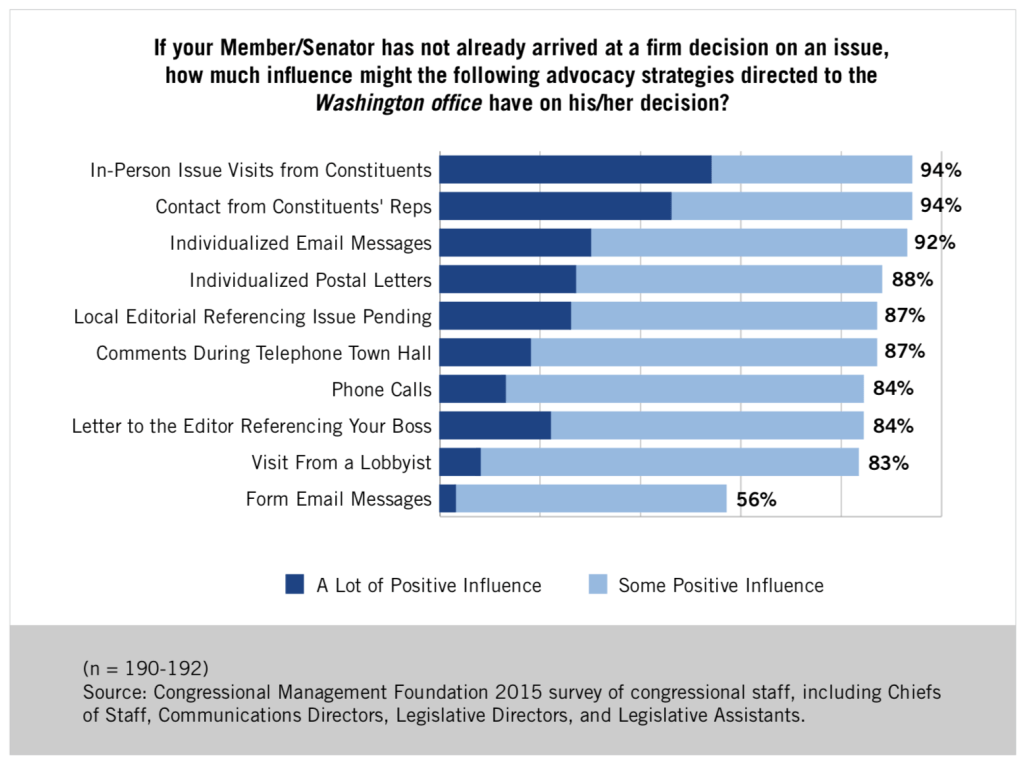
And that may be enough to get someone to take an initial action. But how do we keep them involved? How do we continue to show their value to the process? Well, I start by showing them this chart, also from CMF:

Not for nothing, look how far down the list we lobbyists rank. Frankly, I think that’s because we’re seen as mercenaries. The volunteer advocates we empower, though, are the true believers and our most effective storytellers. It’s our place to propel them forward, arm them with the tools they need to communicate the issue and its importance to them, and then get out of the way.

Volunteer advocates are the secret sauce in American politics. If you’re not already engaged in some kind of advocacy, I challenge you to get involved. Find an issue important to you, join a group working on it, and get some basic training on storytelling.

Bottom line: You matter more than you think.

← Back

Thank you for your response. ✨

New posts to your inbox

There’s Room for Everyone to Succeed

The surest way to achieve your own goals is to help others achieve theirs. When we think of serving each other in this way, we acknowledge an abundance in the world around us – and that there’s more than enough for all of us to find success.

I was reminded of this truism while painting my house this weekend. You see, I decided to paint most of the interior of my home in the next week. Couple that project with a SNAFU courtesy of my internet provider, and you get a clean recipe for lots of time with my own thoughts (no streaming service + lots of quiet = a pensive millennial). Luckily, a number of text chains remained active all weekend and gave me the opportunity to spend some of that time reflecting on the people in my life.

Frankly, I’m blessed. I’m surrounded by some truly remarkable people. You may not have heard of many of them, yet, but they are achievers. More to the point, they have the mindset of achievers – they see a world of abundance around themselves. They acknowledge that there’s room for everyone to succeed.

You see, a number of my friends have been in the career transition game over the past several months. Some have found new opportunities, and others are continuing to chase their next gig. But none of them stop cheering for each other. None of them have looked on the others with an envious eye. Rather, they’ve vouched for each other, shared interview tips, and kept each other apprised of positions that may fit their search. Throughout this past weekend, I saw this in action via text, and it stuck with me.

I know this doesn’t seem like much in the grand scheme of our lives, but I found it inspiring. And as I’m sitting here tonight, drinking a bourbon and relishing a fresh coat of paint, I keep coming back to that inspiration.

Politics is a tough business – regardless of where you fall within the industry’s spectrum of opportunities. But here, in a little nook of the midwest, I’ve stumbled into relationships with more than my fair share of sensational people. You’ve heard from a few on this blog before – like Abe Jacob who regularly contributes. But there are many, many more. Somehow, our little corner of the American political and governmental system have yielded a crop of incredibly generous, thoughtful, and supportive people.

In the last year, I’ve come to cherish these people more and more. As I reflect and share on this blog, I find myself thinking about the people in politics more than the politics itself, and becoming increasingly grateful along the way. Like my old boss used to say, “You Win with People.” I certainly feel like I’m winning tonight.

Take a look at your circle. Do you have some folks who fit this bill? Are there folks who inspire you through their service to others? Do you find yourself seeking to up your game because they continue to push you?

I hope so. And if you do, maybe share this post and tag them in it. Let it serve as a little “thank you” for all they do to inspire you to live up to your own abundant mindset.

Overcoming Barriers to Advocacy

“I just don’t know enough about it.”

“What I have to say won’t really matter.”

“I just don’t have the time right now.”

“I’ve never done it. I don’t know what to say.”

Sound familiar? These are some of the most common responses when folks are asked to participate in advocacy campaigns. Successful advocacy organizations have quite a lift ahead of them to get those same folks over these barriers.

Nationally, political campaigns, issue campaigns, advocacy support and the like are billion dollar industries. The fluidity and complexity of our political process here in the states compounds the problem. It’s more than just election cycles. The onerous nature of the legislative process alone reinforces the need to spend so much talent and treasure on engagement.

So, from where I’m sitting, we’re left with two major questions: 1) How do we, as individuals, overcome the barriers to participation? And, 2) What are the effective strategies our organizations can pursue to help potential advocates overcome those barriers?

Let’s begin at the beginning and make sure we’re talking about the same barriers. From my view they are the following:

  1. Time Commitment – How they perceive the burden of participation will impact their lives.
  2. Self-Perception & Doubt – Questioning their own abilities to participate effectively.
  3. Diminished understanding of their inherent value – Belief that their contributions won’t ultimately matter.
  4. Perceived lack of knowledge – A belief they can’t or won’t be considered as an expert on an issue.

Over the past several weeks, I laid out some basic principles for storytelling and how you can reduce advocacy to a more natural style of communication. By avoiding jargon, process talk and data you’re empowering your advocates to focus on what they know best: their own stories.

But looking ahead, it’s critical that we work to better aid our would-be advocates in overcoming these very basic, early barriers to entry.

Over the next several weeks, we’re going to do just that. I’m going to share some tools that have worked for me along the way. And I’m asking some other folks to join the conversation as well.

My hope is that you’ll also share your own thoughts on these barriers. I hope you’ll drop a comment on this post, message me on social media or email me at luke@partofthepossible.com with your own questions and concerns.

Until we address these first order problems, it will be incredibly difficult to advance our prospective advocates up the ladder of advocacy and participation. I hope you’ll find value for your own organization as we go through this little series!

In the meantime, start thinking about this question: what prevents me from taking action on issues that affect my life or career?

Put Your Money Where Your Mouth Is

The dirtiest part about money in politics is when someone tries to shame you out of contributing. Unfortunately for them, there is nothing shameful about legally fighting for your issues.

Newsflash: Elections are expensive. The candidates you support, regardless of the level of government, put an incredible amount of work into raising funds to support their campaigns. There is absolutely nothing glamorous about the fundraising process. And as much as opportunists will bemoan that process, political action committees, and the chicken dinner circuit, the truth about money in politics is that it’s absolutely necessary.

Personally, I prefer my politicians to have a bit of socio-economic diversity. Do you? There are dedicated public servants out there who can only continue in their work if they are supported by their communities (both geographical, professional, industrial, etc). If you’re in a position to support someone who aligns with your causes, you should absolutely show up, participate in, and contribute to, the campaign process.

But what if you don’t know the candidates? How do you screen? How do you make sure your dollars are being put to effective use?

Enter the Political Action Committee (PAC)

I’m not talking about dark-money, super PACs. I’m talking about the closely watched, publicly reported organizations who operate in the sunlight of modern politics. Issue-focused Political Action Committees offer a framework for you to participate in politics while focusing on specific issues instead of partisan battles. Especially for moderates across the States, PACs are an important tool to bolster those who cross the partisan divides and work to constructively govern.

Early on in this blog I shared a piece by a good friend, Anne Thompson, who manages the work of such a PAC. In that piece she laid out some key lessons about what makes for a good PAC. I hope you check out that piece here.

Here’s a quick excerpt:

“At the end of the day, PACs are a vehicle through which like-minded individuals can pool their collective resources to support candidates for elected office who support ideals their organization seeks to promote.”

Anne Thompson, PAC Management

Unfortunately, PACs are inaccurately portrayed in our body politic. They are regularly under attack from all sides because operatives know: if you can dry up the funds for the other camp you have an advantage. So, they’ll actively promote tactics to discourage participation.

If you ever run into such an operative ask them this: Isn’t our system built on citizen participation? I have a hard time understanding how not doing so would help prevent bad politicians from being elected. Is it really a winning strategy for us to diminish involvement? Shouldn’t we focus on what really wins elections: getting people to the polls?

If you want to stand out in politics, consider joining a PAC. Consider contributing to an organization that represents your profession or industry and contributes to politicians of any party who support your causes. There are plenty of good, effective PACs out there. They stand for issues, and they’re an easy way to amplify your own effectiveness. Many also provide benefits to their members like political updates that will give you a clearer vision of the campaign and political environments.

When you’re ready to put your money where your mouth is, PACs are a good first step. And if you ever need a recommendation, drop me a line.

Storytelling 104: Join the Quest

If you go back to the very first post introducing this storytelling series (Opposing Isn’t Good Enough), you’ll recall the inspiration behind it – the book Building a Story Brand by Donald Miller. In that piece, Miller lays out a basic seven step process for storytelling geared toward maximizing the impact of our stories on prospective customers, calling them to action, and getting them to engage with a brand. It’s an easily digestible piece with solid, thought-provoking ideas.

Yet the world of advocacy is, just a little bit, different from sales and marketing. Sure, we can draw plenty of parallels. The psychology and the interpersonal framework of sales can all be correlated to the world of advocacy. Certainly the motivation, the why, behind telling a good story is the same: to convince the listener to take a desired action. But unlike in sales and marketing, a singular point of sale or commitment to a brand is not the end goal of advocacy.

The deliberative nature of our political process is…well…not that direct. When we call a decision maker to action, we’re really asking them to embark on a quest. This is especially true if we’re asking them to champion a cause from conception to execution. And guess what? They’ll need us, and a few good friends and allies, to tag along.

Complex issues and fluid political processes stand as formidable barriers to entry in the political world. Despite their role in those processes, decision makers must overcome the same barriers as the rest. And there’s a dirty little secret they may not share with you: the prospect can be just as daunting to them.

After we’ve given our heroes a plan and positioned them to take action, it falls to us to demonstrate how we will walk alongside them through the political fray. What can you offer them along the way? Here are some tangibles:

  1. Coalition building – offer to assist in bringing other stakeholder groups into the drafting process.
  2. Grassroots activation – identify opportunities to mobilize volunteer activities to bolster the effort.
  3. Educational events – focused on informing additional targets, these events can be critical in the early days of an effort.
  4. Research – funding and developing critical data and information sets that will reinforce arguments.
  5. Communications – amplifying the hero’s own messaging on the issue through traditional and new media.

While you’re delivering your ask through storytelling, it’s ok to paint the picture of what lies ahead. You can identify and mitigate the pitfalls and offer specific fixes at the beginning of your engagement. When the hero knows they won’t be questing alone, they’re more likely to make your story, your cause, their own.

As you apply the storytelling framework to your own advocacy organizations, it’s important to keep in mind that this is just one tool in your kit. It won’t win you every champion you desire. But as you adopt storytelling to your efforts, you’re building a critical skill. Remember this: only 1 in 20 people you meet will remember the facts you tell them. More than 60% will retain a good story. That’s too big a margin to leave on the table.

So now, my question for you: have you practiced framing stories in your own advocacy efforts? What worked? How did you practice? Drop a comment on this post and let me know your lessons learned!

Choose to Be Kind

We all need a pick-me-up from time to time. And all too often we don’t voice that need. Too many of us are walking around, silently carrying the burdens of our concerns while comparing ourselves to the perfect lives of those we see on social media platforms. For content creators, bloggers, YouTubers and the like it’s difficult not to spend your mental reserves each day critiquing even the tiniest bits of your content.

Luckily, more and more are adopting the adage: “Done is better than perfect.” Or an emerging contemporary: “Quantity makes quality.” At least in my own social media feeds, I’m seeing creators actively sharing the challenges and real-time failures of content creation.

If I’m being honest, the past couple of weeks have had me taking a hard look at the products I’m delivering to all of you. As this blog has evolved along the way there have been ups and downs – and not just in view counts. But the more I look to where I’d like to take this “brand” in the future, I’ve found myself doubting my own abilities. I know my own limitations all too well. That’s why I’ve invested time in a few key learning opportunities of late to improve this blog for you.

But there’s only so much I can accomplish alone. And graphic design is most decidedly NOT in that category. I am absolutely hopeless when it comes to visual art, graphics and computer design. I’m beyond redemption. It’s just not going to be in my wheelhouse.

Even though I can admit that, I also find I’ve kept criticizing myself over things like not having a brand logo that fits and feels right.

Enter an unexpected hero.

I’ve gotten to meet a lot of folks along the way in politics. Volunteers, interns, advocates – all come in and out of your life as they move into, around and out of political circles. It’s critically important as those moves occur that you find opportunities to support and be kind to the others in the arena – even if you disagree with them on policy.

One of those folks I’ve met along the way, Maggie, reached out to me late last week with an incredibly thoughtful and impossibly well-timed gift. Out of absolutely nowhere, she messaged me on Facebook with a personal note – and a new logo for this site. I was absolutely floored! Take a look:

Here’s what Maggie said about the logo she designed –

“The globe and eagle are (hopefully obvious) nods to your service in the USMC, the globe and hook are supposed to be similar to a padlock, which the eagle is pulling open. The goal is to visually represent how policy advocates “unlock” the world.”

Out of the blue she custom designed this new logo, tying in so much about my history and purpose, with nothing requested in return. She exemplified giving without expectation. Maggie plays around with designs like this as a hobby and just wanted to do something kind!

On my best day I could not have found a way to weave together all these different facets. Maggie, I’m really grateful for you today. Thank you for living generously. I’m proud to adopt this logo and feature it on Part of the Possible. Thank you for helping fix a problem no one knew I was having! I’m thrilled to put this logo to good use. (And if you look around the other pages on the blog today you’ll see it’s already live!)

So, for everyone else, here’s today’s reminder to seek out opportunities to serve and be kind. We can all try to be just a little bit better at that.

Storytelling 103: Bring a Solution

Have you ever had a co-worker who always finds a problem to solve, but never has the wherewithal to provide a solution? I know. We all have.

While I was in uniform, there was one especially acute case in my unit. A young leader, he tended to be crippled by obstacles. At the same time, he was always the first to find those same obstacles. As far as yellow canaries go, he was great. But like all yellow canaries in coal mines, he wasn’t much good to us after the problems took him out.

Luckily, he had a commander who knew just how to mentor this young lad – and teach the rest of us a thing or two about leadership along the way. After one too many occurrences of the sky falling around him, the officer in charge finally pulled him aside and said “Listen, I don’t expect you to find the full solution to any given problem. It’s my call how we’re going to get past this thing. But I need you to come up with at least 60% of a solution before you alert me to a problem like this. It’s your specialty area, not mine, and we can all learn from your expertise.”

Yes, he built the young guy up a bit. But more importantly, he modeled an important concept for me at a critical stage in my professional development:

Don’t come to me with a problem without bringing me a feasible solution.

You would be shocked, shocked I say, to know just how many advocacy organizations don’t have this same lesson internalized. I cannot begin to count the number of meetings I had as a political staffer where a visiting organization lacked a clear, actionable ask for the office. When pressed for the solution, they were caught off guard, and often unaware of alternative proposals already being considered.

When you’re trying to call a target to action, simply stating the problem isn’t enough. In the world of advocacy, this is especially true. Elected officials are an inch deep and mile wide on issues – they are generalists to the extreme. Often, the higher you move up the political ladder, the more general they must become. Expecting any less is unrealistic and harmful to your cause.

But that’s why our advocacy organizations exist – to present solutions. With the unlimited number of resolutions, bills, rules and orders issued across levels and branches of government it falls on us to help drive our targets, our story’s heroes, to a proper solution. Unfortunately, that proper solution may be buried in the midst of several other proposals.

While you are in the process of storytelling, laying out your preference clearly, and repeatedly, will bolster your efforts. Here’s how:

  1. Know the full bill title and number if already introduced
  2. Present the three (max) most important aspects of the bill for your organization
  3. Be prepared to repeat yourself

As you’re developing your story, take steps to actively script the these three action items into your meeting. Your primary storyteller needs to practice them in realistic settings to be prepared for interruptions and questions. Falling short of that will leave a critical piece of your storytelling efforts incomplete.

Bottom line? Bring a solution. Ask yourself: do we have a bill or solution to present on this issue area? If not, do we need to focus on this issue area during this particular meeting?

I know there’s a temptation to cover every priority you have in every meeting. Unfortunately, that’s not real-world politics. Our stories empower our ability to develop a lasting relationship with elected officials. Don’t waste the opportunity. Bring a solution that they can understand and execute.