In today’s vlog, I share some perspectives from life inside a congressional district office and how you can better work with these teams to advance your cause.
Check it out below, and let me know what you think! What should I cover the next time I record a quick vlog?
No matter how often you do it. No matter how second-nature it may seem. No matter how much you practice. No matter what, public advocacy is intimidating.
Yesterday, I had to do the uncomfortable part of that work by testifying in front of the Ohio House of Representatives’ Armed Forces and Veterans Affairs Committee. On a topic that won’t necessarily be popular with every veterans organization.
Why?
Because I was asked what I thought. And when you’re asked to weigh in like this, you should show up. Because those who do can really have an impact.
But here’s what you should know – even those who work in this field get hung up on how they perform in these moments. So no, you’re not alone. I’ve spent a fair amount of time since leaving the committee room trying to dissect my performance and see what could be better next time. Even though I work in the field, I have imposter syndrome. Almost every day.
So, I think I’m going to keep the video below handy for the next time someone asks me “what’s it like?” And I’ll show them just how much I beat myself up for tripping over a word or two (okay, maybe 10).
In the meantime, I’ll share it with you in full here today – along with the written testimony I submitted below. I hope it will show you that testimony like this doesn’t have to be extravagant. It doesn’t have to be lengthy. It certainly doesn’t have to be flawless – mine certainly never will be! But good testimony absolutely has to be clear, carry your story, and deliver a definitive ask.
Check it out by clicking on the video below and let me know what you think!
Crumley Testimony, HB 69, Ohio House of Representatives, Armed Forces and Veterans Affairs Committee, May 9, 2023
Chairman Loychik, Vice Chair Demetriou, and Ranking Member Miller, thank you for the opportunity to join you today and offer proponent testimony on House Bill 69, which aims to modernize the composition of county veterans service commissions across the state. I’m here today to seek your support of this bill and encourage swift action on this legislation.
It’s a pleasure to join all of you today as you consider this important step forward in our state’s efforts to meet the moment and serve our friends and neighbors who have worn the nation’s uniform through our most recent conflicts. Each of these individuals faced unique challenges stemming from a type of warfare never before seen by previous American warfighters. Not only did we develop new ways to fight, but our conflict literally bridged generations – where the children of our warriors would later return to the same battle-spaces as we endured lengthy nation-building efforts on multiple fronts.
From 2007 to 2011, I was proud to stand among the ranks of those patriots. Serving as a Commissioned Officer in the United States Marine Corps, I had a front row seat to witness the character of this generation of veterans while it was tested time and again. After my time in uniform, I went on to work for two members of Congress providing direct relief to veterans of all ages – and their families – as part of our constituent services team. It was in this role that I came to know the diverse challenges that face our county veterans service commissions as they also evolved to meet shifting needs. It’s also where I saw my brothers and sisters-in-arms face unnecessary challenges.
At that intersection of people and process, one simple truth became clearer to me than ever: representation matters.
Veterans service commissions operate on tight budgets and can face broad mission sets – driven by diverse local challenges. But those budgets are how we set priorities – as you all know all too well. Unfortunately, without a seat at the table, my contemporaries don’t have the opportunity to affect meaningful change by informing those priorities. House Bill 69 aims to address this by calling for conflict-specific representation at the county service commission level. This builds on similar precedents that existed to serve the interest of veterans from both the first and second World War. This is a measured, rational approach to ensure our county commissions are poised to steward public dollars and meet the real need of the moment. From my vantage point, that makes this effort a good government initiative as well.
I’m not here today representing any veterans service organizations. I don’t presume to speak on behalf of all my brothers and sisters. But I do know each of them deserves the finest programming, and highest quality of service we can provide at the county level. As we work with veterans service organizations to help them navigate the maze of national veterans benefits and address critical issues like mental health and housing security, we need those with similar experiences at the table, crafting our local strategies. Because representation matters.
That’s why I’m proud to stand before you today and ask for your support on this bill. This time-tested, responsible approach is one meaningful step forward at the right moment. As the Post-9/11 generation continues to age, progress through their careers, and raise their families, we can take action now to ensure they aren’t met with an outdated system, unresponsive to their reality.
As you continue to consider this legislation, I ask you to do right by them and by the local taxpayers who support this important work. To ensure we provide the right services to our local patriots, while protecting the public trust, please vote in favor of House Bill 69. With that, I’m happy to answer any questions you may have.
When I went on active duty, the conflict in Iraq had reached its high point. The dominant tactic from enemy forces on the ground had shifted, employing a devastating tactic: improvised explosive devices. Accordingly, our training was geared toward preparing us to think about the battle space in a different way – a way that would prepare us to handle this exceedingly difficult form of asymmetrical warfare. And it showed up in our lingo.
Whether you were headed to that particular combat zone or not, a phrase edged its way into your lexicon. Suddenly, almost overnight, the training came to be summed up in a singular phrase: “get left of the explosion.”
That phrase helps encapsulate a dramatic shift that needed to happen for us to execute that different thinking as we headed to the fleet. Conventional, established training programs had focused generations on how to deal with “actions on the objective” in combat scenarios. Read that as training aimed toward preparing our teams on the expectations for their performance when we know we are going to face a point of friction.
The only problem with that is we don’t know when an ambush is going to happen. The enemy on the ground gets a vote on that. If your team encountered IEDs, the disruption to your actions could mean that your only recourse was to execute a rapid response on site. Say farewell to the actions on your previous objective. Now you’re in a different type of firefight.
So, how do we reclaim the initiative when an enemy force has found such an impactful asymmetrical approach? We needed to change the game. We needed to think differently about everything that happens before an enemy tries to ambush us.
Instead of crafting ideal actions on the objective, our briefings soon incorporated the steps we would take to mitigate the possibility of an IED attack and maximize our ability to react quickly in the worst case scenario. By thinking about all the steps taking us to our objective, we were zeroing in on the planning we could make to limit the enemy’s ability to impact our mission.
When we would say “get left of the explosion,” we were cuing our teams and ourselves to move deliberately through that thoughtful process. We were practicing a mindset shift in words that would help us do so in deed as well.
In my work as a professional advocate now, I think about the power of words often. I think about how simple changes like this one can set us up to perform better in the midst of unpredictable shifts of the political sands. I also spend a great deal of time contemplating how our words matter to the folks we’re trying to move on an issue. I try to think through how to match a common story to an individual listener, so that our policy initiatives are meeting them where they are in the moment.
Unfortunately, there are too many volunteer advocates thrust into the policy arena without being given the time to do the same. Because of the topsy-turvy nature of politics, a hot issue today can be a dead one tomorrow. And in the middle of that, it’s not hard to imagine volunteer advocates – who don’t spend all their time catching up on political gossip – feeling a bit unsure about how to take talking points from an advocacy team and turn them into something more personal, more valuable to the listener.
Because talking points box us in.
We don’t mean for it to happen, but it does nonetheless. We see a bulleted list and salivate over the prospect of not having to do the deep homework on our issues. After all – we have our script right there in front of us. But what happens when the other party in the discussion doesn’t follow the script? After all, they get a vote in how that interaction is going to unfold as well.
When your targets switch to their own form of verbal asymmetrical warfare – how do we react? Do we realize that we’re now in a different type of fight? Or are we stuck applying our typical “actions on the objective” to a moment that doesn’t quite make sense?
Sadly, I don’t think we’re doing enough in advocacy to get “left of the explosion.” We’re taking the easy way out when we hand our volunteers one-pagers and talking points memos. We’re not forcing the thoughtful action they can take to think through the pitfalls coming their way. We’re not helping them mitigate the risk of putting the wrong talking point in front of the wrong target.
In those moments, we’re diminishing their effectiveness. Because a great talking point at the wrong moment is always the wrong argument.
That’s why I’ve spent the last few years trying a different approach. Very rarely do I provide one-page briefing documents and talking points memos. And I take a little bit of heat for it. Volunteer advocates are pressed for time – and digging into the issues is challenging work. Crafting your personal narrative around an issue is daunting. And matching the key points of that narrative to diverse audiences on the Hill is even worse! That’s why I insist we lean into creating space for our teams to get left of the engagement.
Just like the language mindset shift in my training years ago, this practical mindset shift has begun to pay big dividends. Removing policy briefs, and adding time into our operations to facilitate deeper dives from our advocates is helping our advocacy teams come together and think through their own rapid responses. By equipping them with meeting management skills instead, advocacy leads can help them create a natural flow to react quickly in the moment and regain the initiative.
Is it perfect? No. But no advocacy meeting truly is. The opposition gets a vote after all. But we gain credibility in our work when we professionally respond to challenges in the moment. When we’re able to adjust how we speak about an issue to different audiences, we meet them where they are. And all of that places us in a position to get invited back to the table time and again, which is the end goal: gaining new opportunities to engage in the process.
We don’t get there without putting new methods to the test, without evolving. Our strategies in the divisive state of modern politics have to change. We have to accept that our volunteer advocates need the time and space to think through what they are about to do. We can’t script it out for them. That’s why we have to throw away the canned approaches of the past, and help them better react to the reality on the ground today. We do that through mindset shifts.
And I’m getting to that mindset shift faster by throwing away those talking point memos.
Yesterday I spent the better part of five hours watching real Americans do something incredibly uncomfortable: testifying in public before a Congressional committee.
This wasn’t one of those highly visible, controversial hearings where partisan hackery dominates the agenda. No, this was a hearing for a subcommittee focused on agricultural issues and they were debating the next Farm Bill. Because it was so focused on a wide range of deeply technical policy issues – and not on scoring quick political points – this hearing won’t generate the kind of headlines you’ll see from other congressional hearings. It’s just not sexy enough.
Yet there they were. 10 average folks, showing up nonetheless, because they recognized the uniqueness of the opportunity. Would they have to face difficult questions? Sure. Would their assumptions be called into question by committee members? Absolutely.
But if it’s not publicly visible, and it causes your advocates to do something terribly uncomfortable (speak in public, testifying on complex issues), why do it? Is it worth it? Isn’t there a better way in the days of digital communication and social media?
Plainly, no. Because there’s no shortcut to winning in politics.
I say that, knowing full well one of the most effective ways to cause advocates to “take action” is to utilize technology that automates the process – simplifying it so we can generate groundswells around issues. And there is a time for that kind of advocacy. But there is no substitute for showing up in person to participate in an actual dialogue. The give-and-take, question-and-answer, difficult conversations we see in these rooms take on the often overwhelming task of bringing diverse ideas together.
In our rush to automate so much in life, we forget that our public discourse was never meant to be easy. Yes, we elect others to go and do the work of legislating and executing policy – but that does not excuse us from the hard reality that our expertise is still needed to inform their work. That expertise typically doesn’t fit into 140 characters on Twitter, or sixty seconds on TikTok.
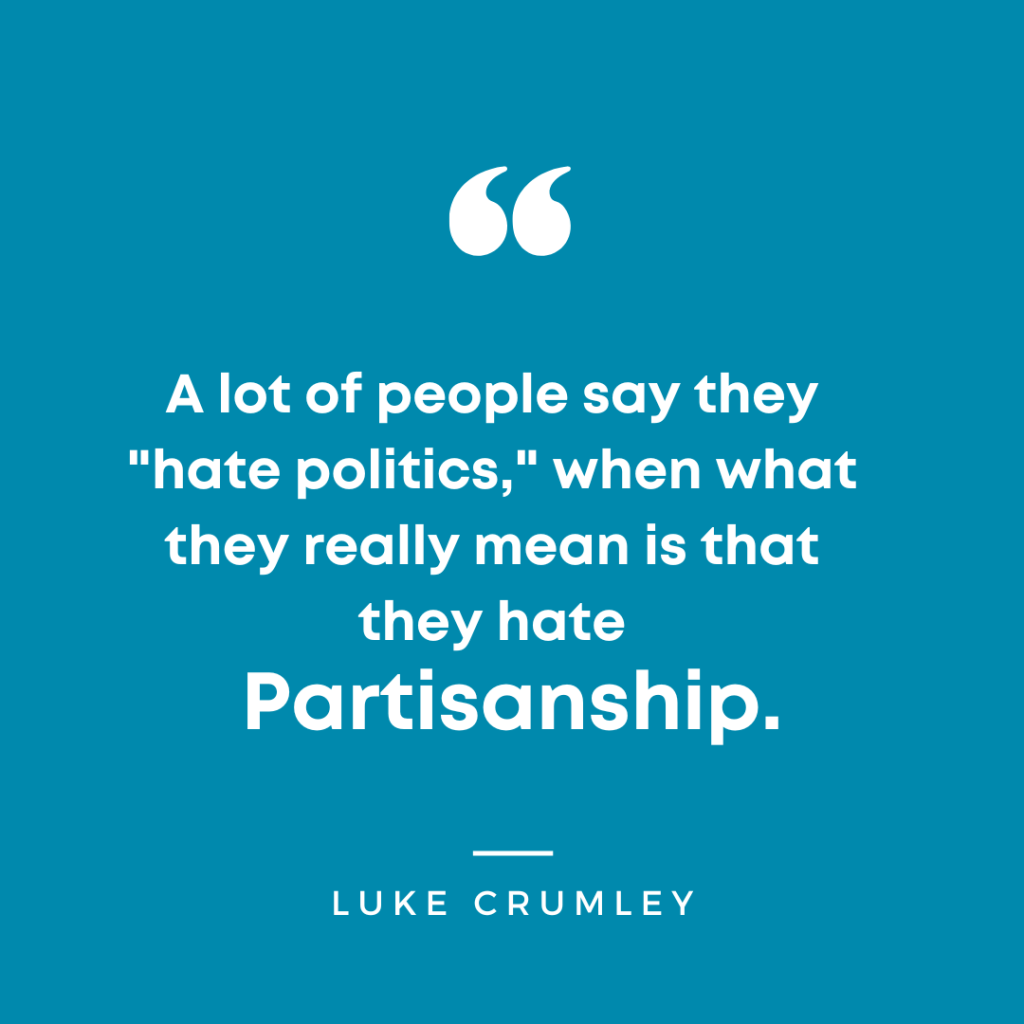
Yet knowing the value of that expertise doesn’t help too many of us over our internal barriers to getting involved. We seek permission to opt out by claiming we “hate politics.” Even on our most dearly held causes we hunt for ways to stay engaged just enough to feel like we are still credible on the issue to those in our closest circles. But I want to challenge you to think deeper on that mindset today. I want you to ask yourself if you really think that tweet, or facebook article you shared, really answers the mail for your cause.
From a former congressional staffer, I can tell you – it doesn’t.
I want you to understand that reaching decision-makers requires more from us. It takes thoughtful, active engagement. And the systems that try to make it easier on you, usually result in too passive an approach. Prompting individuals to post on social media doesn’t guarantee their message will land on the desk of the right person advising an elected issue on the topic of the day. We can’t rely on the message being received.
Here’s what I mean – hashtags, and retweets, and form posts just don’t have the reach you think they do. They are like screaming into the wind and hoping it will carry your voice to the next town away. Sure, you’re making noise, but you have no control over where the sound goes or who will hear it. More than likely, it’ll just be the folks standing closest to you when you scream.
Sadly, that’s the typical impact of social media in advocacy. We place our stances in the open, sure. We share our values with those in our network, of course. But unless we reach a level of virality in our content, those opinions will never make it in front of a real decision-maker. It’s just not in the cards – at least not in a way you can guarantee.
By contrast, in-person advocacy removes the passive, uncontrolled elements of social media and replaces them with the reality of what’s right in front of the staff or decision-maker. Instead of screaming into the wind, this is pulling up a chair next to someone at the coffee shop. You create space for real engagement. And your words can be heard, in real time, and in the full context of your issue. You gain credibility at the expense of your discomfort.
You gain credibility at the expense of your discomfort.
Leaning into that discomfort yesterday put the panel of witnesses in a fantastic position. They were literally in the room with those they hoped to influence. They were able to share their stories, and their unvarnished opinions. And more importantly, their words are now on the record. They’re being weighed and measured, and they may just move the needle on one big, challenging issue.
That’s the impact I want to see for you. That’s why I’ll stand on my soapbox today and beg you to quit confusing your social media posts with that level of engagement. It’s in an entirely different league – but it’s one that I want to help you reach.
There’s been one big addition to my work routine over the last several months that I haven’t really shared here. It’s not a project I own – I’m just a contributor. But it’s been a fun growth experience along the way. It’s challenged our team and helped us stretch. It’s also helping show our team members in a bit of a new light.
It’s a podcast.
Yeah. For a guy who swore he’d never “start a podcast,” here I am tagging along for the ride as our team shares more of our work with those we serve in our association.
Today, I’m going to share our most recent episode with you.
On a show targeting grain farmers in Ohio, our normal fare may not be for you. But I think this episode has something for everyone. And I’ll be up front: I get a little personal. And I hope that our chat adds some value for you as our host, Marlene, and I share how we each stay sane in the tough times.
Without further ado, let me introduce you to Kernels, a podcast brought to you by Ohio Corn & Wheat – click the link below to listen!
A few weeks ago, I was back in Washington, DC with a group of volunteer advocates. Nothing new there. But the outcome was – because we walked away from that advocacy trip with volunteers saying one thing resoundingly: “I felt more prepared than ever before.”
That’s a big deal. Because advocacy is hard. It’s uncomfortable. It’s mentally draining. And it forces you to face those who may disagree with you and have a difficult, but crucial, conversation. That simply doesn’t appeal to a lot of folks.
How do I help volunteers overcome those points of friction? Well, this time, I focused on three specific steps. And if you use them, I think they can help you more effectively stand up for the issues that matter most to you. Because they’re all about recognize the human behind the advocate.
Make Space in the Calendar
Going to your state capital, or Washington, isn’t convenient. It’s simply not. Volunteering for a cause means you’re taking vacation days from work, or setting up child care, or handling any other of a myriad issues that go with disrupting your daily routine. That’s a tough ask. We shouldn’t wonder why so few participate in volunteer advocacy when they are in the daily grind of their careers. It’s just not easy.
And to combat that, many advocacy organizations try to get as much bang for the buck as they can when bringing these volunteers into the fight. To minimize cost, and maximize time, there’s a tendency to cram as much into every minute as possible. And while well-intentioned, we have to balance the value that adds with the second and third order consequences we often conveniently ignore: the frenzied stress we add to our advocates’ experiences, and the exhaustion which will degrade performance as the mission goes on.
During this most recent visit to Washington, we tried something new. And tell me if this would appeal to you as an advocate: we added time to the experience. At first glance, that’s likely not appealing – for all the reasons above. But by right-sizing our calendar footprint, we were able to step away from one of my most despised traditions in volunteer advocacy: the breakfast issues briefing.
At this point, I can’t keep track of how many of these “morning briefings” I’ve attended. Where DC-based political operatives “prepare” out-of-town advocates to go storm Capitol Hill. And they almost all follow the same script: a lobbyist talks about the current political climate; a policy specialist delivers talking points on a particular “ask” for those on the Hill; and then the volunteers are set loose in the wild. All in the space of about 45 minutes over soggy hotel eggs and dry muffins. Just how empowering do we really think these briefings are?!?!
In our recent experience, when we dedicated an entire day to some guided preparation time and it made a world of difference in our performance. Our teams were able to get to know one another, do homework on the issue and become more comfortable in their own skin. And they had time to figure out how they’d share the work load.
Make Space for Practice
The only regret I carry from this day of prep, is that we still didn’t have enough time in the calendar dedicated to that last piece. We didn’t have as much time as I’d like to put all of that homework into practice with some live action role playing.
There’s no substitute for this type of rehearsal – where individual advocacy teams are put in a pressure cooker to really hash out the “how” of working together. Because much of the group were experienced advocates, I had to let something go in my execution. This go around – due to the complexity of one of our issues in particular – I had to make the game time decision to cut this piece short. Sure, doing so allowed space for our teams to dig deeper into the issue. But I wish I hadn’t had to do that.
If you want to avoid this type of decision, build in practice opportunities ahead of your own advocacy day. Ideally, facilitate opportunities to meet with those with whom you’ll spend the day advocating – and put each other to the test. Have someone play the role of the disinterested staffer, or the curmudgeonly representative. Complain. Grumble. Pick a verbal fight. Or ignore them altogether, but find a way to force your team to work through the bad meeting – it’ll make the good meetings that much more enjoyable.
In preparation for the next big swing at our issues, more practice will go back into my plan.
Make Space for Fun
But that plan will also capitalize on another lesson this go-around: proactively lighten the load, and make space for your teams to have a little fun!
Let’s face it, there are a lot of great experiences you can have in just about any new city. There are sights to be seen – especially in a place like DC! But far too many times I’ve seen groups neglect the social value of letting your people break away from the mission for a few precious moments.
We ask so much of our volunteer advocates. We ask them to put so much on the line. Is it really too much to offer them the chance to go see the museums? Tour the national archives? Get a Library of Congress library card?
Ok, that last one may not be for everyone but I’m glad I’ve got mine!
I’ve done my share of marathon meeting days – where dozens of encounters are scheduled on top of each other to squeeze every bit of juice out of the day. But where does that really leave us? That kind of pressure is likely to cause one major reaction from those we need in the trenches. We’ll lose them through attrition.
Our issues can’t afford that kind of loss.
This year, our teams had some of those experiences built in to the agenda. But we also left room for them to explore targets of opportunity themselves – to wander. I think, especially in the wake of COVID-19, advocacy groups would do well to remember the value of these social excursions. Making room for fun will build your team’s sense of camaraderie. It’ll make the work that much more worthwhile. And your folks will be in a better mood!
Won’t that, in and of itself, make us more effective as advocates? Give me the happy warrior any day. They’re more likely to stay in the fight.
And as you jump into the fray, remember that there’s no requirement that participating in the system has to be such a burden. We put that on ourselves. We expect the experience to be unpleasant, and close ourselves off to the benefits it brings to our lives. That’s on us. And if we put these strategies to the test, we can own making it all a little bit better.
Two weeks ago I was back in DC with a group of volunteer advocates – and we were all over the place. Agency visits, meeting with other NGOs and, of course, going to Capitol Hill. We met with a LOT of people to bring more of our message into the public debate.
To do that, we prepared. We did homework on our issues, dug into our policy stances, and rehearsed to make sure our teams were clicking. All that prep work goes a long way toward making citizen advocates feel empowered to do the really uncomfortable work of political advocacy.
But often times some of our best moments in Washington don’t fit the mold of a traditional meeting. Instead, they are off-the-cuff moments when you have 30-60 seconds of someone’s attention because of a chance encounter. Those moments – though brief – can make for meaningful exchanges too.
And the prep work you do for those traditional meetings can carry you through these brief exchanges – if you stick to three things.
1 – Have a clear, actionable ask.
There are a lot of mistakes we can make in advocacy. A lot.
One of the biggest though is being vague about the action we want our politicians to take. When we use phrases like “I’d like you to support us on this issue” we leave too much gray area on what support could mean.
Elected officials aren’t mind readers. We have to specify what we’re seeking. Before you’re ever stepping out publicly on an issue, ask your advocacy team to help you form a concise, measurable ask. Something as simple as “I’d like you to co-sponsor bill X” goes a long way in eliminating that gray area. It will also set a clear context for what comes next.
2 – Tell your story in 30 seconds or less.
Beyond your ask, a 60 second exchange with a legislator has to deliver information in a way they will actually remember. And I hate to break it to you, but that’s not a place for statistics. In a moment like this, you have to use a story.
Raw data isn’t compelling on its own. Human context is what people need when deciding whether to engage on complex issues. And the folks we elect are no different. They are as much storytellers and story listeners as the rest of us. Let’s meet them there.
Compel them by showing how an issue affects real people – like the one standing in front of them. Make it personal. And find a way to help them feel like they could become the heroin that story. Because then, they have a reason to give a damn. And they have a reason to seek you out for more.
3 – Open a door to follow-up.
Credible, sustainable advocacy never relies on one meeting to win an issue. Never.
The real win in a moment like this – when you have a minute or less to talk about your issue – isn’t getting the listener to ‘yes.’ Success is getting them to say ‘I want to know more.’
When you have the rare, chance encounter like this remember this truth: time is our single most valuable, non-renewable resource. If you can turn a one minute exchange into a future 30 minute meeting, you’ve just created one hell of a return on investment.
After your story, be bold – ask them if there’s someone on their team you can contact to share more. Go a step further even – ask them if they’d take a call from you to dive deeper. I think you’ll be surprised how many times you’ll hear yes – especially if you connect with them through your story.
Then it’s on you. It’s on you to pursue that follow-up opportunity. It’s on you to continue building credibility. It’s on you to make that 1 minute just the tip of the ice berg.
When you prep for those longer, more formal meetings keep asking yourself: how can I break this down even more? How can I distill it to what’s most important? And how can I make sure to get invited back to the next conversation?
With practice, you’ll get there. And I think you’ll see that even in advocacy, there are plenty of times when less is more.
I’ve been traveling for four weeks straight – mostly for work, a little for family. Six hotel rooms, 5,000 miles, three annual meetings, an award and a keynote presentation later, I can fairly say I’m glad to be home.
I’m spent.
But I can also point to some wonderful moments that were incredibly meaningful to me in the past few weeks – few more so than the chance to reconnect with a fellow Marine officer.
My graduating class of Marine Officers is incredible. We have folks from our ranks who’ve gone on to just about every type of profession out there – and so many are crushing it. But for a few years now, I’ve been watching from afar as one, in particular, sunk his teeth into serving beyond the uniform. And during these recent travels, we had just an hour available, when we were both in the same city, to catch up. And let me tell you, this fellow jarhead is as inspiring today as he ever was in training and uniform.
Since leaving active duty, Jamal Sowell has gone on to become a Pat Tillman Scholar, Chief of Staff at Port Tampa Bay, and served as the Florida Secretary of Commerce and CEO of Enterprise Florida – the principle economic development organization for the state of Florida. And none of those career milestones is even remotely surprising to those of us who’ve crossed his path. To say Jamal is charismatic may be one of the great understatements one could ever make. He has an infectious energy, and the humility we search to find in so many would-be leaders.
A conversation with Jamal is powerful, but grounded; high-minded, but measured. He holds firm beliefs, and makes thoughtful decisions in challenging situations that would cause others to shy away. But as we chatted that evening, one comment stood out to me in our brief time together – Jamal’s take on why he about-faced, and went back to Florida despite having an opportunity to work in DC.
“I Can Do More Here.”
DC is a tough town. It’s a transactional town. Yes you can accomplish something of significance there. But does that significance align with the purpose you want to serve in life?
When he was in the DC environment, Jamal said, there was a moment when he realized he could have a more direct impact back in his home community. He could do more back in Florida – working with community groups to effect localized change faster. Despite all that he could accomplish if he stuck it out, he just knew there was work to be done back home.
Then he went and did it. And continues to do it. Showing up day after day for the moments that matter. For me, moments like this reaffirm what I’ve told aspiring advocates for many years now: don’t forget just how much we can do back home.
Leveraging the Home District
A while back, I shared a piece on the importance of working with Congressional District Offices. These are the home offices, the local staff of members of Congress that help those members maintain a local footprint. Those offices often focus on constituent services and community engagement – learning from real people about the real problems they face. These are the people who work adjacent to DC politics, but keep themselves grounded in the effects that DC policy actions can cause.
For members of Congress, these district offices will often be where the rubber meets the road.
When Jamal and I were talking, I couldn’t help but be transported back to the many years I spent in one of these district offices – and just how accomplished I could feel at the end of a good day’s work. What’s more, I remembered the real advocates who moved the needles on their issues by building credibility through those district offices. I think Jamal’s words would resonate clearly with all of them. They knew they could “do more here.”
As advocates, there is certainly a time for any cause when it’s imperative we go to the halls of power. But too often we ignore the open doors available to us right here at home. Those doors are accessible – regardless of so many of the barriers that may prevent someone from traveling to Washington or their own state capital.
I want to challenge you today to think about how you could more thoughtfully engage in your own backyard. If you care about a federal issue, have you ever gone to a local district office? Have you met with the constituent services staff to learn just where your representative stands on an issue? Have you tried to build that near field relationship?
If not, I want you to think about people like Jamal – people in the thick of it who recognize the real power of being on the ground, where complex issues meet real people. Could you do more there?
I can’t tell you the number of times I spent as a congressional staffer being ‘talked at.’
In nearly a decade, I could probably count on one hand the number of organizations or individuals who really stood out as advocates. But one thing they almost all shared in common?
They were less interested in lecturing me, and more interested in guiding me.
It’s an important difference. The work of advocacy is about winning real people to act in the interest of difficult causes. It’s more than educating – it’s inviting people along for the crusade. But not everyone does it well.
For the longest time I struggled to really capture what set apart the good from the bad and the ugly in this work. But really, it’s quite simple. The really good players are different because they don’t want to win, they want to stay curious.
Every advocacy cause has its goals. There are tangible achievements we pursue. We seek out champions to take an idea and turn it into a law. We want to win new advocates to our team. We want to raise money to support candidates who lead on our priorities. But the intangible part is almost always where the real work happens. That’s because it’s all the stuff that happens on the way to getting folks to those tangible results.
It’s the change in the timbre of your dialogue. It’s getting invited to be part of an advisory panel. It’s getting folks to stop saying no and start thinking ‘maybe.’ But that’s so difficult to measure! And nowadays, if you can’t measure it, did it really happen?
In the last few weeks, I’ve written less and reflected more. I’ve wanted to re-think how I’m presenting the complexities of politics – both here and in my live trainings. And the more I think on it, the more I feel reaffirmed that folks are hungry for the basic things they can do to be just a little bit better. And by better I mean two things: 1) more effective; and 2) more resilient.
So how does one be both more effective, and more resilient when they’re trying to be remembered by a decision maker? I think it boils down to one counterintuitive skillset: asking questions.
Normally, asking questions is pretty natural. But not in advocacy. Why? Well, because we so often think we have to “win” folks to our cause. How do we do that? The common answer would be persuasion and expertise. And when one thinks persuasion and expertise, rarely do we associate that with asking questions.
But I’m here to say that curiosity will get you further.
When I think about those truly successful advocates over the years, the way they guided me was not what most would expect. It wasn’t a forceful push on an issue, it was a gentle nudge. They were building credibility through curiosity. Curiosity about my boss and his opinion on challenging topics. Curiosity about common ground. And curiosity about what mattered to us as staffers.
All of those layers of curiosity were built into their advocacy program. The professionals and the volunteers alike knew they had to prioritize relationship building. The really good ones knew they could do that by asking more questions and presenting fewer answers.
Ask meaningful questions. Not with the intention to trap someone – but with the motivation to learn about and from them. They’ll reveal more than you could possible imagine.
It doesn’t seem like it fits in modern politics. With all of our division and hyper-partisanship, is there really room for curiosity anymore? I think there is. More importantly, I think it’s on each of us to create even more space for it.
If you’re up for the task – and you want to gain more credibility with decision-makers – try this one trick to be really unforgettable: ask questions. Not with the intent to persuade. But with the intent to learn and evolve how you interact with those you aim to win over.
I’ll never take for granted how working in politics can introduce you to so many remarkable people. Easily one of the best I’ve come to know and work with is my friend John Torres. He’s the Executive Director of the Maryland Farm Bureau, and guides that organization as they fight to protect and promote the interests of nearly 10,000 farmer members and families. He’s a natural storyteller – and he helps those farmer members leave an impact by humanizing complex issues through their lived experiences.
In the discussion linked below, John shares how he helps would-be advocates break through the noise and effectively tell stories that will matter to the people we try to influence. There’s a little bit of something for everyone in here, so I hope you enjoy!
Some questions to think about while you watch:
Do you think of yourself as a strong storyteller?
If not, what can you take from John’s points today to apply in your own daily life?
Is compromise really a dirty word?
Are you trying to be the hero in your own story? Is that a mistake when we are advocating for the causes that matter to us?
Again, I hope you enjoy this special post. Consider leaving a comment here (or on whatever social media channel you saw it) to thank John for his time and tell him what you learned!
P.s. I totally biffed it on my microphone settings for this recording. Lesson learned! Help me get better and let me know how else I can improve!




 Part of the Possible