Need a boost for your sense of optimism? Start here

“I want to know how you can be so optimistic.”

I don’t know why, but this has become a common thread in my conversations lately. As I’ve been briefing advocates on the current political landscape, and helping friends make sense of the recent election, a thought like this almost always creeps into the conversation.

Until yesterday I’m not sure I had a great answer.

You see, yesterday I saw a video that just seemed to set up camp in my mind for hours on end. It was a recording of Michael J. Fox – Alex P. Keaton himself – receiving a humanitarian award from the Academy (you know, the Oscars people). Recognizing his unparalleled advocacy for those living with Parkinson’s, his peers in the industry paused to celebrate the tremendous impact he’s made on the world.

And, as they should, they had him take the stage.

There he was. Every bit of the sparkle a generation grew up knowing just absolutely pouring out of him. Affliction be damned, he was all the best parts of Marty McFly and Mike Flaherty, Scott Howard and Lewis Rothschild (if you don’t know those references I just can’t help you).

But what got me was his humility about the work he’d done off stage. He shared the reality of his journey to accepting his own Parkinson’s diagnosis and embracing a new calling to do something about it.

And ever so discreetly, he taught us what should be a new mantra for all of us:

Gratitude.

I know the pop culture self-help acolytes hear this everywhere, but in the world of advocacy I’m not sure we put it into practice enough. I know I still don’t.

The truth is, what keeps me going is realizing just how lucky I am to be doing what I do. A guy from the west side of Columbus, with an odd last name and no family connections, yet here I am – living out the opportunity to help others show up day in and day out for the causes that motivate them. And I’m surrounded by an industry full of professionals who can say a lot of the same.

We take it for granted – this system of ours. Despite its human imperfection, and despite the frustrations that can come with partisan bickering, we have never truly lost our ability to shape the work of that system. The whole of our history has been the slow – many times all too slow – march toward greater agency, greater opportunity, for more people to be involved in that important work.

Why is that?

Well, because at our core, Americans are deeply optimistic. Even in the current age of wedge issues and partisan hackery, I get to see volunteer advocates show up day after frustrating day, to advance their causes. They willingly show up to push against the ocean…because they can.

Just two weeks ago, predominantly young voters – a group with every reason to be checked out in the current moment – shocked the world by drastically altering the end result of the election simply by showing up. Ignore their hope and optimism at your own peril. Hope for a future not yet realized and optimism that there’s still a chance to get there. That’s not naïveté, it’s the American way.

At the constitutional convention of 1787, the most influential delegates – Madison, Morris, Randolph and Hamilton – were all in their thirties; still young even by their contemporary standards. They’d challenge the status quo of the Articles of Confederation and boldly put forth an alternative – fighting tooth and nail to reach consensus. Then Hamilton and Madison took their respective talents to the fight again and again until ratification. Don’t you think they were grateful to take on that fight and stand among the giants of their age?

I know so many, spanning the entirety of the political spectrum, who are tired and frustrated. They wonder how they can carry on the work when their team loses, their bill dies in committee, or their issue is swept away by the crisis du jour. The good ones, the successful ones, know a big secret: the wins don’t motivate us. The process does. We GET TO BE a part of it. Tapping into that understanding can only yield one result – a deep sense of gratitude.

I’ve always found it fitting that one of our most important national holidays is a day of giving thanks. Pausing. Before the Christmas rush, after the harvest has come in, to just be grateful. It’s no wonder why two of our great leaders – Washington and Lincoln both – advocated for a day of prayer and thanksgiving. Two men who faced incredible odds, who stepped into the breach, and had to be optimistic about what could be. I think they knew something about their countrymen: we all need that spiritual sustenance if we are going to feed our American identity.

I don’t know how you’re going to spend your holiday this weekend. I do know many of us will groan as we go around the table telling everyone what we are grateful for this year. But thanks to Fox’s timely reminder, I have an answer I won’t have to groan about when answering that common question I’ve been getting so much lately.

How am I optimistic in the face of it all?

Because I’m grateful I can be part of it all.


If you want to see Fox’s acceptance speech for yourself, you can view it here.

How Do We Hold Politicians Accountable?

This week I had the opportunity to do something I truly love. I got to spend a couple of hours working with students at my alma mater.

Now these weren’t just any college students. These were folks in the John Glenn College at THE Ohio State University, studying public policy. These are MY people. People committed to the idea that the best way to protect our republic is to participate in it. So much so that they are seeking advanced degrees in the theory of how our system works.

But when I get to spend time with them, I get to share my own experiences of seeing the rubber meet the road.

Over the course of a couple hours I beat the same drum that I beat with every group of prospective advocates: that successful advocacy is a cumulative and iterative process, and that like any great craftsman, a successful advocate has to fall in love with the work of perfecting their craft.

There are no short cuts, no easy buttons, and no magic formulas to get the job done. All our field promises is an infinite game of changing players that offer new challenges each and every day.

But when we got to some Q&A, one student asked me a great question that I thought I’d share here today: “how do we go about holding those elected officials accountable?”

For context, we had just been talking about crafting good “asks” for officeholders. I shared with them my standards: clear, actionable, and measurable. A good ask has to be easy to understand, relevant to the office, and able to be tracked with a deliverable.

Here’s a BAD example of an ask:

“I’d like you to get educated on this topic.”

Educated? How? To what extent? Who should I seek out as an expert? Oh and most importantly, how will I demonstrate I’ve done it?

Good asks look a little different. They start with what’s relevant to a position, get spelled out in undeniable terms, and show a measurable outcome. For instance, if you’re talking to a member of Congress, a good ask would be more like:

“I’d like you to co-sponsor HR 5089, the Next Generation Fuels Act, which promotes cleaner fuels and will protect the long term health of our rural economy.

A clear, relevant, measurable action: co-sponsor a bill. But what if they don’t do it? Well that’s what the student was asking. If they don’t do the thing we ask, just how do we hold them accountable? You’re not going to like my answer any more than those students did:

“It depends.”

Before you call me a cop-out, hear me out. When I train advocates, I key in on the concept that seeing advocacy as both cumulative and iterative allows us to do one thing really well – build credibility. And credibility is the currency of the political realm. Regardless of their party or position, public servants need partners in the process. And sound advocacy strives to meet that need.

But if you’re early in a relationship with a decision-maker, you may not yet be ready for the hard conversation on an issue. You may not yet have enough saved up in your credibility account. That’s when you must be ready for a hard decision, because sometimes you have to be willing to sacrifice winning the moment so you can still win a champion to your cause.

That’s a really difficult needle to thread. Because it sucks to hear ‘no.’ It’s awful to expect one action and witness a representative take an opposing stance. It sucks to lose.

The way around that is to develop an infinite mindset for advocacy. Training yourself to think less about wins and losses and more about gaining ground can put it all in perspective. It can help you stay in the game longer – that helps you build credibility. And ultimately, that’s what separates successful advocates from everyone else: they have a way to keep showing up even in the face of ‘no.’

How do you hold them accountable? Keep showing up. Build credibility. Because the greatest way to protect our republic is to participate in it.

Making Sense of, And Moving On From, the 2022 Midterm Elections

By a bit of good luck, I’ve been reading Originals by Adam Grant in the last few days. As a book about original thinking, personal development and change-making, it might not immediately strike you as a relevant read at election time. But here I am, finding myself gleaning important reminders at a time when so many of us are just trying to make sense of the results of the 2022 midterm elections in America.

Let’s start by re-capping what’s going on in the real world:

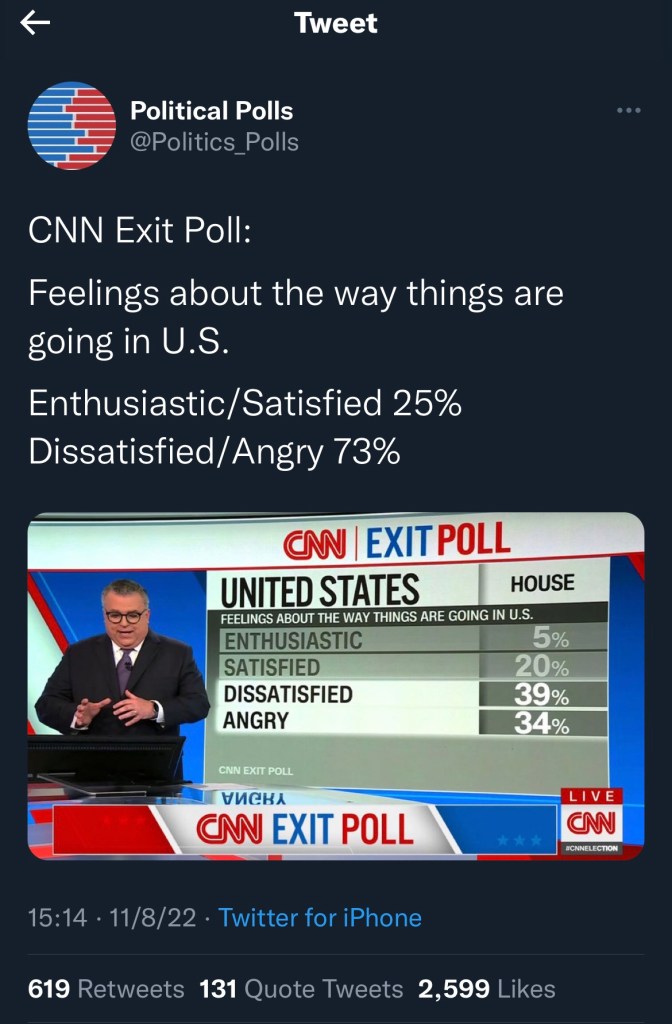
In what had promised to be a sweeping rebuke of the Biden administration, political professionals everywhere are scratching their heads on a whole host of mixed signals coming from the electorate. On election day, CNN exit polls were reporting more than 70% of respondents claiming they were dissatisfied, even angry, about the way things are going in the U.S.

As the day unfolded, and before actual results began rolling in, pundits were interpreting that in a somewhat traditional way: negative feelings mean the party in power will lose a significant number of seats in the legislature. Historically, and especially when a President is seeing low approval ratings, this holds true. It’s what many in the business expected.

But what happened? Well, not a red wave.

In my own home state of Ohio, Republicans saw sweeping victories statewide. But they also witnessed stunning defeats: a longtime Cincinnati area Republican Congressman was upset in his race, while an entrenched Democrat in the Toledo area fought off the challenges of a Trump endorsed challenger in a newly more conservative district. In a brand new iteration of Ohio’s 13th congressional district, a similar dynamic played out – in a district that was truly competitive for Republicans to pick up.

Nationally, many of the same trends held, with Republicans failing to pick up (as of yet) victories in many poachable districts. And as we wait for additional results to trickle in over the coming days and weeks, what was supposed to be a strong Republican majority seems to be shrinking.

For the record, here’s the prediction I had sent to a colleague just last Friday:

Senate: 51-49 R/D split with a late surge by Vance in Ohio; House: 229-206 R/D split with Congresswoman Kaptur (Toledo) surviving her challenge and Congressman Chabot’s (Cincinnati) race called late with a possible upset.

Yes, I have the receipts for that prediction in my email. Those specific race call-outs panned out just that way. And while we’re waiting for the final tallies on Republican/Democrat wins and losses, things aren’t looking like Republicans will gain much ground in the national picture – at least not at 9:30pm the night after Election Day.

What was expected to be a referendum on national Democrat policies has turned into a bit of a windfall for the Biden administration. And while they will very likely still be navigating a divided government next year, the damage was supposed to be a whole heck of a lot worse.

What does that tell us, and why does it matter?

Well – I’m not sure anyone can fully answer the first of those questions. The election returns are a confusing mess, full of mixed messages. In watching hours of coverage over the last day I think just about everyone is seeing these results in whatever way suits them best. But as far as why it matters? Well, that I can answer. With a little help from Adam Grant.

The leadership challenge that arises with smaller majorities is your margin of error. If Republicans were hoping for sweeping legislative action to hold the administration in check, they’re not on track to see that right now. And the narrower their margin of victory in either chamber, the harder it will be for leaders to keep the coalition unified and moving in the same direction. It’s not a lesson Republicans should have had to learn again so soon.

Between 2011 and 2019, Republicans saw varying levels of legislative majorities through the latter three-fourths of the the Obama administration. But successive speakers (John Boehner and Paul Ryan) continually struggled to maintain cohesion in the ranks as those majorities progressed. The emergence of the Tea Party and Freedom Caucus offered an alternative to the more moderate establishment leadership, and the fracturing hampered legislative activity. (That’s a stretch when I was working for a member of congress who was an ally of John Boehner.)

As Grant observed in Originals, the similarities in their objectives led to inevitable disagreements over tactics and strategy. Unhappy with the pace of progress on their agenda, wedges developed between “establishment” and “outsider” groups within the GOP caucus. And as majority margins constricted, those differences empowered the “outsiders” to hinder compromise and incrementalism.

If the tepid nature of Tuesday’s results hold, we are about to see the pattern repeated.

Republican leaders are almost guaranteed to have their feet held to the fire by members of the caucus who are impatient with the status quo. Compromises will be unpopular and debates over tactics will certainly derail major priorities. But what does that mean for advocates and the general public?

“It’s almost certain we’ll see a government shutdown.”

Just a few weeks ago, I asked two colleagues to present to a group of advocates. One Democrat, One Republican. Both with extensive knowledge of party politics and national electorate dynamics. They’d also both held very senior roles in prominent campaigns at the federal and state level.

Toward the end of our session, I asked them to share their predictions on the likelihood of gridlock in the next congress and whether we should be worried about a government shutdown. “Absolutely. It’s almost certain we’ll see that.”

Operatives from the highest levels, and differing parties, could clearly see eye to eye that we should expect some of the worst case scenarios that have played out over the past several years. And while some are celebrating the inevitable slow-down brought on by divided government, advocates must prepare for the challenges that will present to our causes.

If we acknowledge the worst case scenarios ahead – without letting them dominate and depress our thinking – we can plan around them, and how we will react to them. We know the windows of opportunity on our key agenda items will shrink or be crowded out by situations like that. We can also make an informed assumption that in the divided government scenario that social issues will dominate the daily debate while run-of-the-mill governance takes a backseat in the press.

Yet those aren’t necessarily obstacles to our agenda. They are opportunities for us to take the time necessary to develop more thoughtful proposals, more powerful storytelling and more responsive messaging. Instead of rushing from crisis response to crisis response, divided government can be a real boon to those willing to be patient. Because even when impatience is the name of the game in the politics of a caucus, patient advocates demonstrate an ability to keep doing the most important thing in advocacy: showing up.

Especially in divided government, the ability to embrace the cumulative and iterative aspects of advocacy sets the individual – and the successful advocacy organization – apart from the crowd. Those who get really good at it can survive the doldrums better than those seeking to capitalize on controversy and infighting. It may not be as exciting, it may be less frenetic, but it’s certainly not the end of the world. Just another opportunity to be brilliant in the basics.

Keeping Your Head on Election Day

We’ve made it!

In just a few days, we’ll be putting the 2022 election cycle in the rear view mirror. And for many of those paying attention to US politics, it can’t have come soon enough.

As I’m writing this, President Biden has just wrapped his second of two major addresses to the American public this fall – both centered on political division and tense rhetoric. What made tonight’s speech just a little more pointed is the context of a recent physical attack against the spouse of US House Speaker Nancy Pelosi. In the wake of that crime, POTUS’ remarks were much more direct than his previous speech in September.

Many will deem the remarks a political stunt this close to Election Day. It will be described as a last ditch effort to motivate a likely depressed Democrat turnout to mitigate the damage many politicos are predicting. I, however, am thinking about the speech in a different light.

Just the other day, a volunteer advocate asked me “what will we do if _______ loses?”

I wish I could convey the look of fear in their eyes. It was legitimate fear – the kind of fear we Browns fans feel even when we’re leading by two touchdowns in the final 2 minutes of a game. The best way I can describe it is a fear that a part of our core identity will be harmed if we lose in such a specially predictable way.

Since that conversation, I’ve been asking others the same question I ask committed advocates almost every election cycle:

What’s your PLAN when your candidate DOES lose?

I’m not asking to be petty, or partisan. Rather, I’m aiming to help them move beyond speculating about the unknown. I’m aiming to have them remove a mental variable and embrace their own worst case scenario. Why? Because dwelling on the unknown cripples your sense of action – even moving on to a negative scenario helps kickstart your creativity and move you into problem solving.

I have literally zero training or data to back that claim up – just my own experiences that guide me.

You see in the Marines, we specialize in this type of training. Young leaders are constantly placed into worst-case scenarios – and then, when things are falling apart for the team, we try to make it even worse. Not because we like it, but because we know it helps us keep from falling in love with our own plans. We want young leaders who have an impetus for action. Part of that is learning to “embrace the suck” when your fears are being realized so you can simply work the problem in front of you – and ignore what could have been.

I think a similar approach can help us in politics.

Go back to the question I ask. In response to a “what if” I ask about their “plan” when that hypothetical scenario definitely occurs. I don’t let them pause to bemoan the development, I ask them to specifically tell me how they intend to react. That’s a different ballgame.

As we’re getting closer to Election Day, I’m getting this question more and more – and having this same conversation again and again. Ultimately, I’m trying to help folks keep their heads cool on Election Day. Because pundits can be wrong. Hopes can be dashed. And at every level of government, there will be races that disappoint each of us.

But Election Day isn’t a finish line – it’s a starting block. It’s the anticipation of the starting gun for a foot race. It’s getting into position to act. Successful advocates distinguish themselves by realizing that, and visualizing how they’ll react when the starting gun fires.

So, if you’re stressing over next week’s election – and fretting over what could be – ask yourself the question: “what’s my plan when we lose?”

I think you’ll find yourself a little more relieved and a great deal more ready to act.

Become a Better Advocate: Have Hard Conversations

“How do we get our leaders to stop fighting and start working?”

I cannot begin to tell you how many times I’ve been asked that question. Even working for centrist members of Congress, that sentiment came up nearly every week I was on the job. For almost a decade.

I can tell you since I left that work, it is still one of the leading questions people have about politics. Even the rabid partisans ask it in their own way. There’s just a bunch of us who are ready to see politicians put up AND shut up when it comes to getting something, almost anything, done.

But I think we need to turn the mirror around.

Just yesterday, I was chatting with a diesel engine technician from Indiana and he asked me a variation of this question. He was concerned that cancel culture is harming our ability to have hard conversations and find common ground. And I couldn’t agree more.

As we were going back and forth, I reminded him of a quote from President Theodore Roosevelt:

My message to him was simple – it’s just not good enough for us to lay the problem at the feet of elected officials. It’s not their fault we’ve become more tribal, it’s ours. They’re simply reflecting what we choose to convey as important. They’re representing US.

For those of us who want to engage in a better process, that’s a bit of a problem. Because that tribalism, that demand for philosophical purity, isn’t allowing us room to have the hard conversations that need to happen for us to grow together and search out meaningful compromise on issues – the kind of compromise that keeps our country progressing forward.

When I think of that Teddy Roosevelt quote, I feel convicted. We aren’t called to passively let elected officials take the reins. That’s not the American way.

We are called to be people of action. People who do. Not because it’s easy; not because the process is desirable. But precisely because it is hard. And because the results can be desirable.

The quest for partisan and tribal purity has put meaningful advocacy in a tough spot. Volunteers become torn between competing interests. And instead of working through those points of friction to reconcile our beliefs and our realities, too many feel justified in simply not showing up.

That’s the easy way out. It also happens to be the less fulfilling way out.

When volunteer advocates first hear my material, there are more than a few eye rolls. As in everything else, we Americans want what we want, and we want it now. And if we can’t have it that way, we question whether it’s worth it at all.

I get it. But I’m the guy here telling you – there’s no fast pass. If you want to move your issues you have to keep showing up. More often than not, that showing up is going to include hard conversations with people who just don’t get you, and mostly don’t understand your stance on an issue.

Fortunately, showing up for those interactions is how you get better for your cause. Not because you’re honing your ability to parry the thrusts of your opponents, but rather because you have more opportunities to see it from new angles. Those reality checks are going to have a compound effect on the way you fight for your cause. They’ll point you to new solutions to problems. They’ll make you better!

But none of that happens without the first step. We have to acknowledge the need for hard conversations. We have to be willing to get uncomfortable. And while that doesn’t mean we have to change our beliefs, it may just help us change how we show those beliefs to the world.

As for our elected officials, it’s not a lost cause. In pockets around the country you can find a few brave electeds trying to do just this. Trying to live out a calling to engage with people different from themselves. It’s long past time we bolster them by reclaiming our responsibility to demonstrate what we expect.

Doesn’t that sound like work worth doing?

Become a Better Advocate: Find a Team

Last night I went live on TikTok. Why? Because I had writer’s block. I honestly didn’t know what to write about today. So I asked those on the live session what their questions were. I wanted to know, very simply, what mattered to them.

After a little bit of time talking about what a lobbyist is and does, there was a really simple question that I thought I’d answer here today:

“I want to do more for this cause I care about. Besides giving money to some group, what can I do? Where can I start?”

– Chris, Houston, TX

This is a topic I’ve posted about a few times on this site, and it’s a key point I raise with the advocates I train. One of the common barriers to participating in politics and advocacy is as simple as not knowing where to start. We don’t feel empowered enough to act as individuals, and we may even think that it’s just not worth the effort. Does that sound familiar to you?

Well here’s the thing – no one can fault you for feeling that way!

Have you ever tried to search for an advocacy organization without having its name handy? It’s not all that easy! Not many folks would get past the first page on Google without more than a little confusion.

Some geographic areas do have organizations that attempt to make it just a little easier. Here in Columbus, Ohio our Chamber of Commerce maintains a website listing advocacy organizations. But even that feels incomplete and daunting.

But taking the time to find a team to bolster you as an advocate is a worthy investment.

Public policy is complex and confusing at any level. From local ordinances to the federal register, trying to decipher laws and regulations is burdensome and time consuming. And no matter how passionate we may be about any one issue, that complexity can make keeping up with changes untenable.

That’s where a good team becomes your force multiplier.

Trade associations, non-profits, and citizen groups can help you stay informed on what really matters to your issue. They can stay on top of the process and allow you to insert yourself when it’s time to share the personal experiences of those dealing with an issue. They take care of the process, allowing you to focus on humanizing the issue.

That’s incredibly valuable. It allows us to still show up for what we believe while not missing a beat as professionals, parents, students – you name it. They help us show up in any season of our lives.

That’s a massive value-add.

But what’s more, they can also empower us to persevere in the fight. Let’s face it, the policy process doesn’t move as fast as many of us think it should on issues we champion. The grind of the policy process will wear you down – all the more quickly if you’re going it alone. Endurance is the name of the game and a good team can keep you engaged by making sure you don’t invest your time, talents and treasure when they won’t help. That’s massively valuable to you and your sanity.

One final thought...

I’ve had this quote running through my mind for a few weeks now…

I think we should be honest with ourselves that, often, when we choose to commit to a cause, we want to be the hero. We want to be the one who makes an impact. That’s a great competitive edge to have.

But it can’t be our motivating factor to act.

Joining with a team helps keep our egos in check. It reminds us that we’re one part of a much bigger effort. That can keep us from stumbling. It can make us more credible. And it can keep us humble. Those are all traits sought out by decision-makers when they’re looking to their constituencies for guidance.

When we choose to partner with an effective team, we can align our actions with Morrow’s observation above. We can take the first step to making sure we are one of the doers, and prevent ourselves from becoming one of the credit seekers. The team can keep us grounded.


You may not yet feel ready to jump into the fray for your cause. That’s ok. But when you are, focus first on aligning yourself with a team. Use resources like Guidestar.org to search for the non-profits and social clubs focused on what you care about most. If you want to be a better advocate, find a team.

Success in Advocacy: The Power Behind Your Personal Brand

108.6 Million, versus 17.1 Million. That’s the difference in followers between Elon Musk and Tesla on Twitter as of today. Elon has more than six times the reach compared to his own company!

It’s not just about numbers though. When Elon sends a tweet, his followers are likely to see it and engage with it. Because he’s a real, live person – and one who has built a unique online presence.

Without Elon Musk, would Tesla be making the waves it has? I don’t know. That question would likely dog researchers for quite some time. But is Tesla helped by the overwhelming reach of the world’s richest man? I think that evidence is fairly clear.

Beyond the company, Elon is a living example of the tremendous power we have in our personal brands. Albeit on a significantly smaller scale, each of us has a sphere of influence powered by the “brand” we’ve put out into the world. You may not think of yourself as a brand, and that’s fine, but the concept should have you thinking about how you impact your cause through your digital and public presence.

So what’s the bottom line up front (BLUF)? How you present yourself to the world can help or hinder the causes you want to champion. Here are a few ways you could take action to be on the right side of that equation.

No. 1 – Acknowledge That You Have a Brand

Two weeks ago, the Public Affairs Council released results of a recent poll they conducted. This was one of the highlights from their announcement:

Source: Public Affairs Council

While, yes, it is noteworthy that businesses have assumed a more prominent role in influencing political opinion as a “trustworthy” source, that ignores the glaring reality: our personal connections remain dominant. Staggeringly, and unsurprisingly, so. We are tribal. Those in our immediate spheres of influence have tremendous sway over our personal beliefs and attitudes. There’s nothing shocking about that.

What is shocking is just how often we ignore the flip side of that reality – we also have tremendous sway over their personal beliefs and attitudes.

The first step to harnessing your personal brand to effect change is this: acknowledge that sway. Acknowledge and accept that you have an opportunity and a responsibility – to win folks to your causes, and to do so in a trustworthy way.

No. 2 – Don’t Be Afraid to Start Small

A recurring theme for me lately is this: quit caring about how small your audience feels. And this theme is personal.

I only, very recently, gained a sizable following on a single platform. Despite being ON social media since you had to have a .edu email address to join Facebook, growing my reach was never a focus. I’ve hovered around 2,000 friends there and the same on LinkedIn for sometime. One post on Instagram and TikTok made all the difference in my recent growth on those platforms.

But the whole time I had only a few hundred followers I just kept posting. Why? Because how many times do you have an opportunity to speak to a room of 200 people?

When you have a small account, you get to be personal with a tight crowd. You get to learn – on a very granular level – what they like and don’t like. And most importantly, you learn to meet them where they are.

I’m STILL learning a lot of that myself. But the big lesson has made its impact: don’t be afraid to start small. You don’t need a lot of reach to start making an impact for your issues. Those 200 views you get on a LinkedIn post may lead someone to donate to your charity of choice for the first time, or make them re-consider their stance on an issue. Heck, it may even get them to participate in an advocacy call to action.

The only way you can guarantee none of that will happen is if you choose to not start at all. Don’t focus on growth. Focus on serving your issue in a genuine way, with warmth and purpose and you will find your audience. And it will be a hell of a lot easier when your audience is small.

No. 3 – Show Up, Consistently

A couple of months ago, a good friend sent me this image as a bit of encouragement…

Let me tell you, working in politics and advocating for a cause feels PRECISELY like this. The grind is real. And oftentimes we quit just before it really matters. The same is true for growing any size audience on social media. But developing a personal brand helps – because it forces you to show up, consistently.

You may not think of your Facebook page as a personal brand. That’s fine. But when you start putting your beliefs out there, when you share what’s important to you, you’re take the private and making it public. Period. Doing so starts the process of solidifying just who you are In the minds of those in your social network.

When you start showing up consistently, you reinforce that identity, that brand. Embracing your on-line presence as a brand can help your causes because it feeds that consistency loop.

The challenge is this: that kind of post – unless crafted to be incendiary – doesn’t often give us the same dopamine hits as other posts. We can hunt the “likes” by posting edgy material. But try sharing a calm, cool and collected stance on a complex issue. How much traffic are you likely to generate? Probably not as much, or the type that you’re typically seeking.

But you have to keep posting. Even, and especially, when it’s not something a whole lot of folks think about on a regular basis. Your audience will begin to self-select whether they want to hear/see that content. Those who stick around become more likely to extend the reach of your own posts by sharing your ideas in their own networks. That audience refinement and engagement is the real value of building your brand thoughtfully – you start to create a community willing to go to battle by your side. That’s a powerful brand.

Back to the BLUF

Acknowledging that we hold influence, regardless of how expansive our circle, and showing up to use it can be massively impactful for the issues that move us. But you have to be willing to face that responsibility. You have to be willing to own it. If you’re going to win folks to your issue and then cause them to take action, you must understand there is real power behind your personal brand.

Last week I was a panelist for a discussion of social media and its role in advocacy. Here’s what I told them:

We have to re-think how we engage with social media if it’s ever going to be useful as an advocacy tool. Right now, it’s still a passive, public education resource and it’s difficult to prove the return on investment we make. But based on what I’ve seen, advocacy organizations can take advantage of platforms if they leverage their people – volunteers and staff. Those folks have personal brands with larger circles. If we are going to level up advocacy through social media, that’s where the real value lies.

I believe that. And I think if you embrace these three ways to take control of your own brand that you’ll see real, observable results. So go put it to the test!

Success in Advocacy: Clear is Greater than Clever

There’s a big difference between wanting to win for your cause and wanting to beat the other guy.

Advocating for an issue important to us can be a deeply personal effort. It can motivate us to overcome a lot to labor toward a common goal. But it can also draw out some less desirable traits if we aren’t watchful in keeping ourselves in check.

Much of the work to do so revolves around the words we choose, and how we choose to use them.

While I’ve written about that theme previously, I’ve been thinking about it a bit differently over the last week. I’ve been reflecting on this idea ever since consuming a bit of content from Rory Vaden, an author and personal brand consultant. In a recording focused on writing copy, he said something like “clear is greater than clever.”

Rory was speaking in the marketing sense – how we bring our message to those able to listen in a way that they’re ready to hear. But since then, I’ve been thinking of that mantra in the context of advocacy. As I’ve mulled it over, I keep finding the statement holds true in both a similar, and an alternative way for successful advocates.

For sure clarity helps us deliver a message effectively. I regularly coach advocates on how to distill talking points into what really matters in their own stories and experiences around an issue. But I also find myself pulling them back from a tendency to come across as “the smartest in the room.”

Don’t get me wrong, expertise on an issue is incredibly valuable – it often places us in a posting to advance the debate. That is, until our own pride gets in the way.

When we muster the strength to enter the public debate we want to win. That’s good. That competitive edge is great. But when we have a moment to persuade others, too often many of us want to own them instead of win them to our cause. We want to have the one liner that moves them or catches them off guard. Our pride tells us we can accept both as equally good. They’re not.

Don’t believe me? Go search #politics on Twitter and let me know about your reader experience.

I have a good idea what it will be because we see the same in Presidential debate season. If you follow along on social media during a debate, rabid partisans only care about one thing: their guy landing more “gotcha” type body blows to embarrass the opponent. But the vast majority of folks aren’t rabid partisans, and when those verbal blows start flying, they’re just as likely to change the channel to literally anything else.

How can we possibly assume that those in the room with us will react any differently when we descend to the same tactics?

When we opt for clever over clear, we need to understand that anyone listening to us is doing so voluntarily. They owe us nothing. Even political staffers and especially if our words diminish or demean them. Those choices can wipe away any of the good we may otherwise accomplish toward our goals. Being too clever can shut the conversation down long before we ever finish talking.

Instead, we need to develop the tools necessary to remain clear in our communication, and focus on meeting a need the listener really has. It’s about far more than delivering a catchy talking point. It’s about checking our own competitive, partisan tendencies to open pathways to show up authentically and in a way that invites others into our cause.

It’s a tall order. We want to win. But learning when to hold our tongues can go a long way in building a reservoir of trust that helps us win more in the long run. After all, it’s only because of that trust that successful advocates compound their opportunities to participate in the iterative and cumulative process of successful advocacy.

And that’s really the bottom line isn’t it? If we’re truthful about the endurance needed to advance a cause then we know for a fact we will need more opportunities, not fewer, to engage with key decision makers. Choosing to be clear over clever, and checking our competitive pride at the door, gets us just a little bit closer to that goal.

Moments of Leadership from the Marines – Respect and Expect; Two Sides of the Same Coin

Last week I posted a TikTok that’s special to me. It’s not my most viewed. It probably never will be. But it does share something that’s been sitting on my mind ever since – a memory of the first time I had to brief a Major General as a young Marine officer.

Today I want to share that memory with you. But first, watch the clip here:

You see, that day when I had to meet and brief the Commanding General of 2nd Marine Division, I was as green as can be. I was 22 years old. I was fresh out of the school house and brand new to my Military Occupational Specialty (MOS). More than that, I was for all intents and purposes alone in the task – because the others on site for that briefing didn’t know me or how to help me prepare. We were simply showing up, just about as authentically as you can I guess.

And for all those reasons – his seniority, my inexperience, and my lack of overall unit awareness – General Tryon should have written me off, dismissed me and come back later – when he could meet with a more established command team. But that’s not what he did.

I can still remember sitting in the Battalion headquarters command briefing room. Over the next several years, I’d spend a LOT of time in that room delivering updates on the work of our unit. But I didn’t know what to do on that day. I had only a vague understanding of what some other battalions had presented because I called around the Lieutenant underground and got some intel. But really, that was all I had.

And I was admittedly nervous.

What I didn’t share in the TikTok is just how General Tryon responded to the situation. And he had a lot of options. First and foremost, he could have just turned around and walked out, deciding to spend his time more fruitfully. Or, he could have spent the time unengaged, run out the clock and gotten out of there without hassle. He could have talked down to me or embarrassed me. But like any good leader of Marines, he took a different path.

When he walked in the door, and after the standard pleasantries, he addressed the sizable elephant in the room. He pointed out he knew I was in a unique position to be briefing him. He asked me about my time on deck so far. He asked me what I had learned in the first few days on the job. And he asked me if his staff could help me get up and running any faster.

I was stunned. It was certainly not what I expected to happen. If I’m being honest, I was probably hoping he’d just choose one of the other options and move along quickly. But instead, he gave me an incredible insight into a leadership style so many of us are still trying to learn. He demonstrated humility in his actions and he showed through those actions that there were two sides to his approach to leadership: respect and expect.

It would have been far more convenient for him, and far less impactful for me as a young leader for him to bounce. Instead, he chose to mentor me a little bit in the room.

The questions he asked showed me that he wasn’t judging me by my Marine experience in the moment, but by my judgment as a fellow officer. He wasn’t interested in embarrassing me, but rather finding a way to support me and the unit under his command. His lack of pride in the moment helped me feel a little more pride in myself. And when he left, he charged me with a little more. He told me to get ready because he wanted to see me again at the next command briefing.

Respect and expect. That day I learned that in many ways those are two sides of the same coin. They drive how we relate to others in all kinds of situations. Do we lead with a sense of respect and common ground, or do we let our pride take the reins? Do we let people off the hook for whatever convenient excuse may be in front of us, or do we meet them where they are and adjust their (and our) goals accordingly?

General Tryon will likely never remember the meeting we had. I was just some young, dumb lieutenant trying to figure it out. But he didn’t let me off the hook. He set an expectation for me to perform so I’d be in the room again. He met me where I was and respected my experience as a person, not just as a Marine. And he freely gave away his most precious, non-renewable resource – his time.

He inspired me. What a gift.

I’m not sure if you’ve ever had an experience that mirrors what General Tryon did for me. But I think it’s important that we keep track of these moments, small and large alike and think about them from time to time. So I’m going to ask something special of you right now. Will you consider leaving a comment and telling me your own exceptional encounter with a leadership lesson? If you don’t want to leave it publicly, you can email me: luke@partofthepossible.com or message me on Instagram: @luke_crumley.

I’d love to read a few of these. They’ll stay as private as you want them. But I hope you’ll take me up on it because I think you’ll find some real value in the exercise. Oh, and if you WERE the leader who had a moment like this with a subordinate, you’re not off the hook. I want to hear yours too!

Thank you in advance for chiming in. Cheers and Semper Fidelis!

Success in Advocacy: “Just be Human”

When I think about who I’ll be, and what I’ll have experienced 20 years from now, I’m fairly certain I’ll still be working on the basics, the fundamentals, of my work.

Maybe it’s from playing sports growing up, performing on stage, or my time in the Marine Corps. Regardless, at some point I accepted the fact that mastery isn’t flashy – it’s grounded. But even accepting that, and putting it into practice in my daily work around advocacy, I still get frequent reminders of just how important those basics really are.

Yesterday was a perfect example.

I was chatting with a colleague and she told me about a conversation she’d just had while working to prepare a group of advocates to go to Capitol Hill. When asked what she was going to focus on in the training session, she said it as bluntly as I often think it: “I’m going to remind them to just be human.”

If you’re just nibbling around the edges of politics – interested in it, but a little intimidated by it too – participating in the process can seem daunting. The prospect of putting yourself in the room, to speak on an issue – any issue – is probably going to have you more than a bit nervous. That nervousness can take a lot of forms.

For me, the nervous energy sits in my stomach. The morning of a big advocacy day I HAVE to go for a run. I need to push myself hard so that I feel depleted enough to make sure I actually eat something at breakfast. If not, that nervousness will find itself in a nice pairing with my morning pot of coffee and I can come across as agitated and a bit frantic.

It doesn’t matter how well you know the material, presenting yourself like that just isn’t a sound strategy. So I take active steps (like that morning run) to regulate myself.

But for others, their nervousness can present in different ways. One of the hardest to manage is an inclination to put on a grand performance. Here’s what I mean:

Have you ever heard someone deliver a speech on a political issue in the presence of a high ranking politician? What do they do? In far too many cases to count, they assume an air about themselves when they take the stage, and in the first few moments of their remarks they sound as if they’re aiming to add a new paragraph to the Declaration of Independence!

For others, their nervousness will have them hyper fixated on prepared talking points, unable to improvise and go off-script. Others become defensive and want to pick a fight. Still others find themselves frozen, rigid and silent.

Which one sounds familiar to you?

I’ve seen all of these scenarios, lived some of them, and can tell stories about many more. The reality is we all go through some iteration of excitement when we decide to put ourselves out there in some public way. The appropriate question is: how do we correct for it?

Just Be Human

One of my main goals in helping new advocates is for them to embrace the simple step of having a plan for the meeting that assigns small, accomplishable goals for each team member in the meeting. Doing that gives them time and space in their meeting to do one really important thing: be themselves.

When we feel like we are on the hook to deliver a “yes” for our cause, we double down on all the psychological and physiological factors ramping up our excitement or nervousness. By dividing the labor, we can redirect that energy, focus it, and in many ways mitigate it. We can’t eliminate it. But we can help advocates manage it, whether they know that’s happening or not.

The second half of the formula is to reinforce the basics of relationship building. I spend time helping advocates understand who will be in the room and positive ways to engage with those players. I challenge them in practice scenarios to make them feel uncomfortable and help them practice hitting their internal reset buttons. But really what I’m doing is reminding them to just be themselves, and be human.

It’s great that you want to win champions to your cause. It’s commendable that you take the time to study and internalize the talking points. But what really matters is finding a connection point to the target audience so you can start the much longer work of establishing personal credibility. You can’t do that without just being human.

Be kind, be patient, share your story, look for common ground. These are the basics, the fundamentals, any advocate needs to find long term success. Basically, just be human.