Food, Fuel & Fiber: American Agriculture is National Security

Strategically speaking, America has a lot of advantages on the global stage.

Geographically we are protected by distance from much of the world. The diversity of our expansive countryside means we are blessed with an incredible variety of natural resources. Our inland waterways are the envy of the world – granting every one of our industries affordable and secure interstate commerce.

But all of that is just a starting point.

What truly sets us apart – more than any natural advantage – is our culture. Our culture imbues us with a sense of individualism and creativity that makes us highly adaptable as a people. We accept hardship in stride because our national ethos is one of optimism for a brighter future. It feeds our economic resilience and growth. It drives our pursuits of education, research and development. It gives our fighting men and women an edge on the battlefield.

But nowhere is the value of that culture more evident than in the American agriculture sector.

Yesterday I helped staff meetings between Ohio agricultural producers and their members of Congress. These are the owners and operators of family farms right here in the Buckeye state – a state where just about 95% of farms are family owned small businesses. During those meetings, in their own way that never ceases to amaze me, these agricultural producers demonstrated to those elected officials just how critical their application of that culture is to our national security.

The American farmer is facing incredible challenges right now. On average – due to inflation and anti-competition practices – grain producers are seeing massive spikes in the cost of everything they need to put a crop in the ground, bring it to maturity and then market it in a way to remain profitable and in production. And when I say spikes, I mean five-fold increases to the costs driving their bottom lines. It’s a grim prospect.

In the face of those challenges, what did producers seek? Not a hand out from the government. Not a shield from what’s happening in the world. No. One grower said it best: “I just need access to markets where I can sell my grain.”

It’s incredible to watch these folks go to bat for their industry and their livelihoods. They hold an incredible grasp on the roots of our national culture. They are the rugged individualists who take a gamble every spring, labor through the summer to tend to their craft, all in the hopes of a successful crop that answers a need for consumers around the world.

But right now, we should be seeing these folks as our own domestic special forces. And coming from a Marine, that should mean a great deal.

As international markets tighten in response to Russia’s invasion of Ukraine, their mission becomes tougher. Russia is a major supplier for some of the basic nutrients that crops need grow and thrive. American farmers are shouldering a burden in that sense that many of us just can’t understand. They’re facing a need to improvise, adapt and overcome to a set of circumstances not many of us could begin to fathom in our own businesses.

The bottom line is this – food security, fuel security and fiber security all depend on the American farmer. That idyllic view you have of the family farm may not be sufficient to appreciate the battle they’re in right now. They’re providing the animal feed, the renewable biofuels, and the inputs to nearly everything you buy at the grocery store – and they’re doing it with a sense of purpose. They are the homefront.

I’m never going to apologize for my belief in American exceptionalism. It’s rooted in a simple fact: these people exist. Our culture is an X factor uncommon in human history. The men and women serving as stewards of the land are proving that our culture can meet this moment like it has so many others. Let’s make sure to recognize them as the domestic warriors they really are.

20 Hours in America

This past week, I lived out a personal version of two of my favorite episodes of The West Wing.

Season four of the show opens on a campaign stop at a small grain farm in Indiana. Rows of corn and fields of soybeans roll away in the background while President Bartlet works to inspire local voters. But while he delivers rhetoric, two of his top staffers are having a side meeting with the host farmer.

Despite the idyllic setting, the main plot of the episode quickly unfolds as those same senior staffers literally miss the motorcade. They’re left behind, with limited cell phone coverage, and no direct way home. They bum rides with locals, burn time at convenience stores and local restaurants, and even have a run in with a quirky local time zone that doesn’t recognize daylight savings time (or maybe the other way around).

Opening scene, 20 Hours in America, Part 1
Season 4, Episode 1 The West Wing – White House staffers Josh Lyman, Toby Ziegler, and Donna Miss find themselves stranded at a campaign stop in rural Indiana.

My own 20 hours in America played out this past Sunday. I was just wrapping a 5 day conference with grain producers from across the country. And while I didn’t miss the motorcade, I was one of the many unlucky travelers trying to get out of New Orleans amidst an incredible amount of flight cancellations – all on the same day we were recovering from the “spring ahead” into daylight savings. Our team endured our own trek across the country by plane and rental car, spending just about twenty hours “away from the world” ourselves.

But where ours was just a tangle of first world problems, the characters of The West Wing spent their own twenty hours learning a hard lesson. One that can be helpful to aspiring advocates – and political professionals – everywhere: open your eyes and see what’s around you.

You see, those same staffers – and many they interacted with throughout the drama of their travels – wrote off their surroundings and the people living in them. From the beginning of the first episode, the staffers had lived under an assumption that the voters in Indiana were already a lock for their opponent, ignoring their stories until called out by a junior staffer for their shortsightedness. Conversely, the locals repeatedly dismissed them simply because of their employer.

Late in the story line – after being called out by an assistant – we find our senior staffers making their way to a bar. A bar with a lone father, wrestling with the reality of his daughter’s first college visit. Because they finally weren’t talking politics, the staffers hear his story and come to understand just a little bit of the barriers facing him. They come to understand that, like many others, he could benefit from a change in policy that just makes it a little bit easier to send his kid to college.

It’s a great moment and a better lesson for us all. When we are able to make room for the real people, and their stories, our politics become a little more human. We come to understand that a compelling story can make a greater impact than any polls, pundits or policy wonks already in the mix.

The story of these episodes is just that. We can overthink a lot in politics. We can be caught up in the gamesmanship. At the end of the day, our politics must put people first. We are at our very best when we don’t write each other off. We are at our very best when we make room for their stories. We are at our very best when we open our eyes to what’s happening in the lives of others.

High Gasoline Prices? A lower cost, more secure fuel is already here

If you’ve been watching cable news in the past week, you can’t escape one topic: high gas prices. Images from the coasts are making their way around the internet showing retail prices above $6.00. American families, already feeling the squeeze from inflation, are feeling their wants crowded out of their budgets by their needs. Understandably, they are not happy.

So far, the public discussion on how to solve the problem has revolved around old, comfortable, and shortsighted ideas. An administration that began by committing itself to furthering renewable energy is now found begging other oil producing countries to fill the void created by Russian oil removed from the marketplace in the wake of their reckless invasion of a sovereign Ukraine. The Republican response has been just as uninspiring. Instead of seizing a moment to open markets, and true competition, we’re seeing elected officials take the easy route and suggest that American consumers should trade their dependence on Russian Oil for dependence on American Oil.

Newsflash: dependence on American oil is still just dependence on oil.

The true problem with high gas prices is that American consumers have limited options. In a free market system, government policy can’t be allowed to limit alternatives to emerge. Unfortunately, American consumers have been barred from that type of market for generations.

But I and a few of my friends are trying to change that.

A little background

Three years ago, I couldn’t tell you the difference between the gasolines you can purchase at the pump. I didn’t know about the advances of modern internal combustion engines. And I didn’t know the truth about the role agriculture already plays in removing harmful greenhouse gas emissions from our atmosphere. That changed when I started working on behalf of agricultural producers here in Ohio.

In getting introduced to the American biofuels industry, I’ve learned some basics that just aren’t visible to the average consumer. Basics that, when revealed, show American energy (especially in the transportation sector) has real, available, and proven solutions to a whole host of problems that can be used by consumers today. All that’s needed is a political will.

Some facts you may not know

First off – if you think your car can’t run on ethanol, it already does.

Nearly every mile driven by passenger vehicles each year is powered by ethanol. Since 2001, modern engines have been optimized to utilize bio-ethanol. The gasolines we are most familiar with already include a 10% blend of ethanol that has helped replace harmful, cancer causing agents that have since been banned such as an additive known as MTBE.

That 10% blend ratio has ALREADY removed the average equivalent of 11.4 million cars’ emissions from the road, every year, since 2007.

But there’s a new opportunity for almost every passenger vehicle on the road today. Each year, 96% of the miles driven by American consumers are in vehicles that can run on a 15% blend of ethanol. That’s right, nearly every vehicle out there can use a fuel that is available, and growing in accessibility across the country.

Right now in central Ohio, that product – retailed as Unleaded 88 – is averaging a cost savings of 30 cents per gallon. That’s because ethanol’s production process has evolved to make it a more cost effective source of octane than anything else on the market. Those savings are more important than ever. And if you’re lucky enough to own a flex fuel vehicle, your savings are even greater through products like E85 that use even more ethanol per gallon.

But let’s talk security

Right now, there’s a lot affecting fuel prices. Inflation was already hitting consumers hard, but the Russian supply being cutoff compounds the problem. What if I told you it wouldn’t take drilling new oil wells, or spending billions on infrastructure, to make up the difference?

Data from the U.S. Energy Information Administration (EIA) reveals that our Russian oil imports represent between 1.3 billion and 1.7 billion gallons of gasoline per year. If we replaced only 1/3 of our total regular gasoline with cleaner, less expensive and better performing Unleaded 88, we could replace 100% of the fuel we used to buy from Russia. That would require less than half of the annual unused ethanol production capacity we already have. And it can be used to lower costs of fuel for cars we already drive.

While the administration defaults to old solutions – opening the strategic petroleum reserve, begging OPEC, and encouraging domestic oil companies to utilize unused drilling leases – it’s important to remember we have a moment right now. A moment for an immediate transition to more consumer choice and cost savings at the pump. A moment to realize actual transportation energy independence. And a moment to deliver real, meaningful greenhouse gas emission reductions.

So what can you do?

Right now, you’re likely driving a vehicle that can save you money. Download the GasBuddy app and use it to see if there are higher blends of ethanol available in your area. If not, it’s time to start asking fuel retailers – and your legislators – why. Fuel retailers don’t do it all on their own. They are saddled with federal and state regulations that need modernization.

Don’t settle for the answers we used last century. Let’s encourage the use of American renewable fuels that can meet the needs of the 21st century.

Advocacy In The New “New Normal”

There’s no denying many of us are happy to be returning to a sense of normalcy in our daily lives. The same goes for lawmakers and elected officials across the country. Many public servants are eager to be back among those they represent free from mask mandates and crowd restrictions. But there’s another factor at play that will impact the advocacy realm for years to come.

If you’re a volunteer advocate, don’t ditch your zoom background just yet.

During the early months of the pandemic, members of Congress invested significant office resources – scarce budget resources – into technology that would allow them to continue engaging with constituents. They changed their way of doing business. They created flexible work environments for their staffs. They created routines for digital meetings. They got comfortable with a new type of work.

In some ways, this was incredibly beneficial. Many advocacy organizations may tell you they actually had more meaningful touch points with their targeted policymakers. Members and their staffs were stacking meetings on top of each other – like so many of us – and the reduced travel provided greater opportunity for that type of scheduling.

Despite the zoom fatigue that set in quickly, I’ll wager we won’t see the end of those types of meetings. Once new ways of doing business are adopted, it’s a long path to reverse those changes. They’ll outlast mask mandates because they added immense value. Elected officials got comfortable with the flexibility that switch provided, as well as the expanded use of social media that could flow as a natural extension from those digital setups.

But it wasn’t just the elected officials who benefited. In speaking with another organization recently, the new way of doing business helped many participate who couldn’t before.

It’s no secret the Capitol complex in DC – and many state capitals – leaves a bit to be desired for accessibility. Those with disabilities can find themselves facing long lines and a less than forgiving infrastructure. Getting around could keep those with mobility issues disconnected from the legislative staff of those they need to reach.

The advent of digital advocacy has turned that challenge on its head. Now, those same advocates are gaining greater exposure for their causes because they can have the critical face to face interaction that helps storytelling.

Because of the resource investment and the value added, advocacy organizations would be well served to keep their skills sharp when it comes to virtual meetings. While many will, understandably, scramble to get back into the swing of in-person advocacy events, they need to keep that resource investment in mind. Moving forward, successful advocacy will center on right-sizing your approach.

In my own work, I’m recommending balance. For some offices, in-person advocacy will be a must moving forward. But in many more, the flexibility of digital platforms will be additive to our efforts. And as always, emphasizing opportunities to meet in a decision maker’s home district shouldn’t be overlooked.

In the new normal, advocates actually have greater access if they do it right. They’ll have more opportunities for storytelling, testifying and key staff engagement. You’ll feel pressured to return to a comfort zone of the past. Those who will succeed won’t settle for that bygone era.

Our Lives, Our Fortunes, and Our Sacred Honor

“I just have this terrible feeling that they’re going to kill him.”

That line from a friend yesterday certainly struck home for me. We were discussing the situation in Ukraine. She was beaming with pride over the leadership of Volodymyr Zelensky in one moment, and in the span of a breath the gravity of the moment descended on her. The weight of the realization was visible on her face.

A lot of Americans continue to ride this roller coaster as the Russians continue their unwarranted, unjust assault on Ukraine. We may be 247 years removed from those revolutionary days, but the ideals are in our DNA. Our near universal support for an embattled Zelensky is baked in. It helps that our founding document reminds us of the weight of the commitment they made.

Much is made of the introduction and preamble to the Declaration of Independence. For good reason. Those sections introduce the just cause of our founding fathers, laying out the great “why” that drove them.

But there’s another part of the Declaration that raises the hair on my neck. Even as I re-read it this morning. After declaring the why, and stating how they’d reached a point where both conflict and independence were inevitable, they laid out in the plainest of terms just how clearly they understood the stakes.

“And for the support of this Declaration, with a firm reliance on the protection of divine Providence, we mutually pledge to each other our Lives, our Fortunes and our sacred Honor.

Declaration of Independence

For generations, residents of the thirteen colonies had lived in relative autonomy. Subjects of a far away government, inaccessible save for months long, violent and dangerous sea voyages, the founding generation would likely understand the emotions motivating the people of Ukraine today. After all, Ukrainians have enjoyed a generation of liberty.

It’s easy for us to take that for granted today. But 246 years ago, keeping hold of your liberty was worth risking it all. And for the signers of the Declaration, placing their names on that parchment would seal their fates if the gamble failed. They understood that every stroke of their pens would guarantee their spot on the gallows. Even in victory, 9 of those first Americans would not live to see the end of the war.

Today, President Zelensky continues to rally and lead his people. In the face of an enemy willing to shell nuclear facilities, can we really assume any less than the wholesale slaughter of Ukrainian patriots if the Russians succeed?

Zelensky and his people are living out one of our core principles. They’ve pledged their lives, their fortunes, and their sacred honor to the cause. The spirit of 2022 is living up to the spirit of 1776. May Providence protect them.

Elon Musk is a National (Security) Treasure

Over the weekend, Elon Musk did his part to provide aid to Ukraine. The space enthusiast turned billionaire moved assets to allow his Starlink satellite network to provide internet service across Ukraine. It took less than 10 hours for him to deliver a critical infrastructure capability relatively impervious to Russian destabilization efforts.

Credit: Twitter

In a war zone, internet service takes on a higher purpose. It’s no longer a tool of business and leisure, but rather a lynchpin of command and control. Encrypted data can allow commanders and subordinates to communicate clearly, improving both the effectiveness and timelines of their responses. It also allows the government access to another tool to empower their population to weather the storm.

Moving at the speed of human decency, Musk’s quick action caught the attention of the world this past weekend. Deservedly so. In a time when so many of us feel absolutely helpless to make a difference, it’s understandably invigorating to cheer on someone who can.

But musk’s greatest service to the cause of freedom isn’t what he accomplished this weekend. No. That achievement, in my book, occurred on December 21, 2015. You see, that was the first time SpaceX stuck the landing and returned a Falcon 9 booster to Earth for reuse.

A lot has been written about that landing. You’ve likely heard about how truly reusable craft will reduce the cost of spaceflight. In just over a decade we’ve seen the number of SpaceX launches surpass those racked up in the nearly 40 year stretch of the shuttle program. And over the course of the COVID pandemic, we witnessed SpaceX launch American astronauts, from American soil on American rockets – the first since the demise of that same shuttle program in 2011.

But back in December, 2015 is when Musk accomplished the first successful demonstration of concept that would allow his company to create a pathway for security in space. By developing rapidly deployable, inexpensive, and reusable craft he has introduced a never-before-seen set of capabilities into American aerospace. These capabilities bolster national security through resilience and domestic production.

Both of which undermine Russian influence.

In 2014, before that SpaceX landing, we were dependent on Russian tech. We used Soyuz craft to launch astronauts to the ISS and bring them home. Without the Shuttle we couldn’t service satellites. Replacements had to ride atop massively expensive single use vehicles like the Atlas V that used…and by my tone you could have probably guessed this…Russian engines. That same year, Russia invaded Crimea.

In response, the Obama administration pursued significant economic sanctions against the Russians. Some of those sanctions included aims to degrade the Russian aerospace industry. But in the post-shuttle era, that maneuver was severely undercut by our dependence on Soyuz rockets to reach the International Space Station. A defiant Russian deputy Prime Minister took the opportunity to send a pointed message on social media:

“After analyzing the sanctions against our space industry, I suggest to the USA to bring their astronauts to the International Space Station using a trampoline.”

Dmitry Rogozin, Russian Deputy Prime Minister, via Twitter, 2014
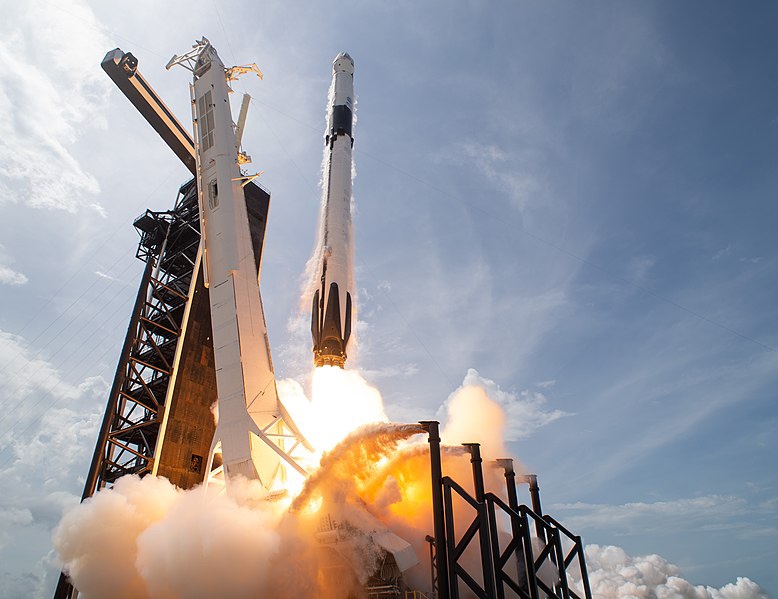
A SpaceX Falcon 9 rocket carrying the company’s Crew Dragon spacecraft is launched on NASA’s SpaceX Demo-2 mission to the International Space Station with NASA astronauts Robert Behnken and Douglas Hurley onboard, Saturday, May 30, 2020, at NASA’s Kennedy Space Center in Florida. Credit: NASA

On May 30th, 2020 Musk answered that challenge. With a successful launch of Demo-2, SpaceX was officially using one of those reusable, inexpensive rockets to do what no private company had ever done before – launch human beings to orbit. A feat still beyond the grasp of other private space companies. While others touch the edge of space, Musk gets us back to orbit – where the real work of spaceflight gets done.

But how did Musk mark the moment? With a solid one-liner:

“The trampoline is working.”

Elon Musk, May 30th, 2020

I wouldn’t describe Musk’s comment as petty. I think that once in a generation brain recognizes exactly how important his accomplishments are in the realm of national security. Maintaining peace in orbit is more critical than most realize. Communications, banking, navigation, shipping, and countless other industries rely on continued, uncontested, American access to space.

In the current conflict, that access is delivering infrastructure that no one else can to a people who need every edge they can get to stand against Goliath. In future conflicts, the capabilities Musk is deploying could be a deciding factor in protecting Americans and our national interest. Winning the modern space race is about more than bragging rights in our generation. A successful SpaceX could just be the X factor we need in a dark time.

So yes, Elon Musk is a national security treasure. By inspiring and equipping us to reach back up to the heavens, he’s helping us fight for our very survival – as a county and a species.

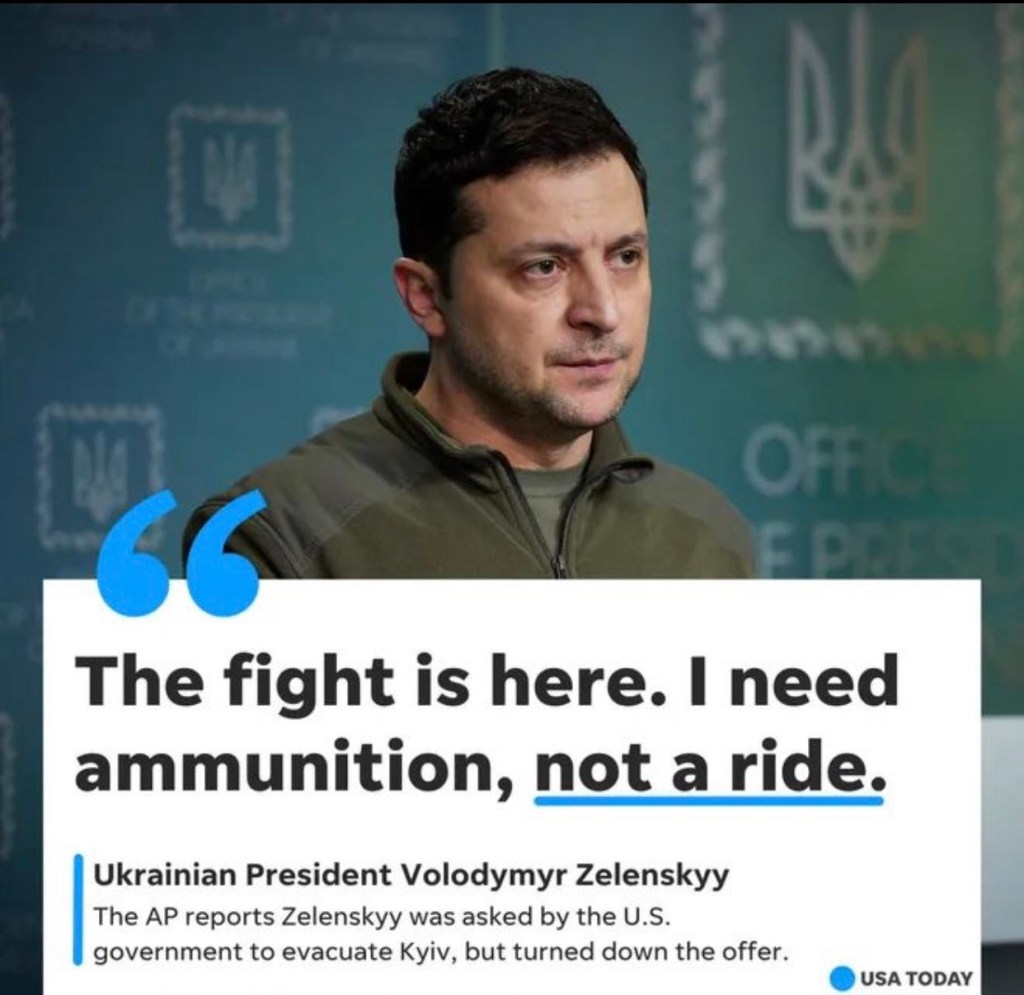
“The fight is here. I need ammunition, not a ride.”

Ukrainian President Volodymyr Zelensky clearly knows the value of his words.

When offered an escape route by American officials, he stood firm. Refusing to leave his people, he doubled down on the need for logistical aid in his country’s fight for existence. But he did something else too – he demonstrated an intuition for warfare that many professional warfighters struggle to internalize.

Credit: USA TODAY

In the Marine Corps, we learn phrases like “surfaces and gaps” or “points of friction.” They’re intended to simply how we see action on the battlefield. Hard surfaces are places where the enemy has amassed a resistance. Gaps are weak points. You build strategies around those surfaces and gaps. Your own resources help you identify how to engage them.

Points of friction are something else. They’re the parts of a plan where you need to insert yourself as the leader. They are the parts of your plan where rapid decision making, and quick action, become the difference between victory and defeat.

Many are focusing on the badassery of a phrase like “I need ammunition, not a ride.” But for me, what cements Zelensky’s place in history is the first sentence: “The fight is here.”

Leadership in moments of crisis demands that you confront the point of friction. In the mundane moments of our daily lives, it’s a manager stepping in to work alongside their team on a difficult project instead of waiting to pass judgment on their work. In the extremes of combat, it’s a leader recognizing where the fulcrum point of a conflict is, and putting themselves right there to make the decisions that matter.

These are the moments like Lincoln in the telegraph room dispatching orders in real time. Whether he’s carrying a rifle or not, a leader in these moments reduces confusion by being there and devoting himself to the problem in front of him.

It’s far too early to predict how this war will end. But in this moment, the Ukrainian people are showing a mettle and resolve that will resonate through history. And they’re receiving a level of leadership to match.

Ukrainians like Vitaly Skakun will be remembered for what they’ve done. He’s reported to have manually detonated the mined Henichesky Bridge to blunt the advance of Russian forces. He radioed his team to tell them what he was preparing to do, knowing this would be his final goodbye.

Credit: Twitter

Zelensky knows this is the spirit of his people. He knows they will fight. He knows the fight is here. He doesn’t need to escape. He’ll face the point of friction beside them.

Advocacy During Times of Crisis

“If we weigh in on our issues right now, it will fall on deaf ears. They’ve got bigger fish to fry.”

It’s a refrain I heard time and time again throughout 2020. At the beginning of COVID, through the summer of Black Lives Matter protests and into the presidential election, it seemed a whole host of advocacy organizations turned gun-shy and opted to pause, or outright retreat from, their advocacy efforts.

To a degree, I get that urge. I’ve even advised caution to some in making sure you optimize the timing of your message – to a degree. Remaining aware of the broader political climate can help keep you from misstepping. But it will also crush your momentum.

Advocacy organizations exist to push agendas forward. By nature, they must engage in all types of political climates. But when we aim for perfection in our messaging, we’re compounding the likelihood our message will go unheard.

Right this moment, while so much of the political world is focused on the Russian invasion of Ukraine, it’s more important than ever that individuals and organizations evaluate the environment and make a deliberate decision: do they go to the mat for their issues, or do they step back and wait for “a better time”?

Well, I hate to break it to you – there will never be a better time. There will always be another crisis, another scandal, another headline in the way. History marches on. But we can only control what we can control. So, here are three ways you can make your message count – even when the timing seems wrong.

Paint Your Priorities With Broad Brushstrokes

Legislators, administrators, and executives alike are pressed for time. They don’t have the bandwidth to deal with the nitty gritty detail of every issue. When preparing to talk to your legislator you don’t need to know every angle on an issue. You DO need to be able to tell a story that frames the issue in terms they understand.

Tell decision makers about how a reality in the headlines is affecting your business. Share how a policy is impacting the real people you’re serving. Tell a story. When groups successfully fight the urge to micromanage their message, they empower their advocates to do just that.

Be of Service

Again, it’s about bandwidth. Find a way to align your agenda items with their needs. Especially during a crisis, decision makers need to see a broader picture so they can understand the second and third order impacts of policy. They need advocates who can provide trusted information in a way that helps them better serve their own constituents. Help them do that.

If our nation is on the brink of war, that situation crowds out every other detail in the public discourse. But you can continue to communicate your issues in the context of those “bigger” stories. Don’t be afraid to connect the dots from those stories to yours. Then help your target gather information, engage with constituents, or share their own message. Find a way to add value when so much else is drawing on their limited resources. In short, find a way to be of service.

Focus on Regulators

Please never forget the fourth branch of government: administration. Only so much of the government’s impact on your daily life flows through the legislature. Much, much more bubbles up through the regulatory process. During times of heated national debate, or global emergency, unelected administrators continue to do the work of rule making. Find a key issue where you can operate in this space, and avoid the broader fray if you must.

But Above All, You Must Eventually “Press On”

My favorite President, Calvin Coolidge, had a touch of the stoic in him. One of my most often cited quotes from him is an important reminder for all of us in the advocacy realm – now and always.

There is real power in continuing to show up, continuing to engage, continuing to “Press On.” We cannot control the tide of global events. But in our own local work, we can strive for more. We can keep showing up. We can press on. And there’s no better time than the present.

Biden’s Chamberlain or Churchill Moment

I’m no fan of isolationism. It’s one of the many reasons I’d never be welcomed into the ranks of Libertarians.

My distaste for isolationism is rooted in the cold reality of human existence. There has been no time in human history free from the threat of violence. Time and time again, when defenders of the innocent and individual liberty recede into the wings, others take the stage. More often than not they choose violence. Right now, we see the inevitable result playing out in Ukraine.

As I’m writing this on the evening of Monday February 21st, 2022 we are hearing the news of Russian forces entering two regions of Ukraine under the guise of cultural reunification. For better or worse, the move leaves little room for the leaders of other nations. Those in a position to oppose Russia are being solicited to do so. Their choice is binary.

Action, Or Appeasement.

Before any of us begins pointing fingers, it’s important to acknowledge that no single American administration is to blame for what’s going on right now. Putin’s actions are his to own. All our internal politics has done is foment the isolationist spirit that pulls America back into itself from time to time. I wrote a piece about this in the wake of the Afghanistan crisis this past August.

Although he is not to blame for this current crisis, President Biden does hold the unimaginable responsibility to respond to it. The magnitude of that responsibility is not for the faint of heart.

Unlike the conflicts of the last twenty years, a war between the militaries of two major modern nation states would be cataclysmic. Total war, supported by massive economies and powered by modern weapons would yield destruction like few can imagine – even if you exclude the nuclear scenario.

Logistics will rule the battlefield. Natural resources, manufacturing capability, transportation and national infrastructure – all those things that make the wholesale destruction of human life possible. War is hell. Modern war will be something else entirely.

And President Biden has the unlucky task of navigating the West through this storm. How will we stand?

Chamberlain vs Churchill

A sad reality of human history is our need to re-learn the lessons of those who came before us. History doesn’t necessarily repeat. But it does rhyme. Hard times create strong men; strong men create easy times; easy times create weak men; weak men create hard times. And the cycle continues.

At unique points in time we’re given the starkest examples of how this process unfolds. In the late 1930’s Neville Chamberlain proved himself unequal to the task of his time. As Germany invaded and annexed culturally German areas beyond its borders, Chamberlain opted to appease Hitler and recognize those territorial acquisitions.

Even after declaring war in the autumn of 1939, Chamberlain’s approach to the war – tepid and timid at best – failed to blunt the progress of Germany’s forces. His failure to adapt to the new state of the world lost him the confidence of the British parliament, and vaulted the First Lord of the Admiralty, Winston Churchill, into power.

Churchill was the right man for his time. Bulldogged and stern, he was also deeply optimistic about the future of the war. Because he knew the resolve of his people. Unfortunately, after the victorious conclusion of the war, those same people were equally resolved to move on from the severity of wartime life. They left Winston in that time (at least for a little while).

Easy times had made for a weak leader. A weak leader fostered a hard time. A more determined leader rose to meet the moment. And he led the way to a prosperous half century. When the time is right, I’ll hope any American President will find a bit of that bulldog spirit in themselves.

Whether we proceed by sanctions or military force, we need to remember that the world is watching. Friend and future foe alike. Will we continue to retreat from the stage? Or will we stand for our ideals? One way or another, we’ll find out what we’re made of, and if we can each answer the times.

All Eyes On Ohio’s US Senate Race

In a little over two months, Ohioans will vote to determine the major party candidates who will compete this fall to replace US Senator Rob Portman. Right now, they’re all on the intra-party grassroots circuits, scrambling to earn votes, donations, and endorsements. While the candidates rack up road miles, they’re wondering about the same thing we are: who’s going to win this thing?

Well, just yesterday, Rob Portman broke his silence and endorsed a candidate – aiming to tip the balance within a large, and competitive crowd of candidates. During any other time in Ohio politics, the endorsement of your predecessor would weigh heavily on the outcome of any race. That’s not necessarily the case in the era of former President Trump.

I want to take you back to just last year – and another unique special election right here in Ohio – one that followed a very similar track.

Last year, Ohio’s 11th and 15th districts were seeking new members to fulfill the remainder of the current term after incumbents left office early. The 15th, in particular, bears a striking resemblance to what we’re seeing now. Here are the big factors.

Red Wave

Democrats in Ohio are feeling the heat. With plummeting polling, and a general sense of listlessness within the country, they (and most political pundits) are calling for a red wave this fall. Democrats have told me privately “we’re going to get creamed”. With Ohio’s recent electoral track record, they’re likely to be right.

Now, as in the race for OH-15 last year, there’s a level of presumption that whoever wins the Republican nomination will carry the seat in the fall. That pressure means the Republican candidates are under a great deal of scrutiny. And there are two camps developing.

Competing Visions

Those separate camps revolve around one really big endorsement: Donald Trump’s. President Trump’s fundraising to date puts him in a place of incredible influence. He can take a candidate from relative obscurity, to elective office, in rapid succession because he has the resources to do so.

But not everyone is aiming for his endorsement. At least one candidate in the race is differentiating himself from 45 and the other candidates. And that’s not necessarily a bad move, because…

It’s Still a Big Field

With so many in the ring, each candidate is gunning for the slightest edge over their opponents. A big field means a small minority of voters can decide who wins the nomination. Last year, the eventual nominee in the 15th benefited heavily from a split vote amongst 10 candidates. In that race, only 37% of the vote ultimately went to the winner, propelled soundly by the resources of the Trump camp. But that means nearly 2/3 of that heavily Republican leaning district went a different way.

This time, though, it’s not establishment types crowding the field. Of the 5 serious candidates remaining in the race, 4 are heavily pursuing the Trump endorsement. Rumors are flying about who will receive it and whether it will come in hours, days or weeks. If some of those rumors are true, Rob Portman’s endorsement may not carry weight for much longer.

The Deciding Factor?

For a Donald Trump supported nominee to run away with this race though, there has to be one key difference from OH-15 in 2021: the Trump leaning herd will have to thin.

Love him or hate him, 45 should never be underestimated. He and his team know a divided field, with multiple players working to earn the support of the Trump coalition, provides a window for an alternative to be successful. May 3rd, 2022 could just see a historical flip compared to the events of the 2021 show in southern and central Ohio.

From my view, the chances of that compound because of one last X factor.

The Top of the Ticket

As important as this race for the US senate is, it’s actually not the biggest draw in an Ohio mid-term election. No, that honor belongs to our other statewide candidates. And Mike DeWine draws a different coalition.

Without a presidential race, and the swollen voter rolls that accompany it, this race really belongs to those who are likely to show up. It’s a game centered on turnout – getting real people to vote, not just answer polling questions. That all takes resources: money and logistics. It will also require getting the attention of an exhausted public who are finally seeing light at the end of the COVID tunnel.

With mask mandates on the decline, and “normalcy” barreling at us, candidates from all corners will struggle with turnout this year. It’s likely a lot of folks will wake up on May 3rd not knowing they have a civic duty to perform. Even in the Buckeye state, with all our bluster, we are still merely human. Turning folks out on Election Day, and chasing absentee ballot requests to sway the double digit percentage of undecideds remains king in Ohio’s retail politics.

These are some of the big factors I’m watching in this race. It will be very telling who doubles down when, and if, we do see an endorsement out of Mar-a-Lago. That could be the real test of the former President’s influence moving forward. If the crowded field doesn’t thin at his urging, the race really does stay anyone’s game to win.

Say what you want about my home state, but we keep it interesting.